

Discover the fascinating history of the Selkirk Rex breed and find out why owners love it: soft, curly fur and a calm, family-friendly disposition are its hallmarks.
Table of Contents
- Origin and History of the Selkirk Rex
- Unique Appearance and Body Structure
- Character and Personality of Selkirk Rex Cats
- Curly Coat Care
- Health and Typical Diseases
- Is the Selkirk Rex the Cat for You?
Origin and History of the Selkirk Rex
The Selkirk Rex is one of the youngest recognized cat breeds in the world, with its history beginning relatively recently — at the end of the 1980s in the United States. The breed’s origins date back to 1987, when an extraordinary litter of kittens was found in a shelter in Montana, born to a short-haired domestic cat mother. Among them was a single female kitten with distinctly different, curly fur and a unique, fluffy hair texture. She caught the attention of Jeri Newman, an experienced Persian cat breeder, who saw in this feline “difference” the potential to create a new breed. The kitten was named Miss DePesto of Noface, often shortened to Miss DePesto, after a character from a then-popular TV series. Her fur was soft, distinctly wavy, and her whiskers delicately curled — features that remain the Selkirk Rex’s trademarks today. Importantly, the mutation responsible for curly fur proved to be dominant, immediately distinguishing the future Selkirk from other “curly” breeds such as the German Rex or Peterbald, where the genes for shortened, wavy hair are inherited recessively. As a result, Miss DePesto’s first crosses with other cats quickly confirmed the trait’s stability — some kittens inherited the characteristic curls, opening the door to an organized breeding program. The breed’s name — Selkirk Rex — is no accident either. “Rex” is a commonly used element in cat breed names for fur mutations, while “Selkirk” honors Jeri Newman’s adoptive father, Selkirk, with whom she had a close emotional bond. This is unique in the world of cat fancy, as breed names usually refer to regions, countries, or distinct physical traits, not people. This personal story gives the Selkirk Rex’s name a more intimate and sentimental dimension.
From the discovery of Miss DePesto, the breed began to be developed in a conscious way, based on well-thought-out crosses with both long-haired and short-haired breeds. Jeri Newman decided to include primarily Persians, Exotic Shorthairs, and British Shorthairs to achieve the desired massive body shape, gentle temperament, and broad gene pool. Persians and exotics contributed a strong skeleton, rounded head, full cheeks, and a friendly, somewhat phlegmatic character, while British Shorthairs added a solid build, calm temperament, and genetic stability. From the very beginning, the breeding program’s goal for the Selkirk Rex breed was not only to stabilize the spectacular curly fur but also to create a healthy, harmonious breed with a balanced psyche. Initially, the newly emerging breed met with mixed reactions — some breeders delighted in its original look and “plush” texture, while others were reserved about another genetic “experiment.” Nevertheless, the Selkirk Rex quickly began to gain recognition in cat fancy organizations. In 1990, TICA (The International Cat Association) granted it experimental breed status, and already in 1992, the Selkirk Rex was recognized as a full-fledged breed eligible for shows. In the following years, the breed was also accepted by, among others, the CFA (Cat Fanciers’ Association), ACFA, and other associations, though the process was gradual and varied by country. The Selkirk Rex appeared in Europe in the 1990s and was initially treated as a curiosity. Over time, as interest in breeds with unique fur structure grew, so did its popularity. Two variants were introduced: shorthair and longhair, with both types maintaining a standard that emphasized moderation — medium-to-large but not excessively massive build, and especially soft, dense, highly curled fur. An important step in creating and stabilizing the breed was gradually limiting outcrosses to the foundation breeds (Persian, Exotic, British Shorthair), to avoid diluting the Selkirk’s traits and to reduce the risk of importing health issues common in those breeds (e.g., diseases related to the brachycephalic skull structure in Persians). Nowadays, many organizations have strict guidelines for breeding partner selection and pedigree requirements, which has allowed the Selkirk Rex to emerge as a fully independent, genetically stable breed. Despite its relatively short history, the Selkirk Rex has established a clear identity: a cat with deep roots in traditional “classic” breeds, but at the same time distinguished by its unique, “lamb-like” coat and gentle, sociable temperament that sets it apart both from other Rexes and its ancestors.
Unique Appearance and Body Structure
The Selkirk Rex stands out among other breeds primarily for its distinctive, curly coat, though its beauty is not limited to just the fur. It is a medium to large-sized cat with a strong, well-built physique, reflecting a solid bone structure and good musculature. The Selkirk’s body is slightly elongated, but gives an impression of compactness and robustness, thanks to a deep chest as well as broad shoulders and hindquarters. The backline is straight, the legs relatively short in proportion to the body, strong and stable, ending with round, firm paws that add to the breed’s impression of massiveness. The tail is of medium length, proportionate to the body, well-muscled, with a rounded tip, and in the longhaired variety, covered with thick, curly fur forming a “plume.”
The Selkirk’s head is rounded, broad, and full, with distinctly marked cheeks, especially in adult males. The stop between the forehead and nose is visible but not extreme — the breed standard avoids the flattened muzzle typical of extreme Persian lines. The nose is straight, of medium length, with a slight dip at the base, giving the muzzle a soft, friendly look. Eyes are large, round, set wide apart and slightly protruding, creating a “babyish,” endearing expression. Eye color should harmonize with the coat — for colourpoint types this is usually an intense blue, for solid colors, shades of green, gold, or copper, with depth and intensity being more important than the exact tone. The ears are medium-sized, wide at the base with rounded tips, set on the sides of the head to maintain the rounded skull contour; the inner ears can be abundantly haired with delicately curled fur, further emphasizing the “plush” character of the breed.
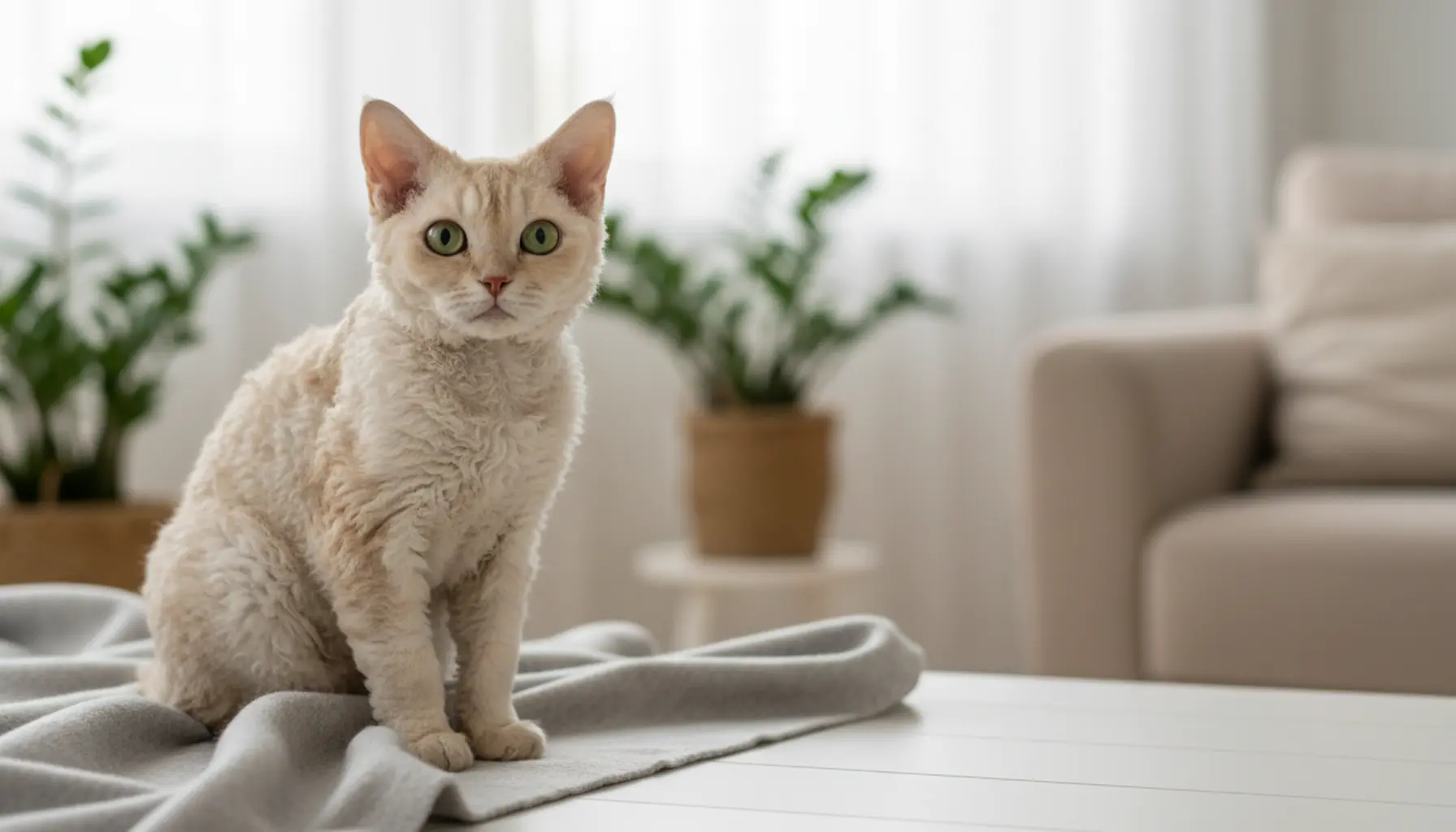
Still, the Selkirk Rex’s most recognizable trait remains its unique coat, which—unlike other “Rexes”—is dense, lush, and three-dimensional, often compared to sheep’s wool or soft twisted yarn. The breed comes in two varieties: Shorthair and Longhair. The shorthair Selkirk’s coat is of medium length, very dense and resilient, forming distinct curls, waves, or “ringlets” all over, especially on the neck, tail, and sides; the undercoat is rich, causing the fur to stand away from the body and giving an “airy” impression. In the longhaired variety, guard hairs are notably longer, the curls may be looser and flowing, and the neck forms a spectacular curled mane with a ruffled chest. Uniquely, both the guard hairs and undercoat are curled, giving the entire coat extraordinary volume. The curls may vary in intensity — from tight ringlets to larger waves — and often change as the cat ages or with the seasons; many kittens are born clearly curly, then straighten out in adolescence, only to curl again in adulthood. Importantly for breeders, not all Selkirks are born curly — straight-haired cats (so-called “straights”) also occur and are used in breeding, though they do not meet the show standard. The breed accepts nearly all possible colors and patterns: solids (black, blue, cream, red, chocolate, lilac), tabby, tortoiseshell, bicolor, tricolor, as well as pointed, smoke, and silver varieties. This means every Selkirk can look very different, and combined with an individual curl pattern, it’s hard to find two identical cats. To the touch, Selkirk’s coat is soft but also springy; not as silky and close-lying as in the Cornish Rex, but more like thick plush with “memory” — after gentle pressing with fingers, the curls return to position. All these elements — a solid, muscular build, rounded head with large eyes and curled whiskers, dense three-dimensional coat, and the variety of colors — add up to an exceptionally original, yet proportional and harmonious, feline silhouette. It captivates both show enthusiasts and people seeking a pet with a unique, “plush” look.
Character and Personality of Selkirk Rex Cats
The Selkirk Rex is famous for its exceptionally gentle, balanced temperament, often described as a “couch potato with a clown’s soul.” It is a sociable cat, oriented toward human contact, but without the pushiness typical of some highly energetic breeds. Most representatives of this breed enjoy being around their caregiver — following from room to room, sleeping on the same couch, willingly lounging in laps, but respecting personal space and not demanding constant attention. Their character is said to be a blend of the phlegmatic calm of the Persian, the sociability of the British Shorthair, and the cheerfulness of the Exotic Shorthair, reflecting the breeds used to create the Selkirk Rex. Their natural emotional balance means they rarely panic at new stimuli — they typically observe, give themselves time to acclimate, and only then begin to explore new surroundings, which is important in households with changes, children, or other animals. At the same time, they are not typical “lazybones”: during active moments, they display a keen sense of humor, playing with their tails, chasing shadows on the wall, or retrieving favorite toys, and their endearing clumsiness often makes family members laugh. These are cats that enjoy “vocal” communication — not excessively loud, but able to “talk” to humans with soft meows, especially to ask for food, invite to play, or simply greet their caregiver returning home.
The Selkirk Rex’s personality makes it an excellent choice for families, singles, and seniors — it’s an adaptive breed, able to match its activity level to its humans’ lifestyle. In households with children, the breed typically shows great patience, does not react nervously to louder noises or uncoordinated movements, provided interactions are respectful of its boundaries; teaching children gentle animal handling means the Selkirk soon becomes a mild and friendly playmate. In interactions with other animals — both cats and dogs — this breed usually adopts a cooperative approach: instead of dominating, it prefers peaceful coexistence, especially if the process of introducing a new member is gradual. Thanks to inborn intelligence and curiosity, the Selkirk Rex responds well to simple training, such as learning to come when called, use a scratching post, or even perform tricks rewarded with treats; clicker training can be an intellectual challenge and a great way to strengthen the cat-human bond. Despite their calm nature, they do not handle long periods of solitude well — being left alone too often can result in boredom and subsequently unwanted behaviors such as excessive meowing or overgrooming due to lack of stimulation. For this reason, it is worth providing an enriched home environment: scratching posts of various heights, shelves for climbing, interactive toys, tunnels, or cardboard hideaways. Many owners also note that Selkirks have a strong need to be near their “person” during stressful times — if something unusual is happening at home, the cat will often choose a spot next to the caregiver, seeking calm and a sense of safety. At the same time, their gentle nature is paired with sensitivity: harsh treatment, yelling, or physical punishment can undermine their trust. The best educational effects come from a consistent but gentle approach, using positive reinforcement, routines, and predictability. All these traits make the Selkirk Rex appear in daily life as a cheerful, emotionally stable friend who likes to be part of the family ritual — from morning coffee to evening relaxation on the sofa — but does not demand attention around the clock, forming harmonious bonds even with less experienced cat owners.
Curly Coat Care
Caring for a Selkirk Rex’s coat requires a slightly different approach than straight-haired cats, but it is not as complicated as it may seem at first glance. The most important rule: regularity and gentleness instead of intensive, daily brushing. Curly fur naturally forms curls and waves, and brushing too often can unnecessarily straighten, frizz, or even break the hair shaft. In most cases, thorough brushing 2–3 times a week is sufficient, though frequency can be adjusted depending on the hair length — the longhaired variety generally needs a bit more attention than the shorthaired. Instead of traditional metal slicker brushes, it’s better to use a soft natural-bristle brush, grooming glove, or a wide-toothed comb to separate curls without pulling the skin. When brushing, work in layers — start with the underparts (belly, sides, armpits), where mats are most likely to form, then gently finish the topcoat. For Selkirks, it’s essential to monitor coat structure during different life periods — kittens often go through a “ugly duckling” phase between 6 and 10 months, when their coat may thin or look less impressive; at that stage, extra care is needed to avoid irritating delicate skin, use shorter but gentler sessions, and not overuse grooming products. For show cats or those with especially thick fur, it’s a good idea to accustom the cat from a young age to touch in key areas — armpits, groin, and tail base — which greatly eases later detangling. Remember that although this breed has curly fur, it still sheds — usually seasonally, in spring and autumn — and during heavy molting, you can increase grooming frequency, but avoid aggressive undercoat removal, which can destabilize the natural curl structure. Curly fur tends to trap dead skin and dust close to the skin, so during each session, palpate the cat’s body looking for lumps, redness, or dandruff, which helps spot early signs of skin problems.
Bathing a Selkirk Rex is an individual matter, but with proper nutrition and daily care, it’s rarely necessary to bathe more than every few months, often only once or twice a year or before shows. Curly hair has a peculiarity — when wet, curls can “relax” and need time to return to their natural state, so appropriate cosmetics and drying technique are very important. Only use shampoos dedicated to cats, preferably mild, moisturizing, and unscented, to avoid skin irritation. Some breeders use special products for curly hair to upkeep the curl, but all extra products (conditioners, sprays) should be used carefully and preferably after consulting an experienced groomer or breed specialist. During bathing, avoid strong rubbing — instead, gently massage the shampoo along the direction of hair growth, then rinse thoroughly, as residue in the dense fur can cause itching, greasiness, and matting. After the bath, don’t rub the cat hard with a towel; instead, gently “blot” the water with a microfiber towel, then allow the coat to air-dry naturally or use a warm (not hot!) dryer from a distance while gently shaping curls with your fingers. Over-brushing damp hair straightens curls, so limit yourself to very light combing with a wide-toothed comb when the fur is almost dry. Besides the coat, pay attention to other areas that indirectly affect coat condition: regular nail trimming prevents scratching and pulling out tufts, while systematic ear cleaning and eye control are especially important in cats with more “Persian” type heads who may be prone to tearing. A diet rich in omega-3 and omega-6 fatty acids, biotin, and high-quality protein supports healthy hair growth, improves elasticity and shine, making the curls more springy and less prone to breakage. For many owners, minimizing fur around the house is essential — for the Selkirk, systematic, gentle care and good skin condition are your best allies, as they decrease loose hair swallowed during self-grooming, thus reducing hairball risk. It’s best to develop positive grooming associations from the start using treats, a calm tone, and short, regular sessions — with this approach, the Selkirk Rex usually quickly accepts grooming as a part of daily routine, and well-kept, soft curls become a true hallmark of this amazing breed.
Health and Typical Diseases
Thanks to thoughtful breeding and outcrossing with robust breeds, the Selkirk Rex is generally considered a resilient cat. However, like all breeds, it has some health predispositions that any prospective owner should be aware of. The average Selkirk Rex lifespan is 12 to 16 years, with responsible breeding, veterinary prevention, nutrition, and living conditions playing key roles. Owing to its Persian and British heritage, attention must be paid to inherited diseases such as polycystic kidney disease (PKD), hypertrophic cardiomyopathy (HCM), and musculoskeletal issues. Good breeders perform genetic and imaging tests, excluding affected animals from breeding, but when choosing a kitten, always ask for parental test results — including heart ultrasound and PKD DNA results. Polycystic kidney disease is an inherited disorder causing gradual kidney damage by cysts; symptoms (increased thirst, weight loss, apathy, recurring urinary infections) usually appear in middle age, making it vital to breed only from PKD1 mutation-free animals. Hypertrophic cardiomyopathy involves thickening of the heart muscle wall, potentially leading to heart failure, blood clots, and sudden death; detection relies on regular heart ultrasounds in breeding cats, ideally every 1–2 years. Selkirks, especially those closer in type to their Persian ancestors, can also have dental and cranial structure problems — although the breed standard doesn’t allow a very flattened muzzle, some may develop dental tartar, gingivitis, or in extreme cases, bite malocclusion which can hinder food intake. Hence, regular vet check-ups, mouth inspections, and (if tolerated) home dental care (tooth brushing, dental treats, or water additives) are especially advisable. Proper feeding, weight control, and exercise are also important for joint health; obesity increases the risk of degenerative joint disease and diabetes, so even if the Selkirk Rex has a laid-back nature, it still needs daily play and activity.
Genetics and care both influence Selkirk Rex skin and coat health. Curly fur itself isn’t a disease, but its structure can trap dead hair and debris, making skin problems more likely if grooming is inadequate. Some common issues include skin irritation, local inflammation, and flakiness caused by dryness — often resulting from unsuitable grooming products or excessive bathing. Certain lines can also show tendency towards skin allergies or food sensitivities, manifesting as itching, fur-chewing, or recurring ear infections — in these cases, a vet-supervised elimination diet and supplementing omega-3 and omega-6 fatty acids may help. Eyes, ears, and (if present) prominent cheek folds should be regularly checked for excessive discharge, redness, unpleasant odor, or scratching, which can indicate bacterial, fungal, or sebaceous gland problems. Preventive care also includes a complete vaccination schedule (herpesvirus, calicivirus, panleukopenia, and in justified cases, rabies and chlamydia), regular deworming suited to the cat’s lifestyle, and protection against parasites. The Selkirk Rex, being sociable and often living exclusively indoors, can be prone to problems caused by boredom and chronic stress — such as compulsive grooming, lowered immunity, recurring upper respiratory infections, or idiopathic cystitis (FIC). Prevention means providing an enriched environment (scratching posts, shelves, hideaways, interactive toys), maintaining a steady daily rhythm, soft socialization, and avoiding sudden environmental changes. A key element in health care is also spaying or neutering at the appropriate age, which reduces the risk of reproductive system disease (pyometra, mammary tumors in females, testicular tumors and prostate issues in males) and limits marking behavior and territorial disputes, which themselves can cause stress. Regular annual health checks at the vet — every 6 months for older cats — combined with blood and urine tests, help catch problems in kidneys, liver, thyroid, or hematopoietic system early, which is important for long-lived breeds like the Selkirk Rex.
Is the Selkirk Rex the Cat for You?
Choosing a Selkirk Rex as a companion should consider both your lifestyle and your expectations for a cat-human relationship. This breed usually feels happiest in homes with a calm, predictable atmosphere, but also where there is space for play and closeness with humans. Selkirks are not typical individualists — while they can entertain themselves, they really enjoy their caregiver’s company and often seek physical contact: coming onto laps, lying beside you on the couch, keeping you company in daily routines. If you dream of a cat that will be a “family member” rather than an independent loner, this breed may suit your expectations. On the other hand, their attachment means they are not best for people who frequently and for a long time travel or spend most of the day away from home, unless there is a second pet or trusted person to provide company. The Selkirk Rex does well in families with children, provided the youngest understand proper animal handling — their solid body and gentle nature mean the cat is generally patient with hugging, but excessive noise or chaotic movement can stress them. It’s also a suitable cat for seniors and singles who value peace but not a totally static lifestyle: the Selkirk enjoys playing, but does not require the extreme activity levels of some highly energetic breeds. Remember that, despite their gentle character, Selkirks are intelligent cats who need stimulation — interactive play, scratching posts, shelves, tunnels, or intelligence toys — to avoid boredom that might lead to destructive behaviors or overeating. If you like creating small rituals — evening petting, playtime at set hours, feeding on schedule — Selkirk will quickly fit into such a routine and feel secure. Your preferences for looks and grooming are also key; curly fur means the Selkirk looks sweet and soft, but requires regular combing and an acceptance of periods of heavier shedding, and that fur may appear on furniture more than with some short-haired breeds — though with proper care, this can be minimized.
Before deciding, realistically assess your own financial and organizational capacities, as the Selkirk Rex, like other breeds descended from Persians and exotics, requires some investment in health and grooming prevention. A responsible owner must plan for regular vet visits, check-ups (especially heart and kidneys), and the cost of high-quality food supporting overall condition and skin/hair health. If your budget is tight and expensive tests or procedures would be a substantial burden, think twice and discuss the issue with both a breeder and a vet. Also key is the breeder: a reputable Selkirk Rex breeder will show you parental health tests (e.g., for PKD and HCM), explain typical traits of the line, and help select a kitten with a temperament fitting your family. If you expect an extremely active cat that climbs everything and demands constant high-energy play, the Selkirk may seem too calm. If you require a show cat with “perfect” looks and plan for many shows, remember keeping the coat in show condition, and prepping for shows, will require extra time, knowledge, and investment in professional products. The “hypoallergenic” issue is also important: despite their curly fur, Selkirk Rexes are not hypoallergenic, so those with allergies should spend extended time with a cat of this breed before adopting or purchasing to check for reactions. If you value a pet’s ability to match your mood, gentle attitude toward all household members, and friendliness to guests, the Selkirk usually meets those needs — most individuals are not fearful or aggressive, though of course every cat has its own personality. Before welcoming such a cat into your home, ask yourself: are you ready to spend time calmly introducing the cat into your environment, teaching grooming from the very first weeks, playing and building a bond every day? Do you accept that your cat will be present in your space: on the couch, bed, often right next to you? Honest answers, along with talking to an experienced breeder or behaviorist, will help you realistically determine if the Selkirk Rex matches your needs, abilities, and vision of the perfect feline companion.
Summary
The Selkirk Rex is a remarkable breed, known for its characteristic curly fur and gentle personality. These cats require regular grooming to keep their coat healthy and shiny. They are sociable and get along well with other animals, making them ideal companions for families. The breed’s health is generally good, though as with any breed, it may be prone to certain typical diseases. If you’re looking for a cat with unique looks and a friendly nature, the Selkirk Rex may be the perfect choice for you.

