

Understanding a cat is an art of observation and interpreting subtle signals. Discover the key aspects of feline body language, sounds, and behaviors to build a harmonious relationship at home.
Find the key to understanding your cat’s behavior! Learn how to recognize emotions, body signals, and sounds to better care for your pet.
Table of Contents
- The Most Important Cat Body Language Signals
- Recognizing Feline Emotions – from Happiness to Stress
- Communicating with Your Cat: Sounds and Their Meaning
- Personality and Home Behavior of Cats
- The Emotional Needs of Your Cat – How to Meet Them?
- Cat Reactions to Caregivers and Relationships with People
The Most Important Cat Body Language Signals
A cat’s body language is a complex but logical system where every detail matters: from ear positioning, tail posture, to muscle tension and movement. To truly understand your cat, you need to observe its whole posture rather than focusing on a single element. Let’s start with the tail as it’s the most noticeable mood indicator. A tail raised vertically with a slightly rounded tip usually signals joy and friendliness – this is how a confident, happy cat greets its person. If the tail is up but the fur is slightly bristled, it may indicate mild arousal or excitement, for example during playtime. A tail held low, especially tucked between the legs, signifies fear, uncertainty, or submission, while energetic, nervous swishing from side to side typically means irritation, frustration, or internal conflict (the cat can’t decide whether to attack or retreat). A “puffed out” tail, resembling a bottle brush, is a classic sign of strong fear mixed with defensive readiness – the cat is trying to look bigger and more threatening. Ears are equally important. Ears up and forward generally mean confidence and interest: the cat observes its surroundings but feels at ease. Ears turned to the sides or gently flattened can signal anxiety, uncertainty, or a warning that the cat is uncomfortable. Ears completely flattened against the head, especially with dilated pupils and tense body, are clear signs of fear or defensive aggression – in such cases it’s best to give the cat space. Pay attention to micro-signals, like a quick flick of one ear, often indicating the cat is catching and analyzing a specific sound, and general symmetry of ear position: the more “uneven,” the greater the internal anxiety. Another key element is the eyes. Narrow, vertical pupils usually appear in bright light but also when the cat is focused, relaxed, and feels safe. Very wide, round pupils, especially in normal lighting, indicate strong arousal – this could mean fear, hunting excitement, or intense play. Staring directly into the eyes of a human or animal can be seen as a challenge or sign of tension; prolonged eye contact may signal conflict for a cat. Gentle, slow blinking (“cat kiss”) shows trust and a sense of security – if the owner responds with a slow blink, it often calms the cat and strengthens the positive bond. Wide open eyes with raised brows (skin fold above the eye), coupled with a withdrawn body, usually express surprise or fear. Also observe the whiskers: pushed forward means arousal and interest, pulled back – fear or discomfort.
The cat’s whole silhouette is a key indicator of its emotional state. A relaxed cat moves smoothly and “fluidly,” limbs and tail loosely hanging, the body elongated and flexible – such a cat may stretch, calmly groom, or nap with its belly exposed (exposing the belly is more a signal of trust and relaxation than an invitation to touch). A curled, “compact” silhouette, tail tucked, paws hidden beneath, usually signals uncertainty, feeling cold, or the desire to hide. The “Halloween cat” stance – arched back, bristled fur, tail straight up or arched, moving sideways – is intended to scare off a threat, making the cat appear larger and more dangerous, though it often masks fear. The “coil” posture – body low to the ground, legs ready to jump, low or slightly twitching tail – is typical of the hunting stance or a playful pounce. Warning signals include muscle tension, rigid gait, and a frozen posture: the cat may stand or sit still, but its whole body “shouts” readiness to attack or flee instantly. Also, behaviors like rolling, rubbing, and marking areas are important communicators. A cat rubbing its body or cheeks on its owner’s legs, furniture, or door frames is spreading its pheromones – marking the space as “safe” and “its own” while showing friendliness and bond. Rolling on the floor, belly up with a relaxed body, usually means high trust and good mood, but vigorous, quick rolling and wagging the tail can also indicate over-excitement; always read this signal in context. When a cat arches its back while stretching, it’s a relaxation signal, but if you see an arched back with bristled fur and widespread legs, that’s a defensive behavior. Finally, regarding face and mouth: a relaxed cat has loose lips and a closed mouth, but may open it slightly when sniffing an intense smell (flehmen response). Yawning can signal tiredness or be a stress-relief action, e.g., during awkward encounters with strangers or other animals. Growling, hissing, showing teeth, pulled-back lips, and wrinkled nose are clear warnings: “stay away.” Each of these signals takes on full meaning only in context of the situation – place, other animals present, the cat’s past experiences, and individual temperament. Learning feline body language means regular observation in various conditions to catch your cat’s unique versions of these general signs.
Recognizing Feline Emotions – from Happiness to Stress
Cat emotions are subtle but not that hard to read if you know what to look for and how to combine signals from tail, ears, eyes, body, and vocal behaviors. Feline joy is easiest to notice in daily life: when you come home, the cat greets you upright, tail vertical like an “exclamation mark,” often with a gently curled tip – a sign of affection and satisfaction. A relaxed body, soft, springy gait, and free movement around the home also show a good mood. A happy cat eagerly seeks contact: rubbing against your legs, marking you with its scent from the body side or cheek is an expression of bond and security. Contentment is usually accompanied by purring – steady, low, rhythmic – during petting, cuddling on the sofa, or falling asleep. Remember, however, that purring doesn’t always mean pure happiness, but often reflects “elevated emotions” and self-soothing; always interpret it within the cat’s overall posture. Typical relaxation signs are calm, even breathing, half-closed eyes, soft whiskers, and no muscle tension – the cat may lay stretched out, even showing its belly, which many owners interpret as an invitation for intensive petting. In practice, this rather means high trust and comfort, but not always permission to touch – whether you can pet the belly depends on the cat’s individual tolerance. Curiosity and excitement, e.g., during play, show as a straight, slightly forward-leaning posture, ears pointed at the stimulus, wide eyes, and rapid tail movements, which can move horizontally or bounce. In this state, the cat is in hunting mode – focused, excited, but not necessarily stressed; short, quiet chirps, “chattering,” or teeth chattering when observing birds, are also signs of hunting excitement and frustration, not fear.
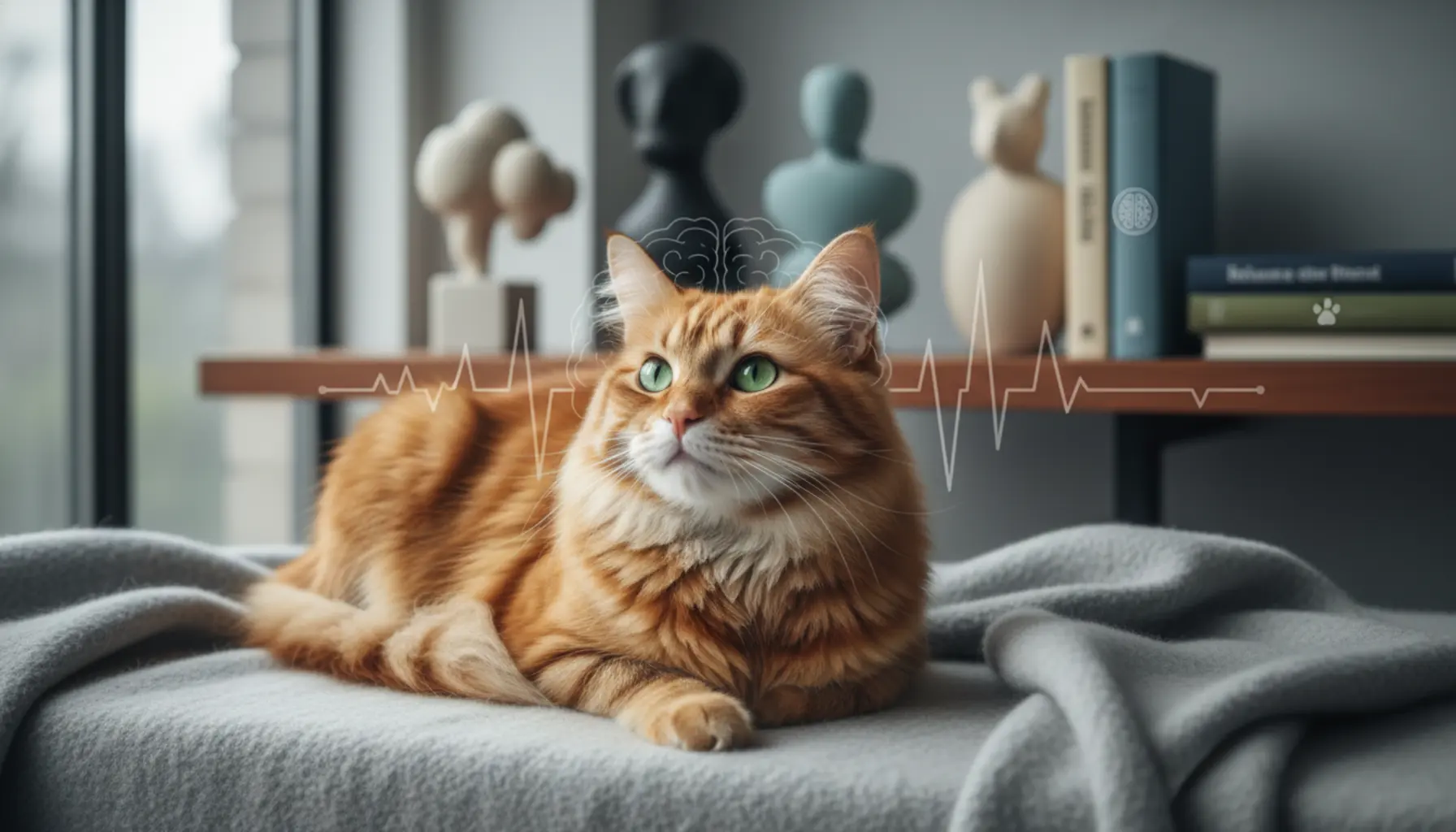
At the other extreme are negative emotions: anxiety, fear, frustration, and chronic stress, which are less obvious but greatly affect a cat’s health and behavior. The first sign of mild anxiety is often a tense, lowered posture, body kept “tight,” tail close to the ground or tightly curled around the body when lying down, ears slightly to the sides or “radaring” in different directions. The cat may groom itself more, yawn during social situations (displacement behaviors), turn its head or body to avoid direct eye contact – subtle signals of discomfort. As fear increases, the tail tucks between the legs, the body hugs the floor, ears flatten back; pupils dilate suddenly, and the cat may press itself to the ground or try to hide – behind furniture, in a carrier, or under the bed. Fear mixed with readiness to defend shows as a “puffed” silhouette: arched back, bristled coat, a “Christmas tree” tail, along with hissing, growling, or spitting – clear warnings to keep distance. Importantly, do not force contact, shout, or punish in such situations; best to withdraw and give the cat space to calm down. Chronic stress is particularly insidious, as it rarely presents dramatic reactions; instead, you see gradual changes: the cat may stop playing, sleep more, seek less attention, or the opposite – become overly “clingy.” Excessive grooming (especially belly, thighs, or flanks), even to balding, increased scratching, “sudden” urination outside the litter box, lack of appetite, or binge eating – all are signals of disturbed sense of safety. Add reluctance to explore, hiding at any noise, avoiding contact with other animals or people, or hypersensitivity to touch. Frustration can quickly turn into defensive aggression: if a cat repeatedly tries to communicate discomfort (leaving, tail lashing, ears back, soft growling) but its boundaries are ignored, it may escalate to scratching or biting. Understanding these emotions involves reading not just single signals, but their combination in context: the same cat may use different strategies in a calm home vs. a stimulus-filled environment. Careful daily observation, noting small behavior changes, and responding quickly to early stress signs (by providing hiding spots, stable routines, enriching environment, and consulting a behaviorist or vet) are key to reading feline emotions – from carefree joy to deep anxiety.
Communicating with Your Cat: Sounds and Their Meaning
Cats do not communicate only through body language – their “language” is a rich repertoire of sounds, each carrying specific emotional and informational content. Unlike dogs, cats use vocalization more often with people than with other cats, meaning they largely “tune” their voice to their caregiver. The most recognizable sound is, of course, the meow, but its tone, pitch, length, and frequency vary widely – from quiet, pleading “meows,” to long, drawn-out calls, to hoarse, rough shouts. Short, high-pitched “meows” often mean greeting or asking for attention (“look at me”), while a series of increasingly loud meows is usually frustration or irritation, e.g., when asking for food or to be let out. Meowing can also indicate discomfort: a sudden change in intensity, or persistent, monotonous meowing in a formerly quiet cat, may be a sign of pain, disorientation (especially in older cats), or environmental stress – in such cases, consult a behaviorist or veterinarian. A special form of meow is “chirping” or “trilling” – a short, vibrating sound a cat can use to greet you, ask you to follow (to a food bowl, for example), or express enthusiasm during play; one of the friendliest vocal signals, usually seen with positive excitement and intent to interact. Long, loud crying, often while walking through the apartment, especially at night, may be related to heat cycles (in unneutered cats) but can also indicate separation anxiety or boredom – ignoring such behavior without changing the environment will almost always reinforce it. Beyond meowing, cats produce sounds like muttering, short grumbles, or “chattering” during exploration; these are mixed signals blending curiosity, slight tension, and the need to check that everything is safe. The key rule in interpreting feline sounds is to look at the full context: body posture, facial expression, ear and tail position, and the situation – the same meow type may mean something very different at the bowl in the morning than at the closed bedroom door at night.
One of the most fascinating and often misinterpreted sounds is purring. Commonly associated only with contentment, the reality is cats purr when happy and relaxed, but also when in pain, afraid, or even dying. In domestic cats, purring usually occurs during comfort: when petted, sleeping in a safe place, in contact with their owner, or during feeding. In these cases, the purr is rhythmic and steady, accompanied by relaxation, half-closed eyes, and slow movements. But purring can also serve as self-soothing – a sick or scared cat may purr to regulate its emotions and lower stress. Thus, if purring occurs with other concerning signs, like lack of appetite, hiding, aggression to touch, or unusual posture, don’t assume the cat is well. Other sound groups are growls, hisses, and rumbling grumbles, almost always linked to negative emotions. Growling is a warning – the cat feels threatened, overwhelmed, or trapped; hissing occurs with sudden fear or when an intruder gets too close. If a cat hisses when you pick up or touch a certain body part, it could mean pain, again warranting professional advice. Sometimes cats produce “roaring” or loud, piercing screams – typically in sharp conflict with another cat or during acute panic; these mean the cat has reached its tolerance limit and may attack or flee. “Chattering” and “twittering” at a window while observing birds are short, repetitive jaw clacks and giggling grumbles, reflecting strong hunting arousal and frustration at not being able to hunt. For the owner, it’s crucial to not just passively listen to these sounds, but to actively respond: calm voice, predictable signals (saying the same words during feeding or play, for example) help the cat understand you and create a shared “signal base.” Many cats begin to adjust their vocalizations to their household’s responses – some purposely use a more “childlike,” high-pitched voice because they see it attracts attention. Mindful attention to feline sounds, observation of patterns, and respecting the animal’s boundaries lay the foundation for a trust-based dialogue, where voice is just one – yet strong – means of communication.
Personality and Home Behavior of Cats
A cat’s personality is largely shaped by genetics, early experiences, and the home environment, which is why two cats who appear similar may behave very differently in the same conditions. Some cats are extremely social, following their owner, sitting on laps, and loudly seeking attention, while others prefer distance and interact on their own terms, appearing only when they want to. Typical “extraverted” cats vocalize a lot, initiate play, explore every corner, and quickly adapt to changes, while anxious or introverted cats may hide for long periods in new places, react to noises with sudden retreat, or be sensitive to emotional tension at home. It’s important not to try to “break” a cat’s character, but instead recognize its natural temperament and adjust care accordingly – confident cats need more stimulation and challenges; shy cats need security, stable routine, and quiet rituals. Home behaviors are also closely connected to daily rhythms: most cats are most active in the morning and evening, often showing increased play, “zoomies” through the apartment, or “hunting” for toys (or your feet in bed). Lack of outlet for natural energy often leads to behaviors seen as problematic: scratching furniture, climbing curtains, nibbling hands, or destroying objects. For the cat, these are normal, instinctive actions, so the key is a rich environment: vertical and horizontal scratchers, hiding spots, climbing shelves, tunnels, and daily interactive play with wand toys. This not only meets the need for movement and hunting but also builds a bond, which is especially meaningful for cats naturally more wary or reserved. In multi-cat households, personalities influence each other: a confident, friendly cat may “open up” a shy companion, but a dominant cat can overwhelm a sensitive one, leading to anxious behaviors like hiding, urine marking, or avoiding the litter box – often misread as “naughtiness” while actually expressing stress.
Everyday behavior at home consists of repeatable patterns which, if learned by the owner, reveal much about the cat’s feelings and relationships. A balanced, contented cat willingly uses different areas, moves around freely, has consistent appetite, uses the litter box at regular times, initiates brief contact (nuzzling, lounging beside you, soft purring), and can also self-soothe by retreating to a favorite hideout. In contrast, a stressed or frustrated cat often “sends” clear signals through its actions: sudden withdrawal, isolation, lack of play, redirected aggression (e.g., attacking the owner after seeing another cat outside), compulsive grooming, or marking new places. Remember these signals are rarely “sudden” – they’re usually preceded by minor changes: shorter play, faster withdrawing from petting, more frequent “moods,” longer naps in hiding. Understanding your cat’s personality helps you notice when behavior diverges from the norm, which may signal stress or health woes. For a bold and energetic cat, sudden “laziness” is concerning, while for a normally calm cat, sudden overactivity, irritability, or agitated vocalizations are more alarming. Home routine also matters: cats love repetition, so changing feeding times, frequent rearrangements, new people, pets, or renovation noise can all disrupt their sense of safety. A responsible caregiver, knowing the cat’s nature, can “buffer” these changes, establishing routine (set mealtimes, play sessions, a “safe area”), and slowly introducing novelties. This way, home becomes a predictable base where the cat’s character can thrive rather than react to stimuli in constant tension. Realizing that a cat’s personality is not “just a mood,” but a consistent set of traits affecting how it sleeps, plays, eats, interacts, and reacts to change, helps interpret home behaviors and support your cat in a way that suits its unique nature.
The Emotional Needs of Your Cat – How to Meet Them?
Cats, though often viewed as independent and “always managing on their own,” have very real emotional needs, and unmet needs can lead to stress, behavioral problems, or even physical illness. Every cat’s core need is a sense of safety – both physical and emotional. This means a predictable environment, regular daily routine (for feeding, play, rest), absence of sudden stimuli, and the option to retreat when overwhelmed. A cat should have its own “safe zones”: high shelves, dens, boxes or hideouts, where no one drags it out. Especially in homes with children or other pets, these “no-entry” sanctuaries should be respected, teaching household members to let the cat be when it retreats there. For many cats, control over their environment adds to security: observation points (like window sills, scratching posts, shelves), easy access to resources (litter box, bowls, water, sleeping areas), and predictable owner behavior – no shouting, physical punishment, or sudden grabs. Emotional needs also include fulfilling natural hunting and exploratory instincts; suppressing these leads to chronic frustration. The hunting sequence (watching – stalking – chasing – catching – “killing” – tearing apart) can be safely recreated at home with interactive wand toys, balls, or treat-dispensing toys. Regular daily play isn’t a whim, but a basic stress-reduction tool and bond enhancer; best short but frequent sessions (2–4 times daily for 5–10 minutes), suited to the cat’s age and condition. Confident, young cats enjoy energetic play; older or timid cats may prefer gentler activities and slower movement. Offer a meal or treat after play – this completes the hunting cycle and brings satisfaction, helping regulate emotions.
The second key group of emotional needs are social needs and bonds, which are more nuanced in cats than in dogs. Cats don’t always want constant physical contact, but almost every housecat needs some form of safe, predictable relationship with their caregiver. The answer is “cat-centered contact”: instead of forcing petting or picking up, let the cat initiate interaction by approaching, rubbing against you, or jumping on your lap. Gentle stroking on “safe zones” (sides, base of tail, cheeks) and observing reactions – does the cat relax, blink slowly, purr, or tense and pull away – will build trust and fulfill the need for closeness without crossing boundaries. Many owners unknowingly ignore “I’ve had enough” signals like tail flicks, head turns, ear flattening, or body tension, and in the long run, this teaches the cat its signals are ineffective and can lead to “sudden” bites – though, from the cat’s view, there were plenty of warnings. Meeting emotional needs thus means paying attention to subtle body language and respecting refusal. Don’t ignore the need for mental stimulation either. Bored cats are often mistaken for being “lazy,” while actually showing it through incessant food requests, destructive behavior, excessive meowing, or compulsive acts (like overgrooming or tail chasing). To prevent this, use environmental enrichment: interactive toys, scent mats, slow-feeder bowls (puzzle feeders), varied scratching posts, wall shelves, and toy rotation to keep them interesting. For indoor-only cats, contact with outside stimuli is vital – a safe window view, netted balcony, or harness walks (for certain cats) can be invaluable, as long as it’s done without pressure and suited to the cat’s temperament. Lastly, relationship stability is crucial for emotional wellbeing: cats feel best with a predictable caregiver who doesn’t punish fear signs (hissing, hiding) but gives space and gentle support. When making changes at home – moving, new roommate, another pet, renovation – remember gradual introductions, safe hideouts, extra rest areas, and calm presence as the “secure base.” Fulfilling these complex emotional needs isn’t about flooding the cat with stimuli or caresses, but consciously creating an environment and routine where the cat can choose when it wants contact, play, or rest, and where its boundaries are always respected.
Cat Reactions to Caregivers and Relationships with People
Cats form bonds with people that may seem distant or cold at first glance, but in reality are often very deep and stable. Studies show many cats treat their caregiver as a “secure base” – much like children with parents – apparent in how they react to the person’s presence, absence, and return. A cat that feels safe typically greets its owner at the door, raises its tail with a gentle bend at the tip, rubs its body and head against the legs, sometimes meows or gives a short “trill” in welcome. These rituals are social glue – the cat “marks” its owner with scent and simultaneously signals trust. Predictability is vital in human-cat relationships: cats quickly learn their person’s daily schedule and respond to signals for feeding, play, or evening snuggles. Lack of consistency, sudden schedule changes, or different interaction styles can confuse sensitive cats, even leading to anxiety behaviors – hiding, avoiding contact, or excessive vocalizing like loud nighttime meowing. Cats also offer different forms of affection: some choose “controlled closeness” by sitting nearby but not right on you; others seek intense physical contact, kneading blankets or you, sleeping on your chest or under the covers. If the cat consistently chooses to be in the same room as you, follows you, responds to your voice, comes when called or at least perks ears at its name, that’s a strong sign the relationship matters to them. Conversely, “cold” behavior – ignoring, not greeting, avoiding eye contact or withdrawing at closeness – doesn’t always mean dislike; it can be shaped by past experience (like poor socialization), too much forced contact, or that the cat currently feels stress or pain and has low tolerance for interaction. In such situations, observe other body signals like tail, ears, and muscle tension to gauge if the distance is part of temperament or emotional discomfort.
The key to building positive relations with your cat is in initiating and conducting interactions – in feline etiquette, the cat should decide when and how to approach. A cat used to being “cornered” (grabbed, held forcibly, endlessly petted despite impatience) associates people with loss of control and unpredictability. This results in “mixed signals”: the cat approaches, sniffs your hand, allows a brief pet, then suddenly bats at you, bites, or moves away. To the owner this seems “unprovoked,” but from a feline perspective it’s about drawing boundaries. Hence, it is important to notice “stop” signs: ears slightly sideways or back, tail flicks, shallower breathing, tense body, head turning away, less eye contact. Stopping petting and giving space strengthens the trust that the cat’s cues are respected, leading to a more stable bond. Equally important is adjusting contact types – some cats like short but frequent petting around head and neck, others prefer proximity “without touching,” i.e., quietly hanging out nearby, speaking softly, and letting the cat initiate brief contact. In a multi-person home, cats often pick a “favorite person,” usually the most predictable, least pushy, and the one who plays hunting games rather than merely petting. The cat’s reactions to different household members – approaching one person but avoiding another – are useful indications of how the cat perceives their interaction styles and what kind of relationship it seeks. Cats also sense human emotions and tension: raised voices, arguments, sudden movements can make cats more alert, hiding, or, conversely, seeking closer contact with a trusted person as a “refuge.” Reactions to guests depend on a mix of personality and experience – confident cats may make contact themselves, sniffing newcomers or jumping on the sofa, whereas timid cats observe from a distance, using hideouts and may not come out until quiet returns. Giving the cat choice and gradual introductions to new people, while avoiding forcing interaction, supports its sense of security and strengthens trust, even with the main caregiver.
Summary
Correctly reading a cat’s body language and emotions is the foundation of conscious care and a deep bond. By observing gestures, sounds, and daily behaviors, you will better understand your pet’s needs, stress, or joy. By meeting your cat’s emotional needs, you make them feel safe and secure at home. The right relationship with your cat and understanding of its signals is the guarantee of its wellbeing and happiness, making your daily life full of feline harmony.

