
The Bombay cat is an extraordinary breed known as a miniature panther, combining an exotic appearance with an exceptionally friendly, family-oriented character. Discover the history, description of traits, temperament, care needs and price of this rare cat.
The Bombay cat is a black mini-panther with a unique temperament. Learn about the price, breed description, character, and tips concerning care and health.
Table of Contents
- Bombay Cat – History and Origin
- Appearance and Coat of the Bombay Cat
- Character, Temperament and Behavior
- Care and Health of the Bombay Cat
- Bombay Cat Price – How Much Does a Miniature Panther Cost?
- Bombay Cat: For Whom Is This Breed Perfect?
Bombay Cat – History and Origin
The Bombay cat, often called “the miniature living-room panther”, is actually a relatively young breed whose roots go back to the middle of the 20th century in the United States—and not, as its name might suggest, India or the city of Bombay (Mumbai). The creator of the breed was American breeder Nikki Horner from Louisville, Kentucky, who, fascinated by the elegance of the Indian jungle black panther, decided to recreate its appearance in a domestic, people-friendly version. She began her breeding project in the 1950s, crossing a black American Shorthair with the extremely sociable and muscular sable-colored Burmese cat. The aim was to create a cat with deep, glossy black fur, a round head, large, wide-set eyes in intense copper or gold, and a calm, balanced character suitable for domestic life. The first litters did not yet fully meet these breeding goals—kittens often had too long muzzles from the American Shorthair or less intense coat shade. However, Horner persistently selected individuals and continued line breeding to stabilize the desired looks and temperament. Initially, the breeder environment was not enthusiastic about the project—some felt that “creating a new breed of black cats” made little sense and was just a color variant of already existing breeds. Despite criticism, Horner refined the standard and documented her work, presenting cats at shows and lobbying for official recognition. An important stage in the history of the Bombay was drawing up a preliminary breed standard detailing the desired body type—medium-sized but strongly muscled, with smooth, rounded lines—and mandatory uniformly black fur to the roots, with no discoloration, spots, or shading. Breeders also paid attention to personality—the ideal was an extremely affectionate, intelligent, and attached cat, a trait heavily drawn from the Burmese ancestors, known for their “dog-like” loyalty and chattiness.
In the 1960s and 1970s, the Bombay cat began to gain recognition from American cat fancy organizations, and the breeding expanded beyond Nikki Horner’s single line. The first official recognition came from the CFA (Cat Fanciers’ Association), which admitted the Bombay to the registry of new breeds in 1970, and in 1976 awarded it full championship status. At the same time, TICA (The International Cat Association) included Bombays in its classification, strengthening their position internationally. In some US federations, the Bombay is recognized as a separate breed, while in others (especially in the context of Burmese pedigrees) it functions as a color variant related to the American Burmese, which impacts breeding regulations and allowed crossings. In Europe, the Bombay cat appeared much later—mainly thanks to imports from the US to the UK and Scandinavian countries, and then to Central and Eastern Europe. On the Old Continent, the breed long remained niche—its development was limited by the small gene pool and the need to import new lines from overseas, raising costs and requiring high breeder commitment. Nevertheless, more breeders slowly emerged, aiming not only to maintain the “panther look” but to avoid too narrow inbreeding. Over time, subtle differences developed between the American and European type—in the US, a more compact, cobby body and very short, close-lying fur are preferred; in Europe, cats are slightly more slender, with just a tad longer, but still smooth coat. The name “Bombay” is purely marketing and symbolic—it’s meant to evoke the exoticism of India and the wild panther of Bombay, though the breed was never created in Asia or as a result of crossing with wild cats. Today, the Bombay cat remains rare but recognized among feline enthusiasts—especially those appreciating the combination of stunning black looks and mild, family-oriented temperament. Modern breeders attach great importance to good health and stable temperaments, avoiding selection based solely on looks. While the development of the breed was slow and involved many breeding compromises, it resulted in a unique domestic cat whose origin is the product of thoughtful, human-controlled selection, not natural evolution or random crossing.
Appearance and Coat of the Bombay Cat
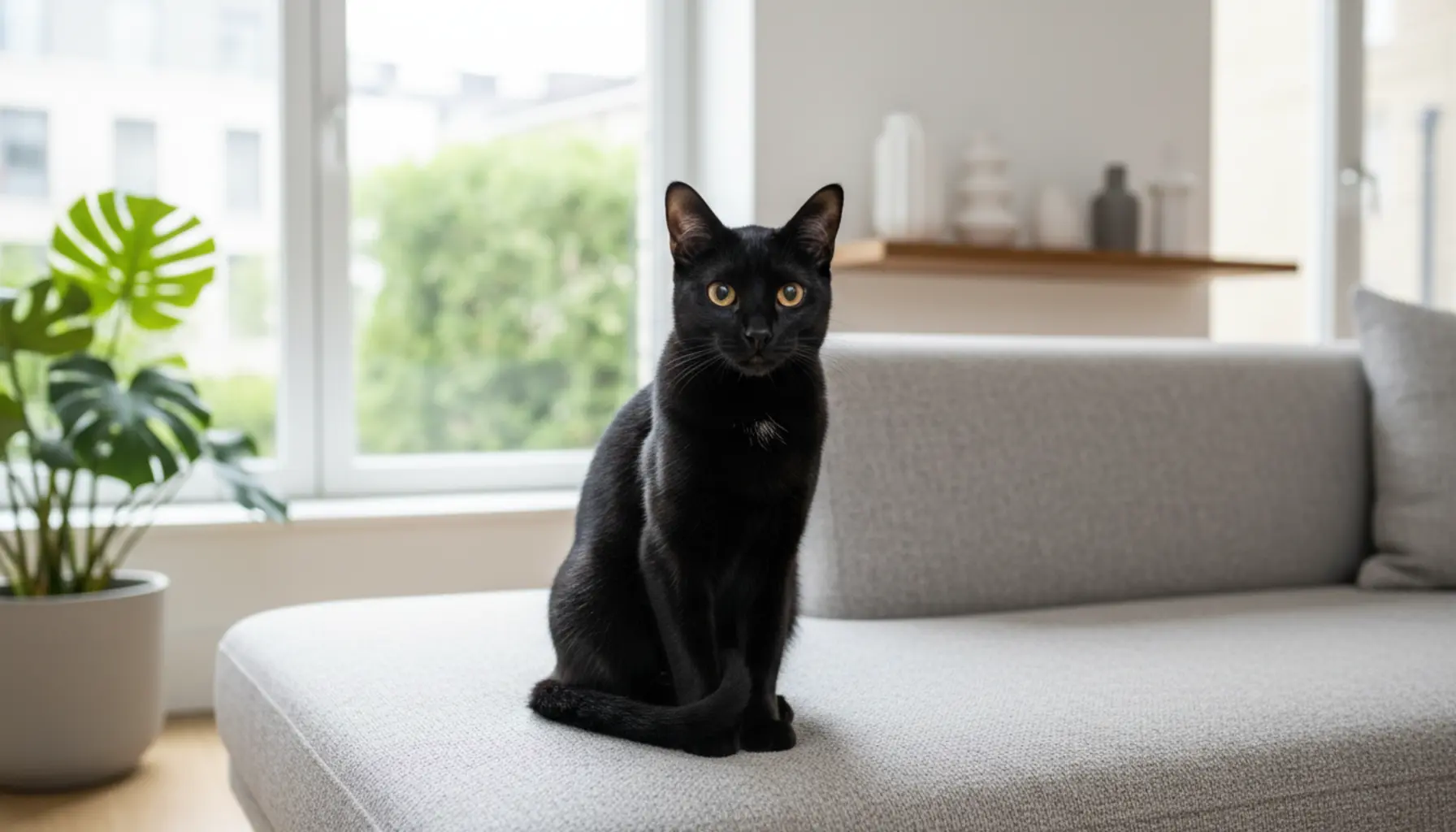
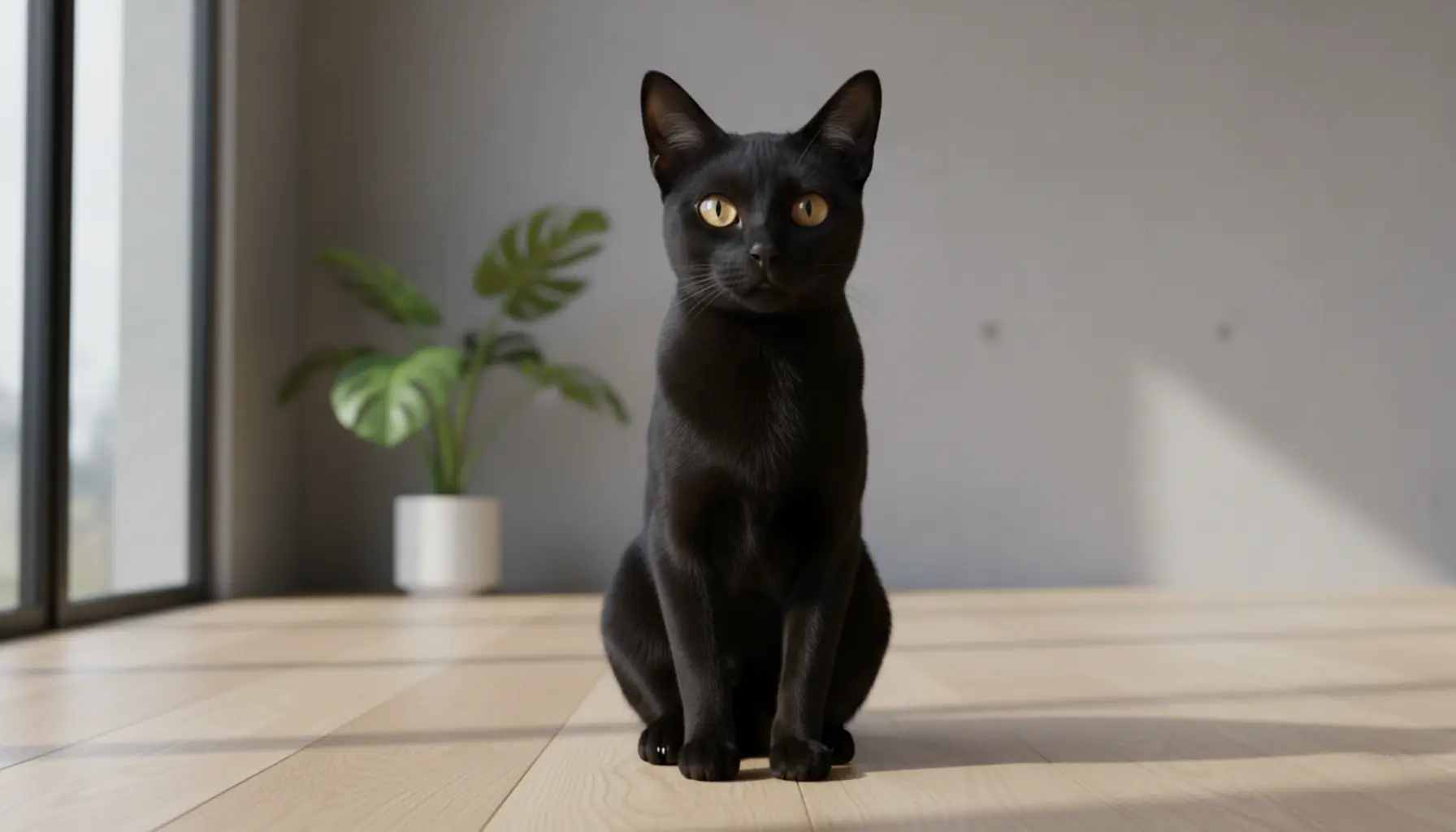
The Bombay cat is one of those breeds that is truly striking at first glance—its silhouette and deep, lacquered black fur evoke a miniature panther. It is medium-sized, with a compact, muscular build that gives it an elegant, slightly athletic look. The torso is relatively short, but well-muscled with a straight backline and a strong chest, lending the Bombay “compact strength” without the heavy mass typical of larger breeds. The legs are medium length, proportional, with solid bone and round, full paws—when standing, the cat gives the impression of a stable, assured posture. The tail is straight, of medium length, tapering at the end, not very thick and without kinks, harmoniously completing the body line. Although Bombays may appear larger in photos, in reality they usually weigh between 3 and 5 kg, with males generally heavier and more massive than females, while retaining smooth, flowing body lines. One of the most distinctive features of the Bombay is its head—clearly rounded with no sharp angles, a short, wide nose and well-developed chin. In profile, a gentle but distinct break is seen at the eyes, differentiating the breed from straight-profiled oriental breeds. Cheeks—especially in mature males—can be fuller, giving the muzzle a bit of a “lion” expression. The ears are medium-sized, broad at the base, rounded at the tips, and set to emphasize the round head shape—not too high nor too widely spaced. The overall impression given by the Bombay’s head is harmony and gentleness combined with a hint of wild elegance, perfectly matching its black coat. According to the breed standard, all visible body parts—including the nose and paw pads—should be as dark as possible, preferably black or deep brown, which further enhances the “mini-panther” effect. Also, the skin texture and musculature matter: under the fingers, the body feels supple, elastic, and entirely free of obesity, while the well-defined thigh and shoulder muscles reveal natural agility, even if the cat leads a typically indoor life.
Even more unique than the body is the Bombay’s coat—according to standard, the breed occurs only in one color variant: a solid, deep, dense black from hair root to tip. This monochrome distinguishes the Bombay from other black domestic cats, which often show lighter undercoat, shading or slight discolorations. A purebred Bombay should give the effect of “lacquered skin”: the fur is very short, fine, close-lying and silky to the touch, with a high gloss that in good light imparts the coat a metallic, almost mirror shine. The lack of undercoat makes the fur lay smooth, not sticking out, and enhances the impression of a smooth leather surface—so a well-groomed Bombay often looks as if gently polished. Thus, every movement highlights muscle lines, and the light gleaming off the fur accentuates body contours just like wild cats. Importantly for breeding and shows, any white spots—even a single white hair—are a fault and disqualify the cat from further breeding, so reputable breeders are extremely strict about pigmentation. Against an ideally black coat, the Bombay’s eyes stand out dramatically: large, round, widely spaced, and giving a look of watchful yet gentle attention. Their color should range from deep, dark copper to bright, rich gold—the more “glowing” amber, the higher the show value. The contrast between jet-black fur and fiery irises is one of the most desirable visual effects and is what often earns the Bombay its “mini panther with golden eyes” nickname. It’s good to know that kittens’ eyes may initially be more yellowish or greenish and only develop the target, deep copper color as they age—final coloration is often assessed after one year. The coat color itself does not change with age, but its condition and shine depend strongly on diet and care: balanced food rich in omega-3 and omega-6, plus regular brushing, maintain intense black and typical gloss. In natural sunlight some individuals may show a delicate, warm brownish cast, which is not considered a fault unless the overall impression remains clearly black. All these traits—a compact, muscular body, a round head with a full muzzle, short, shiny, pitch-black fur, and copper or golden eyes with a hypnotizing stare—create the image of a cat that truly looks like it stepped out of the imagination of a domesticated, miniature panther.
Character, Temperament and Behavior
The Bombay cat is often described as a harmonious combination of a dog, a cat, and… a small human. This is an extremely social animal, strongly attaching to its owner and keenly participating in daily household life. The Bombay is not a typical “independent cat” who appears only when they wish—instead, they tend to follow their human from room to room, lie next to them on the sofa, and even “help” with computer work by sitting on the keyboard or lap. Their strong need for proximity means the breed especially thrives in homes where someone is around most of the day. Left alone for too long, a Bombay may feel frustration, boredom, and loneliness, manifesting as excessive meowing, insistent demands for attention after the owner returns, or—at worst—destructive behaviors or compulsive over-grooming. By nature, these are balanced, affectionate, gentle yet very intelligent and energetic cats. They love physical contact—many enjoy being carried, cuddled, sleep in bed, and seek “nose to nose” closeness with their human. Many owners compare them to children: Bombays want to be at the heart of events, respond to tone of voice, “take offense” at neglect, and quickly learn how to regain attention. Thanks to Burmese lineage, they are basically gentle, people-friendly, and rarely aggressive—if displeased, they more often withdraw than attack. On the other hand, from the American Shorthair, they inherited a touch of energy and love of activity—so they’re not classic “couch potatoes” who nap all day. A Bombay can play with a ball for hours, fetch toys, or chase a wand, and after exercise becomes a calm, quiet housemate that naps close to their person. Thorough communication is also a hallmark—Bombays have a rather soft, medium-volume voice, but use it frequently to “converse” with their carer. With gentle meows, they may request food, encourage play, or signal discomfort. This emotional openness means owners can quickly learn to read their needs. At the same time, Bombays respond well to positive-reinforcement training—they master simple commands, can use harnesses and leashes, and even learn tricks, combining mental stimulation and bonding.
In interactions with other pets, the Bombay cat is generally friendly and open if properly socialized from the start. With a stable, balanced temperament, they usually accept a second cat or a dog, especially if the other animal is also gentle. With correct socialization, they can form complex relationships—play with dogs, co-exist with cats, or act as a “big brother” for other animals at home. With children, the Bombay is usually patient and tolerant but—as with every breed—children must be taught gentle handling, respect for boundaries, and the importance of peaceful resting places for the cat. The strong human bond may facilitate some jealousy when a new pet or baby arrives, so any change in family should be gradual and positive (rewards, play, quality time). Bombays are highly curious—they’ll check every closet, inspect shopping bags, and watch out the window. Unmet curiosity and mental stimulation needs can lead to boredom, so environmental enrichment is advisable: scratchers, shelves, tunnels, interactive toys, sniffing mats, and regular play sessions. Their intelligence means they quickly master puzzle toys or treat feeders, curbing overeating and keeping them mentally fit. The Bombay’s behavior greatly depends on having primary needs—exercise, social contact, exploration—met. Well-socialized Bombays are predictable, steady, and “readable” for owners, facilitating life even for those without much cat experience. But be aware—they are a highly relational breed: happiest as a full-fledged family member, not just a decoration. When choosing a Bombay, be ready for intensive daily interaction—chats, play, shared relaxation—and the black mini-panther wishing to participate in nearly all home life, from morning coffee to an evening movie.
Care and Health of the Bombay Cat
The Bombay cat—despite its exotic looks—is not especially demanding in terms of care, but does require regularity and a health-conscious approach. As a shorthaired breed, it does not need complex grooming, but its delicate, close-lying coat should be brushed regularly to keep the characteristic “lacquer-like” shine. Brushing once a week with a soft natural bristle brush or a rubber glove not only removes dead hair, but stimulates skin circulation and spreads natural sebum for more shine. In shedding seasons (usually spring and autumn), brush 2–3 times a week to limit hair in the house and hairballs in the digestive tract. Bathing is not obligatory unless the cat is a show cat or gets very dirty—then, use only gentle shampoos for dark cats and rinse thoroughly to avoid skin irritation. Bombays also need regular eye and ear care—once a week gently clean the eye corners with a cotton pad moistened with boiled water or special veterinary eyewash; check ears for wax and clean only as needed, always with a cat-safe solution and cotton pad, never cotton swabs. Claw care is just as important: many Bombays keep claws short on scratchers, but indoors it’s often not enough, so trim every 3–4 weeks with a pet nail clipper; failure can lead to ingrown claws or furniture damage. Oral hygiene is key—like most pedigree cats, Bombays tend to develop tartar, so from a young age, get them used to tooth-brushing with cat toothpaste at least 2–3 times per week; combine with a mechanically abrasive diet (dental foods, chew treats) to reduce gum disease and tooth loss. A proper diet hugely impacts coat and health—the best choice is high-meat, grain-free or low-grain food, with controlled fat and balanced micronutrients like zinc, copper and omega-3, omega-6 acids to enhance pigmentation and coat gloss; avoid low-quality foods high in plant fillers that can strain digestion and encourage weight gain. Keep an eye on portions and weight—a Bombay, while lively, can be food-motivated, and obesity raises joint, diabetes and heart risks. Preventative health includes regular vaccinations (against panleukopenia, catflu, rabies as per local rules), scheduled deworming (every 3–6 months depending on lifestyle), and protection against fleas and ticks—even indoor cats can pick them up from humans’ clothing or shoes. Annual (after age 7–8, ideally semi-annual) vet checkups are crucial—these should check clinical health, teeth, body weight, and periodically blood and urine tests to detect chronic illnesses such as kidney dysfunction or liver issues early.
Genetically, the Bombay cat is regarded as a relatively healthy and robust breed, but—as with all selectively bred cats—there are some predispositions, so a responsible owner should know the risks and work with both their breeder and vet. Lines derived from Burmese have sometimes displayed hypertrophic cardiomyopathy (HCM)—a heart muscle disease leading to heart failure and clots; good breeders run echocardiograms and eliminate affected animals from breeding. Some Bombays also have a tendency for airway issues due to a shorter muzzle and rounded head, but this is not the brachycephalic extreme seen in some dogs—though still worthwhile to watch for loud snoring, breathing difficulties or chronic nasal discharge. There can also be a tendency for food sensitivities and allergies, causing itchiness, over-grooming, dandruff, or diarrhea; in such cases, single-protein or hypoallergenic diets under a vet are effective. The Bombay’s active character means daily exercise is essential—this is both a plus and means the home must be secured with robust scratchers, shelves, “cat highways” and secure windows and balconies (nets or enclosures) to prevent falls. Because of their attachment to people, Bombays cope poorly with extended solitude, and chronic stress can lead to behavioral issues (excess meowing, urine marking, over-grooming) and lowered immunity; so it is extremely important to care for not only their physical but also mental well-being with daily play, a stable schedule, gentle introduction to changes, and safe spots for calm and withdrawal. Big moves, renovation, or the arrival of a child or pet should be preceded by behavioral or vet consultation, especially if the cat is prone to nervousness. Daily health care should include monitoring the litter box—any change in urination frequency, stool volume or appearance (diarrhea, constipation, blood) may signal urinary, intestinal or pancreatic disorders and need swift vet attention. Thanks to the right care, nutrition and stimulating environment, the Bombay can enjoy a long, active life—often up to 15–18 years—retaining vitality and “panther” charm even at a mature age.
Bombay Cat Price – How Much Does a Miniature Panther Cost?
The Bombay cat is considered one of the more elite shorthaired breeds, which is directly reflected in its price. In Poland, a kitten from a legal, registered breeder usually costs about 4000–5000 PLN and up, and for exceptional breeding lines with prestigious parents, the price can reach 7000–9000 PLN or higher. The final amount is mainly determined by the cat’s purpose—“pet” kittens (only for companionship, with castration/spaying contract) are less expensive than breeding or show cats whose breeders pay particular attention to breed standard, beauty, and genetic potential. The very occurrence of Bombay cats is rare—the number of breeders in Europe is still small; imports (e.g., from the USA, UK, France) are common and raise costs. Note that the kitten’s price covers not just its “mini-panther” look, but also all the care and investments made during its first months. This includes high-quality food, basic and booster vaccinations, multiple dewormings, often chipping, vet checks, and—if going abroad—passport, extra shots, export paperwork. Breeders also invest in socialization—teaching kittens human contact, grooming, travel in a carrier, litter box and scratcher use. Thus, the price of a Bombay from a good breeder reflects not just exotic looks but also the quality start and lower risk of future health or behavior issues. The high price might seem steep, but cheaper, “pseudo-bred” kittens often end up much more costly in terms of vet bills, behavioral consultations, and addressing issues from random mating, lack of parent tests, or poor upbringing. For such a human-focused cat as the Bombay, early socialization is crucial—something you can’t “add” later, and which is thus a hidden element in the price.
The total cost of owning a Bombay cat also includes seemingly secondary factors. Breeder location can affect the price—in big cities, with higher maintenance and vet costs, kittens are more expensive than in smaller towns. Include transport—especially for imports: plane tickets, suitable carrier, airport fees, sometimes a pet-courier—all of this can increase the entry price by several thousand PLN. For those considering a breeding Bombay, the price is almost always much higher than for a pet cat, as breeders typically select the best individuals for breeding, forgoing their potential in their own programs. Also included are wider genetic tests of parents and kitten, contracts (e.g. co-ownership, show obligations, breeding limitations), and extra paperwork for cat fancy registrations. Whether you seek a pet or breeding Bombay, be alert to “bargain” offers—kittens for 1500–2500 PLN, listed as “Bombay type” or “Bombay without papers”, are almost certainly not purebred Bombays, but simply black mixes of unknown origin. No pedigree means no parental control, possible genetic faults, inbreeding risk, and unpredictable temperament. To the purchase cost, you should also add the “starter kit” for the mini-panther—premium food (these cats are very sociable but also sensitive to food quality), scratchers and climbing shelves, interactive toys, regular vet visits, and pet insurance, which is a wise choice for such a rare breed. It is best at the search stage to consider the annual cost of ownership rather than only kitten price—over time, daily care, preventive health and feeding will be the main budget items. The Bombay is not a “budget” cat—either in price or needs—so working with a reputable, transparent breeder is essential so your investment in this mini panther is conscious and satisfying for years to come.
Bombay Cat: For Whom Is This Breed Perfect?
The Bombay cat is a breed that thrives among people who consider the pet a real family member, not just a “decoration” at home. It’s an excellent choice for owners who spend much time at home or can work remotely, as the Bombay strongly bonds with its owner and needs daily attention, contact, and conversation. While not hyperactive, it is definitely not a loner—long hours in an empty home can lead to anxiety or destructive behavior. The ideal owner enjoys interacting with their cat, loves playing with wands, throwing balls, organizing obstacle courses, or hide-and-seek treats. An engaged owner will appreciate the Bombay’s intelligence and ability to quickly learn simple commands, recall, or leash-walking. The breed suits singles and couples who want a closely bonded companion—provided the cat doesn’t spend most of the day alone. For those working outside home, taking a second cat (not necessarily a Bombay) is often a good idea, provided proper socialization and gradual introduction. Thanks to its friendly, stable character, the Bombay usually gets on with other cats and with gentle dogs, making it suited for multi-pet homes where calm, controlled introductions are prioritized.
This breed can be perfect for families with children—especially older ones who understand how to treat animals. Bombays are patient, playful and enjoy gentle petting and spending time around people. However, respect for their boundaries is required—children should be taught not to squeeze, pull tails, or wake cats by force. In a responsible home, the Bombay will be an affectionate, stable companion, often bonding especially with one person yet maintaining good relations with others. The breed is also suitable for people living in apartments because it does not need much space—just an interesting environment: tall scratchers, shelves, climbing and viewing spots. Its curious, social personality means it’s wise to secure windows and balconies with nets, so it can safely observe the world. The Bombay is not a good choice for those seeking a completely independent animal that requires little attention or for people planning to travel often and leave the cat with friends or in a pet hotel—such a bonded breed may then develop stress or longing. Nor is it ideal for very noisy, impulsive people or chaotic homes lacking routine. Although Bombays do well in lively, family environments, they still require stability and safe retreat spots. Anyone interested should be ready for daily play rituals, conversations, regular vet checks, investment in quality food and accessories, and to treat the Bombay as an active household partner, who lives for the relationship and gives back with loyalty, intelligence and a unique, close bond with its owner.
Summary
The Bombay cat enchants with its black mini-panther look and gentle, intelligent character. It’s a family-oriented, energetic and extremely sociable cat, ideal for both children and adults. Thanks to the short, shiny coat, care is easy and, with the right care, the health is usually good. The price of Bombay kittens reflects the rarity of the breed and its remarkable features. If you are looking for a friendly, active and unique cat, the Bombay may be a perfect choice.

