

Looking for the best toys for a cat left alone at home? Discover proven solutions that will guarantee your pet entertainment, activity, and safety even during long hours of solitude. Learn how to choose the right gadgets tailored to your cat’s needs.
See the ranking of the best toys for cats left home alone. Check which interactive gadgets provide activity and joy for your furry friend.
Table of Contents
- Why provide toys for your cat when you’re not at home?
- Most popular types of cat toys
- Interactive and smart gadgets — how do they work?
- Safe and creative play for a lonely cat
- How to match a toy to your cat’s temperament and needs?
- What to watch for when buying toys for cats left alone?
Why provide toys for your cat when you’re not at home?
Cats, even the cuddliest, are natural solitary hunters that need many short bursts of activity throughout the day—hunting, exploring, solving “environmental puzzles.” When you go to work, school, or out for a longer meeting, your home becomes quiet and predictable—often translating to boredom and lack of stimulation for your cat. As a pet parent, you might think your cat sleeps all day, but a prolonged lack of stimuli affects your cat’s mental and physical well-being. Well-chosen toys for use during your absence act as a “substitute hunting environment”: they encourage movement, hunting, thinking, and reward activity, allowing your pet to vent natural instincts. This way, your cat is not only occupied but also can satisfy their species-specific needs, directly improving their welfare. In practice, a well-organized “play zone” means a decreased risk of furniture being scratched, items thrown from shelves, or other destructive behavior from frustration. Instead, energy is directed at safe targets: obstacle courses, balls, interactive feeders, and electronic gadgets. It’s also worth noting that loneliness is stressful for many cats—a change in routine, absence of their human, and lack of interaction. Toys, especially those engaging smell and hearing, act as “circuit breakers” reducing stress by distracting attention from noises in the stairwell, outside, or from other animals. This limits compulsive behaviors like over-grooming, tail-chasing, or excessive vocalizing. Physically, toys are as important: they encourage running, jumping, climbing, helping maintain a healthy weight, and reducing the risk of obesity—a major issue for indoor cats. Interactive feeders or treat-dispensing toys slow down eating and simulate the natural sequence: hunting, catch, meal. Such solutions prevent wolfing down food, supporting digestion and reducing the risk of vomiting or tummy upsets. Chasing balls, feather teasers, or finding treats in sniffing mats strengthen muscles and joints and improve coordination, especially important for senior cats, who may lose mobility but still enjoy gentle activity when the play is right. Well-matched toys also prevent behavioral problems: they curb night-time “madness,” redirected aggression (biting the owner after work), or excessive meowing for attention—a cat that’s burned off energy during the day is calmer and more balanced in the evening.
Providing entertainment for your cat in your absence is also crucial for emotional and relational reasons. A cat that perceives its environment as predictable and self-accessible feels more confident in its territory—not solely dependent on humans as the source of fun and reward. Toys give a sense of agency: your cat can initiate a ball chase, activate an interactive “bug,” or extract treats from a maze. This reduces helplessness, a major cause of feline stress. Gadgets that respond to touch or movement stimulate feline intelligence—forcing your pet to think, plan, and solve puzzles, appreciated not just by active, intelligent breeds like Bengals, Abyssinians, and Siamese, but also lively moggies. Without such stimulation, especially during long hours alone, your cat may lapse into chronic boredom, often mistaken for laziness or a “phlegmatic character.” Lacking intellectual challenges, cats may become passive, dulled, or uninterested in their surroundings. Toys and planned play areas act as a mental gym, keeping your cat’s brain fit—a benefit for seniors too, as cognitive abilities decline with age. You can’t forget safety: a cat with enticing, purpose-made toys is less likely to go after “forbidden” items—cables, houseplants, small objects that could be knocked down or swallowed. This directly reduces accidents, poisoning, or injuries when you’re not home. A well-thought-out toy set (especially rotatable ones, switched every few days) keeps interest high without overwhelming your cat with stimuli. It’s important toys suit your cat’s age, health, and temperament: an energetic kitten has different needs than a calm senior or a shy rescue just learning to trust people. Offering diversity and independence in play invests in stable mental health, physical fitness, and harmonious relationships—you’ll come home to a more relaxed, balanced cat, eager for quality shared time, not desperate for attention from all-day boredom.
Most popular types of cat toys
The market offers a wide variety of toys to help your cat constructively pass the time alone, but not all work the same way or suit every feline. One of the most popular categories are interactive toys: electronic mice, rolling electronic balls, as well as automated teasers or racetracks with rolling balls. Such gadgets stimulate the cat’s hunting instinct, encouraging them to stalk, chase, and hunt even when you’re away. Many models feature different modes, unpredictable movements, or timed pauses—so the play is never the same and boredom is minimized. Another important group: puzzle toys and interactive feeders—treat balls, sniffing mats, treat mazes, or boxes with holes that challenge your cat to extract hidden food. These require mental involvement and working with paws and mouth, combating monotony while slowing down eating and reducing boredom-munching. The right puzzle feeder can even replace a traditional bowl for some meals, turning feeding time into engaging play. Another universally loved category: balls and small chase/shake toys—made of rubber, felt, rattan, or plastic, sometimes filled with rattles, feathers, or catnip. The key is for the ball to be light and durable—your cat can push it easily and it survives intense play. For cats left alone often, multi-ball toy sets work well—your pet can pick their preferred one at any time, keeping interest up for longer.
Also very popular: toys with catnip or valerian, acting as natural motivators. They come as plush mice, fish, pillows, rolls, or cylinders—objects to kick, bite, and toss around. Some cats get euphoric and playful, others are calmed, relieving lonelines-induced stress. Make sure catnip toys are safe, strongly sewn, and the stuffing is hard to access—too much ingested plant can be problematic. Another category: “feather on a spring” toys or scratchers with attached bits for biting or catching. They combine scratching and stretching with active play—the cat can attack the feather, spring from the post, crouch, jump—just like in the wild. For cats left home alone, also consider simple but cunning sensory toys: rustling tunnels, mats with multiple textures, bells and balls, or “hidden” toys in boxes with paw holes. These stimulate both touch and hearing and encourage exploration—your cat can tunnel like in a burrow, listen for rustling, set imaginary traps. Don’t dismiss “stationary” toys: scratchers, wall shelves, climbing towers, window hammocks, radiator beds. Though static, they let cats climb, perch, and claim territory. When you combine all these categories, you see cat toys aren’t just cute trinkets—they’re tools to satisfy hunting, tracking, climbing, scratching, sniffing, and exploring instincts. Combine different types—moving gadgets, puzzle feeders, climbing stations—so your cat’s environment is always engaging, never boring after a few days.
Interactive and smart gadgets — how do they work?
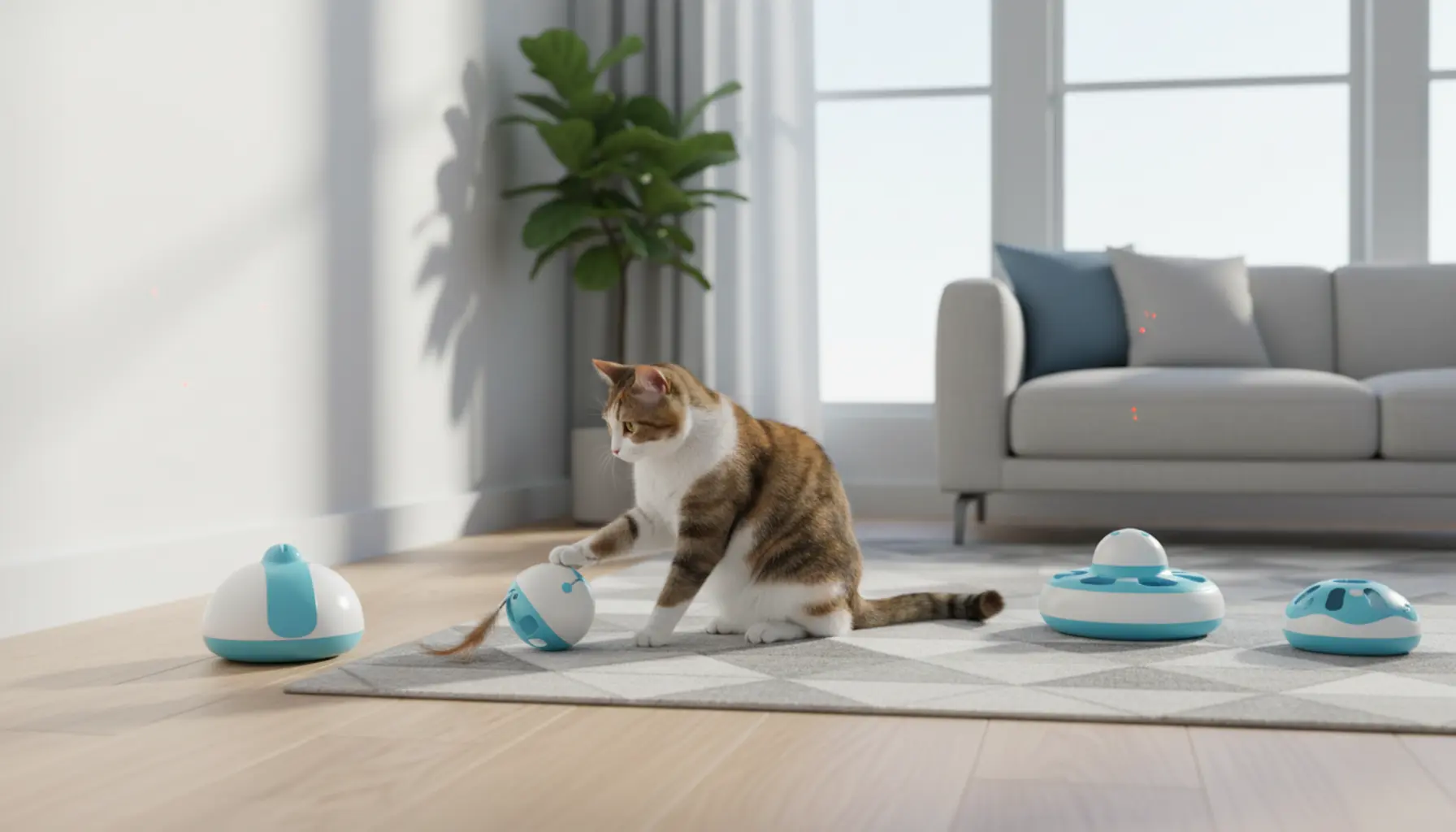
Interactive and smart cat gadgets are devices that “replace” the human during play by using movement, light, sound, or even artificial intelligence. Their key feature: they react to the cat’s behavior or follow programmed scenarios, instead of just sitting passively like plushies. This means the toy moves, changes direction, starts and stops, emits lights or sounds, or dispenses food imitating a real hunt. Simple models use mechanical features—springs, strings, wheels, spinning tips powered by batteries or rechargeables. More advanced gadgets include motion, touch, or sound sensors, activating when the cat passes, touches, or meows nearby. This way, the toy doesn’t run endlessly (which quickly bores cats) but provides surprises and keeps your cat engaged even during long absences. Electronics play a major background role—microprocessors determine movement sequences, pause times, sometimes even analyze how often your cat interacts, adjusting difficulty or pace accordingly. You’ll see this in self-driving balls and mice, which “rest” after a few minutes to avoid overheating or tiring your cat before starting again. Automated teasers or “paws” randomly pop out of holes—mimicking live prey that never moves on a set pattern. In smarter models, algorithms alter behavior based on the cat’s reaction—if your cat starts losing interest, it speeds up, changes direction, emits sounds or lights. Some gadgets go online via Wi-Fi or Bluetooth, allowing you to control play from a mobile app: you can remotely turn it on, change the mode, or schedule sessions during the workday. This is invaluable for easily bored cats and owners with irregular schedules—activities can be spread over multiple short bursts, not one exhausting session when you get home. Many smart gadgets support pet cameras—watch your cat’s reactions live and adjust settings on the fly: shorten or intensify the play as you wish.
Another class: interactive feeders, treat dispensers, and puzzle toys that merge play with food rewards. Here, the cat must perform a task (move a piece, press a button, spin a ball, slide a flap) to get kibble or treats. Non-electronic versions rely on clever obstacles or mazes adjustable for difficulty. Smarter devices sense when and how long the cat uses them, uploading stats to an app so you can monitor feedings, activity, and your cat’s peak playtime. Some dispensers weigh portions for precise caloric control—great for overweight cats. Smart bowls identify pets by microchip or RFID collar, letting only the “owner” access food in multi-cat homes. Interactive tracks and tunnels can also be “smart”—featuring LED lights, balls changing color, or sound modules triggered by the cat’s movement. All these options stimulate intellect and create positive associations: play = reward, motivating your cat to explore on their own. Safety is also important: most gadgets have auto-off timers, energy-saving mode, rounded edges, no small loose parts, and robust casing to resist teeth or claws. Well-designed toys are fairly quiet, avoiding stress-inducing high-pitched sounds; they use gentle acoustic cues (rustling, scratching, muted squeaks) reminiscent of natural prey. Before buying a smart gadget, understand its functions—does it respond to motion, touch, sound, work in activity/pause cycles, have adjustable difficulty/intensity, and actually serve your cat’s needs: lively youngster, sedate senior, or a timid cat needing gentle stimulation.
Safe and creative play for a lonely cat
Safety for a cat left home alone starts with prepping the space and choosing smart toys. Remove obvious hazards: all strings, yarns, thin ribbons, plastic wraps, and small items that could be swallowed; secure cables, and anchor plants in heavy pots (many plants are toxic to cats). Leave only toys with no small, removable pieces, properly stitched or glued, and no sharp edges. Fishing rods/teasers, stringed feather toys, or lasers should be only for supervised play—otherwise your cat risks entanglement, eye injury, or frustration from “ungrabbable” prey. Creative solo play means organizing the environment so your cat can hunt, explore, climb, and scratch naturally and safely—without you. Build an indoor “playground”: vertical and horizontal scratchers, wall shelves, fabric tunnels, cardboard hideouts, and relaxation/play zones at different heights. You can also DIY cheap, safe toys—a cardboard box filled with packing paper or cartons with holes is a “cat jungle” for hiding, hunting, and climbing. Rotate toys every 2–3 days, store some away and bring them back intermittently. This keeps even simple objects interesting, reducing boredom. Change the play setup creatively—balls rolling in a cardboard track one day, hidden in paper another, or pile light toys on the scratching tower for a new “hunt.” Watch how your cat uses new setups; if anything is too slippery, unstable, or causes stress, adjust quickly.
Creative play for a lonely cat isn’t just about gadgets, but integrating activity into daily home routines. One of the simplest, most satisfying ideas: “food hunt.” Instead of a bowlful of food, place some in treat-dispensing toys or perforated bottles, and scatter portions in different spots (shelves, in the tunnel, in boxes), creating a scent map to explore. Start easy and gradually increase difficulty—success keeps your cat motivated. DIY “treat labyrinths” from rolled paper towels or tissue boxes—add holes and treats inside. Another idea: scent trails—dab catnip, valerian root, or favorite toy’s scent on tunnels, scratchers, cardboard for new inspiration. Energetic cats benefit from “activity zones”—arrange furniture and scratchers for jumping, dashing, leaping, and landing on soft blankets (cat parkour!). Make sure setups are stable and the right height. For introverts or seniors, calmer play: sniff mats, catnip boxes, slow-rolling soft balls, toys with bells or crinkling paper. Leverage light and windows—safe viewing spots (window ledges with suction-cup hammocks) give visual entertainment; pair with toys to limit frustration. Purposefully reserve some toys for times you’re away (“good stuff appears when I’m alone!”) and others for shared play—closing the cat “hunting cycle” of hunt, eat, rest. Such a planned approach, based on your cat’s unique preferences, creates a safe, creative environment minimizing stress and destructive behavior, and lets your cat spend time alone in a satisfying way.
How to match a toy to your cat’s temperament and needs?
Choosing the right toy starts with careful observation of your cat’s character, energy level, and play style. A young energetic “sprinter” needs vigorous movement stimulation; a calm lap cat prefers gentle activities and food puzzles. Notice if your cat loves to chase, jump, and pursue “prey,” or prefers watching and batting moving objects—this helps you pick between fast-movers and slow, puzzle-based toys. Brave, curious cats quickly engage with new gadgets—try interactive, sensor-activated toys, automatic balls, or unpredictable movement toys. Shy or sensitive cats may be startled by loud noises, bright LEDs, or erratic motion; for them, sniffing mats, static treat puzzles, multi-exit tunnels, soft balls, or plushies with catnip are better. Age also counts—kittens develop coordination and love lightweight balls, crinkly tunnels, chase mice, and simple touch-activated toys. Adults need both mental and physical stimulation—combine obstacle courses, moving gadgets, and food puzzles. Seniors, especially with arthritis or overweight, need easy play: food puzzles, slow balls, catnip softies for gentle rolling, and low scratchers with paw-play features instead of high climbing posts.
Health and emotional needs also matter. With overweight-prone cats, opt for toys that make them move while eating: treat balls, food labyrinths, sniff mats. This way, your cat burns calories, slows eating, and is less bored while alone. Dynamic or easily frustrated cats benefit from robust vertical and horizontal scratchers, interactive ball tracks, electronic mice, or automatic teaser rods working in intervals—a short “hunt” followed by rest. For overly human-dependent, separation-anxious cats, use predictable toys: treat puzzles that always reward, soft plushies scented with the owner, or a bed by the window for simple “watch and rest” play (birds, passersby, cars); stash a few sensory toys nearby for batting between naps. Check which type of reward motivates your cat: food, movement, touch, catnip scent, or just exploring. For food-lovers, opt for treat-dispensing toys; for chasers, get balls, battery mice, moving tracks, or attachable teaser rods. Calm, territory-oriented cats do best with static toys—large scratchers with shelves and huts, tunnels with side holes, sensory mats for walking, sniffing, lying. Introduce new toys gradually, letting your cat explore at their own pace. Test a range, rotate every few days, observe which are favorites—which are ignored—build an individual “play profile” and choose new gadgets to enrich alone time further.
What to watch for when buying toys for cats left alone?
Choosing toys for a cat that spends long hours at home alone demands more caution than for co-play gadgets. First, assess safety—no tiny, easy-to-bite-off or swallow elements like loose eyes, beads, thin strings, feathers, plastics that could splinter into sharp edges. Toys with strings, rubber bands, ribbons, or springs should be for supervised play only—unsupervised, they can entangle the cat’s neck, limbs, or tongue, causing injury or worse. Materials matter too—avoid cheap, strong-smelling plastics of unknown origin, which can contain toxins absorbed by licking or biting. Choose toys from reputable brands, ideally tested or labeled for safety. For plush/textile toys (mice, etc.), check finish: tight, dense seams, no loose ends, secure stuffing—so your cat can’t easily rip and swallow stuffing, silicon beads, or foil inserts. Beware of toys too lightweight but very hard—cat can bounce it and injure eyes/face, or damage delicate home objects in small spaces. Use “cat logic”—imagine your cat hunting, tugging, biting—what would be destroyed in days of solo play? Also, catnip or valerian toys: these are usually safe, but some cats get wild, risking self-injury against hard surfaces. Start with small, well-sewn “herb toys,” observe before leaving them for hours. Examine all glued or thin plastic pieces—intense chewers can detach and possibly swallow sharp parts, leading to an emergency vet visit. Be extra careful with trendy toys from auction sites—low prices often equal poor quality and lack of safety standards. It’s wiser to buy fewer but better-made toys.
Special risks: interactive/electronic gadgets. In addition to durability, check batteries/electronics. Battery compartments should be screwed shut—so your cat can’t open with claws or teeth (battery ingestion, especially button-type, can be fatal). Avoid extraneous wires, bare cables, or thin wires—cats love to chew these, risking short circuits or shocks. Noise matters—gadgets you think are “soft-sounding” might stress your cat with sensitive hearing, especially when auto-activated in your absence. So pick toys with volume controls, timers, or auto-off modes instead of continuous play. Laser toys shouldn’t be left on for solo play—cat could get the beam in eyes, and end up frustrated by the lack of “real prey.” Use lasers only in supervised sessions. For automatic feeders or treat dispensers, ensure no gaps for paws to get trapped and a stable base—to avoid being knocked over and spilling food. Controls/difficulty matter—puzzles too hard frustrate, too easy bore. Mind gadget size and weight—a cat shouldn’t be able to drop a heavy, moving item on itself or trap a paw; look for non-slip feet or options for securing to furniture. Don’t forget easy cleaning—treat toys, sniff mats, food balls need to be washed regularly; pick ones with smooth, accessible surfaces or those that come apart for cleaning. The simpler, sturdier, and better protected a gadget is, the more attractive and, above all, safer it will be for an unattended cat.
Summary
Choosing the right toys is essential for the physical and mental health of a cat left alone at home. With well-matched, interactive, and safe toys, your pet will have activities that stimulate their hunting instincts and prevent boredom or destructive behavior. Always select gadgets to suit your cat’s temperament and check their condition regularly. The right toys enrich your pet’s daily life and make it easier for you to keep a harmonious home.

