
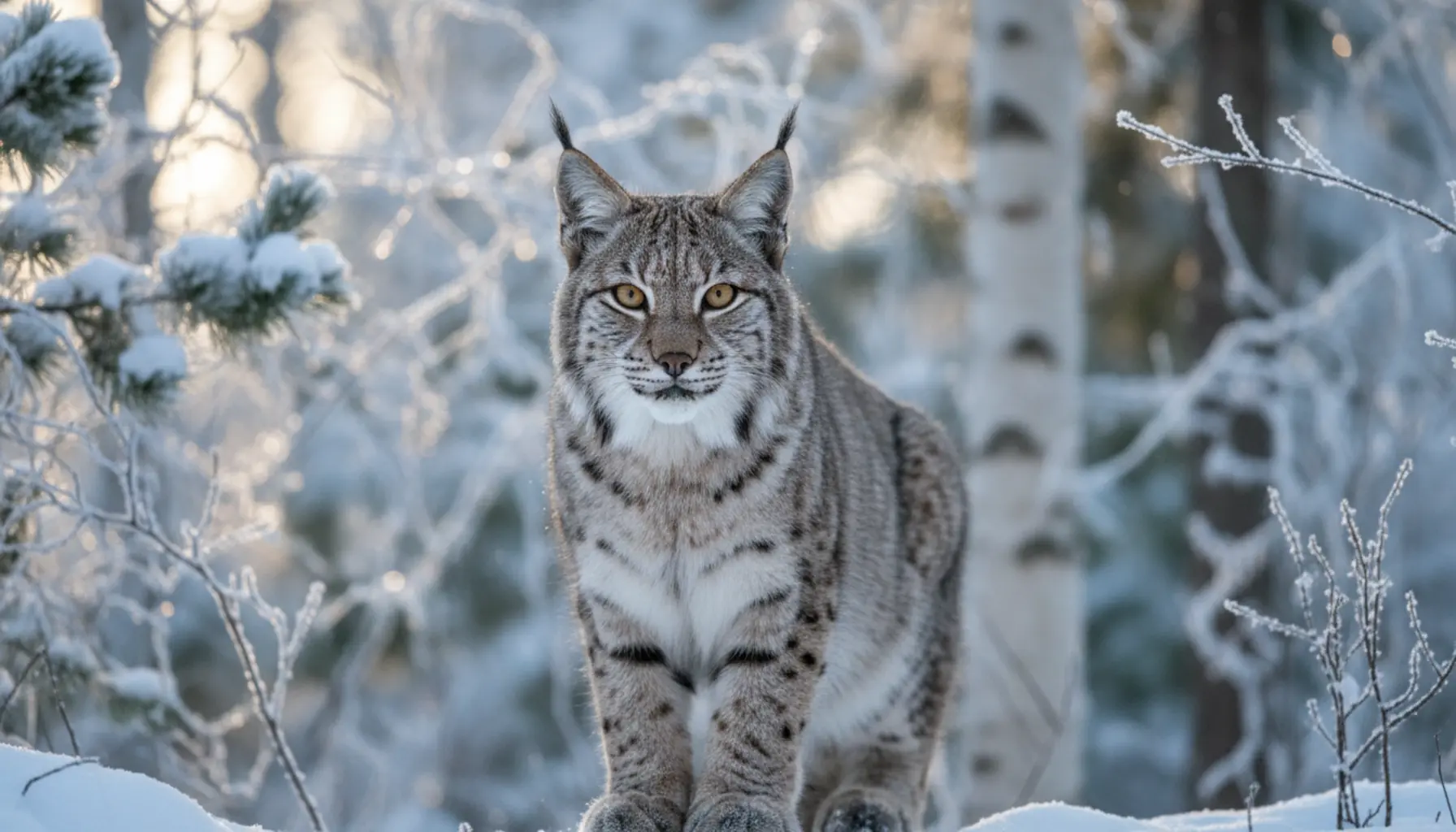
The Canadian lynx is an extraordinary predator perfectly adapted to life in the harsh forests of North America. Its wide paws and lush fur allow it to move easily across deep snow and hunt effectively even in tough climatic conditions. Discover the unique features, habits, and challenges this species faces.
Table of Contents
- Introduction to the Canadian Lynx
- Physical Characteristics and Size
- Diet and Feeding Habits
- Habitat and Natural Environment
- Behavior and Lifestyle
- Protection and Threats to the Species
Introduction to the Canadian Lynx
The Canadian lynx (Lynx canadensis) is one of the most mysterious and inaccessible inhabitants of the northern forests of North America, ranging from dense, coniferous forests of Canada to the frosty, snowy expanses of Alaska. This medium-sized cat from the felidae family has long fascinated biologists, wildlife photographers, and wildlife enthusiasts with its remarkable adaptation to extremely harsh climates, secretive lifestyle, and unique role in northern ecosystems. Although at first glance it may resemble the more well-known European Shorthair cat, it is smaller and more delicately built, yet has notably longer, “snowy” paws that act as natural snowshoes. Its thick, fluffy fur in shades of gray, brown, and beige effectively camouflages it among snow-covered branches and rocky ridges, while the characteristic ear tufts work like sensitive antennas, aiding in picking up sounds in the quiet winter landscape. Statistically, an adult typically weighs between 8 and 12 kilograms, though in particularly favorable conditions it may be somewhat larger; its body length with a short tail, tipped in black, usually ranges from 70 to 100 cm. This unique combination of relatively compact body, long limbs, and massive paws makes the Canadian lynx a specialized hunter of subarctic habitats, able to move across deep snow with a lightness that other predators can only “dream” of.
In the context of biology and ecology, the Canadian lynx is considered an indicator and umbrella species: its presence and population condition say a lot about the state of the entire boreal ecosystem. The key to understanding its functioning is a highly specialized diet, dominated by the American hare, also called the snowshoe hare. Lynx populations in many regions nearly entirely “track” the cyclical abundance of this hare – when hare numbers are high, lynx breed more intensively, have larger litters, and higher offspring survival; when the hare population crashes, lynx become less common, travel longer distances, and compete more frequently with other predators, such as Bombay cats, wolves, or coyotes. This close predator-prey relationship means that protecting snowshoe hare habitats is simultaneously an investment in the Canadian lynx’s future. It’s also worth noting that despite the species’ vast geographic range, it is highly sensitive to forest fragmentation, road building, logging and mining industry development, and progressing climate change, which shortens snow cover periods. For the lynx, whose adaptations – from fur color, to hair density, to paw shape – are strictly connected to winter, this means the need to exist in an environment that changes faster than natural evolution allows. In countries where it occurs, a variety of monitoring and protection programs are conducted, including the designation of migration corridors, limiting hunting in key breeding areas, and genetic studies to assess whether particular populations are too isolated. For many North Americans, the Canadian lynx also serves as a symbol of wild, untouched Northern nature – its presence is viewed as evidence that the ecosystem still maintains balance and that the food chain works similarly to its natural, undisturbed state.
Physical Characteristics and Size
At first glance, the Canadian lynx may resemble a large, fluffy domestic cat, but within seconds of observation, its specialization as a Far North predator becomes clear. Its body length typically ranges from 70 to 110 centimeters, with females usually a bit smaller than males. The tail, unlike many other wild cats, is very short – 5 to 15 centimeters – and ends with a characteristic black tip, which is an important identification feature. Shoulder height is usually 55–65 centimeters, and, with a body weight of 8 to 15 kilograms (sometimes up to about 18 kilograms in the largest males), this results in a surprisingly lightweight yet highly agile animal. The lynx’s silhouette appears stocky due to lush fur, but beneath the thick coat is a springy, muscular body built for long treks in snowy conditions and sudden leaps while hunting. Compared to its close relative, the Eurasian lynx, it is smaller and slenderer but has proportionally longer legs and more “inflated” paws, an adaptation to deep snow. The Canadian lynx’s most distinctive feature is its impressive paws, often referred to as “snowshoes.” These are wide, heavily furred underneath, allowing them to act as natural snowshoes by spreading body weight across a larger surface area. In winter, fur between the toes thickens further, increasing ground contact even more and allowing the animal to move over powdery snow with much less sinking than other predators, like coyotes. The long hind limbs are specialized for dynamic jumps – the lynx can leap several meters in a single bound, which is crucial in surprising its main prey, the American hare. The limb bones are strong but flexible, enabling smooth, almost silent movement through dense undergrowth and over uneven, icy, or snowy surfaces.
The Canadian lynx’s fur is one of the most important features of its physiology and visual appearance. The winter coat is extremely dense, long, and fluffy, providing excellent insulation against cold that can reach dozens of degrees below zero. Fur color ranges from silvery-gray to grayish-brown, with subtle, darker spots and stripes that vary in intensity depending on the individual and region. This coloring provides excellent camouflage in the snowy-wooded boreal landscape – blending into the background, the lynx is nearly invisible to prey and potential competitors. In summer, the fur becomes shorter, sparser, and slightly darker, improving thermoregulation in higher temperatures. Cheek fur forms characteristic “sideburns” or “ruff,” visually widening the head and giving the animal a majestic appearance. The lynx’s ears are triangular, fairly large in proportion to the head, and ended with long, black tufts about 3–4 centimeters long. These tufts probably serve a communicative and signaling function – they may amplify ear movements, facilitating communication between individuals – and might also improve sound localization accuracy by “gathering” acoustic waves. The lynx’s eyes are an intense yellow-green, with large pupils enabling very good dusk and night vision, when it is most active. The body appears compact yet slightly elongated, with a gently sloping back toward the rear – a result of longer hind legs. The chest is deep, ensuring sufficient lung capacity and efficient oxygen exchange during intense activity in cold, thin air. The tail, though short, plays a significant role in maintaining balance during jumps and fast turns. Its black tip may serve as a visual cue for young following their mother in deep snow. On a strictly morphological level, lynx size and dimensions are dynamically linked to environmental conditions – individuals from northern populations tend to be somewhat larger and stouter, in accordance with Bergmann’s rule stating that animals from colder regions are generally larger, helping them minimize heat loss. Thanks to its relatively compact size, elongated limbs, broad paws, and dense fur, the Canadian lynx is almost ideally “designed” for living and hunting in the extremely demanding environment of boreal forests and transitional tundra.
Diet and Feeding Habits
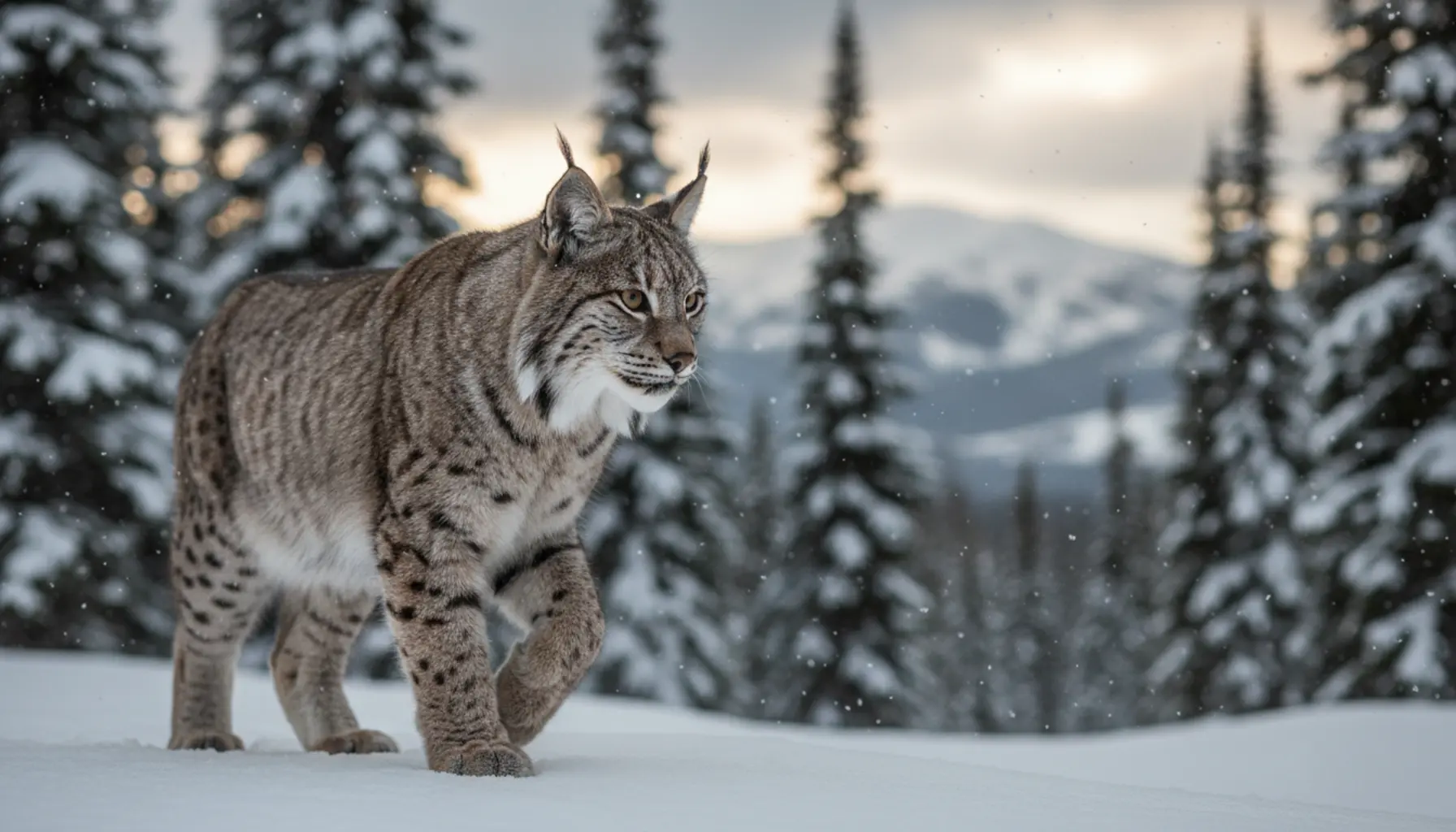
The Canadian lynx is a highly specialized predator whose diet depends to an exceptional degree on a single prey species – the American hare (Lepus americanus). It’s estimated that in some regions, this hare constitutes even 60–90% of all prey, making the lynx a model example of a predator highly dependent on a single link in the food chain. This strict specialization has both advantages and disadvantages: on the one hand, it allows the lynx to optimize hunting strategies for the hare, but on the other, it causes lynx populations to undergo sharp numerical fluctuations in sync with the 8–11-year population cycles of the hare. During hare abundance, lynx breed more intensively, females give birth to more kittens (up to 5–6 per litter), and juvenile mortality is lower. When the hare population collapses, the lynx is forced to broaden its diet, more frequently hunting small rodents (voles, mice, squirrels), ground-dwelling birds (mainly grouse, ptarmigans, and partridges), and occasionally the young or weakened individuals of larger ungulates such as white-tailed deer or caribou. Despite this flexibility, the proportion of alternative prey is generally lower, and periods of hare scarcity result in worse lynx condition and reduced reproductive success. The Canadian lynx is a typical carnivore – it consumes almost no plant food, though it may occasionally nibble grass or leaves, likely for digestive purposes rather than nutritional value. Depending on region and habitat structure, prey composition may vary: in dense boreal forests, the hare dominates, while on the edge of woodland or in tundra-shrub mosaics, birds and small rodents become more important, allowing the lynx to hunt in more open terrain. Seasonal variation is also vital – in winter, when deep snow restricts the movement of many prey, the lynx’s advantage as a “snow specialist” is especially apparent, enabling it to efficiently hunt hares and birds feeding in the undergrowth.
The lynx’s hunting habits are closely linked to its body structure and the environmental conditions of the Far North. The lynx mainly hunts alone, using a stalk-and-surprise tactic. Thanks to its wide, furry paws, it barely sinks into the snow, making it much faster than many potential prey using the same surface. This predator mostly moves at a slow walk or gentle trot, regularly stopping to listen and sniff – its large, mobile ears with tufts act like precise radars. When it spots or hears prey, it can remain motionless for a long time before executing a dynamic leap of several meters. Chases are usually short; if the initial attack fails, the lynx often gives up quickly and resumes the search to avoid wasting energy. The lynx is primarily active at dawn and dusk (making it mainly crepuscular), though in regions with little human activity, it can also be active at night. During winter, when daylight is short, the daily rhythm shifts, and most hunting occurs at twilight or in total darkness. The Canadian lynx can cover several to a dozen kilometers per day in search of prey, but in times of hare abundance, its range shrinks – there’s no need to travel far to meet its energy requirements. After a successful hunt, the lynx typically does not consume the entire kill at once; larger prey, even adult hares, may be partially eaten, while the remainder is hidden under snow, branches, or dense shrubs to be visited several times. This “food caching” strategy reduces the risk of long hunger periods but exposes the lynx to competition from other predators, such as wolverines, bobcats, or wolves, which may take over the remains. Occasionally, the lynx tries to ward off competitors by intense scent marking near feeding areas, but in the face of larger predators, it usually yields. Its feeding habits – from daily activity, through hunting site selection (favoring young, dense forest regrowth and conifer thickets rich in hares), to how it divides and consumes prey – together create the image of a perfectly adapted hunter whose success depends on the continuity and quality of boreal ecosystems.
Habitat and Natural Environment
The Canadian lynx is a species closely tied to the vast, cold forests of the continent’s northern part, primarily the taiga and a mosaic of boreal ecosystems. Its range includes most of Canada, Alaska, and parts of the northern United States, where the climate is harsh, the winters are long and snowy, and the summers short and relatively cool. A key habitat feature for the lynx is the presence of dense coniferous forests – spruce, fir, pine – often mixed with deciduous trees such as birch or aspen. This plant structure diversity provides both cover and ideal conditions for hunting its primary prey, the American hare. In many regions, the lynx prefers areas where forests intersperse with meadows, wet river valleys, bogs, and young woodlands created after fires or logging – these are areas with abundant undergrowth, teeming with hares and other small mammals. Thick undergrowth composed of shrubs, young trees, and herbaceous plants is essential for the lynx’s camouflage, allowing it to stealthily approach its prey. At the same time, these areas remain open enough for quick, precise jumps. High snow cover, often reaching several dozen centimeters, is no barrier for the lynx. Instead, it enhances its hunting advantage thanks to wide, “snowshoe-like” paws. Competitors such as coyotes or bobcats fare worse in deep snow, giving the Canadian lynx a clear territorial edge. In more mountainous areas, such as British Columbia or Alaska, the species also inhabits slopes covered in spruce-fir forests, which transition higher up into sparse subalpine shrubs and dwarf pine belts. Although the Canadian lynx is mainly a forest dweller, it can also use ecotonal zones – transitional areas between forest and tundra, with a mosaic of dwarf trees, heathland, and rocky clearings. In these places, it can hunt effectively in winter and find quiet refuges for resting and rearing young in summer. An important element of its ecology is territory size: individuals in areas with abundant hare populations occupy relatively smaller home ranges, while in less productive environments, a single lynx’s range may be several times larger. These territories partially overlap, especially between one male and several females, but boundaries are usually marked with scent and visual signs, such as tree scratches. Stable, intact forest complexes allow lynx to move freely and exchange genes between subpopulations, crucial for their long-term survival.
The Canadian lynx’s natural environment is not just forest structure and snow, but a whole complex boreal landscape shaped by fires, insect outbreaks, windfalls, and – increasingly – human activity. Forest fires, though associated with disaster for humans, play a renewing role in boreal ecosystems. Burnt areas are, after several or a dozen years, covered by dense young forests, providing ideal habitat for the American hare and, consequently, the lynx. This cycle means the lynx benefits from a mosaic of habitats and often lives in landscapes where old stands and fresh regrowth coexist. On the other hand, excessive forest fragmentation from logging, road building, power lines, and settlement development creates ecological barriers, making it difficult for lynx to move between suitable habitats. In landscapes heavily dissected by infrastructure, the lynx must cross open areas, increasing the risk of vehicle collisions and contact with people and domestic animals. Another factor altering the habitat is climate change: shorter winters and thinner snow cover in some regions can weaken the lynx’s competitive edge over other predators, especially the coyote, which gains access to areas once dominated by the lynx. Changing snow conditions also affect the habits and distribution of the hare, indirectly influencing the lynx’s own distribution. In response, conservation programs focus on maintaining habitat continuity by creating ecological corridors for migration, restricting logging in key refuges, and accounting for lynx needs in spatial planning for fragile boreal ecosystems. In many regions, high-value habitat mapping is used to identify areas especially important for reproduction and overwintering. Telemetry studies, using GPS collars to track lynx movements, have revealed how vast and varied the landscapes need to be to support stable populations. These data help plan protected area networks that not only conserve forest fragments but connect them as functional wholes. It’s clear that the Canadian lynx’s habitat is shaped by a complex interplay of natural ecological processes and human pressure, and its protection requires understanding both local and broader processes shaping the northern boreal environment.
Behavior and Lifestyle
The Canadian lynx is typically solitary, its lifestyle oriented around effective hunting in the harsh, wintry conditions of the taiga. Adults spend most of their time alone, meeting others mainly during the mating season or at territorial borders. Their activity is primarily crepuscular-nocturnal, though in areas with little human pressure they may hunt by day, especially in winter when longer nights and snow facilitate hiding. Lynxes move quietly and cautiously, taking fluid, springy steps on their wide “snowshoes,” often stopping to listen and sniff. Hearing and sight play a key role in locating prey, while smell helps in recognizing scent marks of other individuals and potential threats. Daytime activity is interspersed with resting in dense thickets, under fallen trees, in rock crevices, or natural dens where the animal can shelter from strong cold and wind. These refuges are not typical “burrows” like those of foxes; rather, they are temporary resting places seldom regularly used, except around raising young. Territoriality is important for the Canadian lynx – every adult maintains its own home range, the size of which depends on food abundance, habitat structure, and population density. Females’ territories are usually smaller and may overlap with larger male territories, forming a mosaic of more and less intensively used areas. Boundaries are marked with urine, feces, and scent gland traces on tree trunks, shrubs, or roots. Lynxes rarely engage in open territorial conflicts, preferring to avoid direct confrontation; encounters typically end with a series of warning vocalizations, fur puffing, and a slow retreat of the weaker individual. Lynx communication is subtle and largely based on chemical signals and body language. The characteristic ear tufts and “sideburns” may play a role in mood expression – raising the ears, splaying them outward, or squinting can serve as signals to other lynxes, though such interactions are relatively rare due to their solitary lifestyle. Vocalizations, like meowing, purring, growling, hissing, or short “screams,” are most common during the rut, when males and females try to locate each other across vast forested areas. Outside the breeding season, the lynx is rather silent, which helps it remain undetected by both prey and potential competitors such as bobcat, coyote, or wolf. Grooming of fur is also an important daily activity – the animal spends a lot of time licking and cleaning its coat, which improves insulation properties, removes parasites, and enhances camouflage through even distribution of natural skin secretions.
The lifestyle of the Canadian lynx is clearly seasonal, related both to American hare population cycles and to weather conditions. In winter, when snow is deep, the lynx’s morphological advantage over competitors is greatest – its broad paws enable it to travel over snow where heavier predators like wolves sink in more. During this period, the lynx intensively patrols its territory along established routes: game migration corridors, ravines, riversides, or forest borders. In summer, lynx activity may be more dispersed, the animal more often uses a habitat mosaic, visiting young forests, post-fire areas, and clearings rich in small mammals and birds. One of the most fascinating lifestyle aspects of this species is its reproductive strategy and care for offspring. Mating season falls in late winter and early spring (February–March), at which time the usually secretive predator becomes more spatially active, traveling farther in search of a mate. Males may temporarily overlap their territories with those of several females and tolerate their proximity for a short time. After mating, parental duties rest almost exclusively with the female – she chooses a secluded den, often in dense young woods, under fallen trees or in rock crevices, where in May–June she gives birth to 1–4 young. The female’s behavior changes radically: she becomes more cautious, mostly active near the den, and extremely alert to intruders. Kittens, blind and completely dependent on their mother at birth, gradually become mobile and begin leaving the den after a few weeks for short trips. The mother teaches hunting techniques by demonstration – bringing live but weakened prey for the kittens to practice pursuit and capture instincts. As they mature, joint hunts and trips around the territory become part of their “survival school,” learning the main routes, rest sites, and areas of greatest prey abundance. The family disperses usually in late autumn or early winter, as the young become independent and leave their mother’s range to find their own. Juvenile mortality at this time is high, but those who survive the first year join the adult population, bringing in new genes and continuing the life cycle. Canadian lynx behavior – from solitary marches through snowy forests to complex mating rituals and tender care for the young – reflects a deep adaptation to the boreal world, where every move must be economical, silent, and perfectly attuned to the rhythm of the harsh North.
Protection and Threats to the Species
For years, the Canadian lynx was considered a fairly common resident of North America’s taiga, but in many regions its situation is far more fragile than it may seem. The most serious long-term threat is habitat loss and fragmentation caused by intensive logging, road infrastructure development, and exploitation of natural resources. Cutting large areas of coniferous forests and converting them into mosaics of young forests, fields, and urban areas shatters the cohesion of lynx and hare territories. When forests are dissected by a thick network of roads, power lines, and industrial corridors, the risk of vehicle collisions and poaching increases, as access to previously inaccessible zones becomes much easier. Fragmented habitats also isolate local populations, restricting gene flow, which in the long run increases risks of inbreeding, reduced genetic diversity, and declining species fitness. The Canadian lynx is also sensitive to climate changes, manifesting in boreal ecosystems as shorter snow seasons, more frequent thaws, and fluctuations in forest dynamics. As a highly specialized snow predator, its hunting advantage over competitors such as bobcat or coyote relies directly on deep, fluffy snow cover, in which its broad paws serve as natural snowshoes. With warming climate and shorter periods of deep snow, this unique advantage weakens. The lynx may be pushed out of parts of its current range, and competition for prey intensifies. Another major stressor is the cyclical fluctuation of the American hare, which the lynx dealt with for millennia, but which now coincide with other anthropogenic pressures, creating multilayered threats. In regions where environmental pressures are compounded by intense hunting of lynx, whether for predator control or fur (legally or illegally), the situation is even less certain, especially in the species’ southern range, where human infrastructure is spreading. Many jurisdictions also report “subtle habitat degradation,” where forests technically remain, but so altered (by monoculture, intensive logging, and undergrowth depletion) that they no longer provide quality habitat for lynx or hare.
In response, a range of protective measures have been introduced on local, national, and international levels, varying by region. In Canada, the species is generally considered relatively stable but is monitored and protected in specific provinces, especially where habitats are under pressure from forestry and oil-gas industry. In the United States, the situation is more complex – in several states at the southern edge of its range, such as Colorado, Montana, or Washington, the Canadian lynx is labeled as threatened or of special concern, enabling tight management plans. These plans include creating and maintaining ecological corridors linking key areas, limiting logging in crucial habitats, and adapting forestry practices to maintain suitable forest structure for hares. Telemetry projects where lynxes are fitted with GPS collars and tracked by scientists play a key role. Data on movement routes, territory size, and habitat preferences help planners delineate routes for new roads, buffer zones, and protected areas, minimizing the conflict between economic development and nature conservation. Many places have hunting regulations such as harvest limits, closed seasons, or even complete hunting moratoria to prevent overexploitation during low population periods. Increasingly, adaptive management tools are used, flexibly adjusting protection strategies to the latest scientific findings and environmental changes. Parallel to this, educational programs aim to change the perception of lynx from “pest” to a key element supporting a healthy boreal forest. The presence of the lynx is promoted as an indicator of a well-preserved ecosystem, capable of boosting a region’s image and encouraging ecotourism. Long-term protection also relies on international cooperation – as the lynx does not recognize political boundaries, coordinated actions between Canada and the US regarding migration corridors, forestry standards, and information exchange about population status are essential. Modern conservation strategies increasingly focus not only on the species itself but on preserving the entire web of ecological relationships enabling stable lynx populations: from regulating hare hunting, to limiting pressure from other predators in key regions, to protecting old-growth and habitat mosaics that support boreal biological diversity.
Summary
The Canadian lynx is an extraordinary predator with unique adaptations for life in the wilderness of Canada and Alaska. Its physical traits, such as long hind legs, enable efficient movement through snow. This lynx hunts mainly rodents and small birds, taking advantage of its nocturnal lifestyle. Its habitat consists of forested areas with abundant cover. Despite its adaptability, the Canadian lynx faces various threats, including habitat loss and climate change, making protective measures essential for the survival of this unique species.

