

Proper introduction ensures peace and safety for both the resident and the newcomer. Discover an effective isolation-based socialization process to prepare the environment, avoid mistakes, and build good relationships within your cat group.
Table of Contents
- What is socialization with isolation?
- Preparation before introducing a new cat
- Key stages of socialization with isolation
- Practical advice for owners
- Avoiding common mistakes when introducing cats
- When to consult a behaviorist?
What is socialization with isolation?
Socialization with isolation is a method of gradually, controllably introducing a new cat to a household where another already lives, by physically separating the animals for a period and simultaneously building positive associations between them. In practice, this means the newcomer initially does not have direct contact with the resident, but from the beginning “exists” in their world: it leaves scents, makes sounds, moves behind doors or a gate, but doesn’t pose a real threat. The aim isn’t to cut the cats off completely from one another, but to safely dose stimuli—smells, sounds, and impressions—so each can adapt at their own pace without emotional overload. This method is especially effective because it respects cats’ natural species needs: attachment to territory, an aversion to sudden changes, sensitivity to smells, and a strong need to control the environment. Rather than “throwing” the new cat straight into someone else’s territory, the owner creates a safe transitional space where both sides can “meet” step by step—first with nose and ears, then later with sight and direct contact. Thus, socialization with isolation is an intentional strategy based on the cats’ “comfort zone.” Every new stimulus (strange scent, sound, view) is introduced only after the previous one is accepted. In practice, the new cat is given a separate room (or a clearly defined part of the home) with its own resources—litter box, bowls, bedding, scratching post, and hiding spots. The door remains closed or secured with a gate, but scent and sound exchanges begin in the first hours. The resident cat can sniff under the door, hear sounds, and gradually get used to the presence of an intruder, while the newcomer discovers the home’s smells and its household members with a sense of safety. This approach is the opposite of chaotically “putting cats in one room” and hoping they’ll “somehow get along.” Instead of relying on blind luck, the owner consciously controls the pace, intensity, and context of stimuli: planning when to swap cat-scented blankets, when the animals hear each other more closely, when they first see each other through a cracked door or mesh, and when their first moments of face-to-face contact will occur. This minimizes the risk of sudden conflicts, entrenched fear-aggression, and long-term aversion that could block the introduction process for months.
The essence of socialization with isolation is understanding that cats build relationships differently than dogs or humans: their world is highly territorial, and most information about fellow animals comes from scent. Therefore, in this method, physical isolation is paired with controlled scent and sound exposure. First, cats “meet” by scent — for example, by swapping blankets that each has slept on, rubbing a cloth on both cat’s cheeks, neck, and sides, then placing this blended scent near food bowls or favorite sleeping spots. When the other cat’s scent no longer triggers fearful or aggressive responses, auditory and visual stimuli are added: they hear each other through the doors, eat on either side of a barrier, watch each other through slightly open doors, gates, grilles, or mesh. Only the final stage involves full contact—brief at first, and always under supervision. Socialization with isolation is not just “keeping the new cat in a separate room for a few days,” but a comprehensive relationship management strategy, where each stage has a purpose and clear signs on when to move forward. If the resident hisses at the new cat’s scent, huffs by the door, marks with urine, or hides intensely, it’s a clear signal to slow down. On the other hand, indifference, curiosity, calmly sniffing the door, or playing with a toy near the door indicates the stimulus is within their tolerance zone. This method is suitable not only with typical healthy adult cats, but also for shy cats, those with traumatic pasts, seniors, and cats with medical issues where stress must be closely managed. It also works for indoor cats in small apartments, avoiding “cat armageddon” in a limited space. Importantly, socialization with isolation isn’t reserved only for the first days after the new cat’s arrival—it is a framework you can return to when relations intensify (e.g., after moving, a vet visit, or significant household changes). Its hallmark is a strong emphasis on patience, observation, and respect for each animal’s individual adaptation rate: the goal isn’t quick, showy “cuddling,” but stable co-existence, which over time may blossom into a close bond or peaceful shared territory.
Preparation before introducing a new cat
Preparation for adding a new cat starts long before its arrival—this stage largely decides the success of the entire socialization with isolation process. First, analyze your resident cat’s personality: are they confident or anxious, do they handle changes well, do they have a history of aggression towards animals or people? Such a “diagnosis” helps tailor the pace and strategy—and sometimes consult a behaviorist in advance. Equally important is knowing what resources you have—both spatial and time-related. Socialization with isolation requires regularity, observation, and responding to subtle stress signals, so it’s a weeks-long process, not just days. The first practical step is designating a separate “starter room” for the newcomer, ideally one the resident isn’t territorially attached to (e.g. not their favorite bedroom). The space should close off, be quiet, and allow controlled dosing of stimuli: closed doors, a gate, slightly ajar doors or a curtain—for later socialization stages. Set up a complete, independent “mini-territory” in the room: a litter box (away from food and water bowls), scratching post, beds at different heights, hiding places (box, fabric house), toys, and a blanket or mat to “capture” the new cat’s scent for later swapping. Essential preparation also includes double-checking supplies—beyond the starter kit for your new cat, provide enough resources throughout the home: at least as many litter boxes as cats plus one extra, additional bowls, scratching posts, beds, and observation points. This avoids perceived competition for resources, a central source of stress between cats.
The next preparation step is mapping out “traffic paths” and safety zones so each cat can withdraw when needed, without confrontation. In practice, this means creating vertical spaces (shelves, bookshelves, cat trees) for cats to move without crossing paths in narrow spaces like hallways or kitchen doors. The more alternative routes, the lower the chance of future run-ins during accidental encounters. Minimize household stressors now: tidy up, ensure a regular routine (set mealtimes, play, quiet time), and if there are loud noises (renovation, heavy street traffic), consider extra soundproofing or moving the resident cat to a quieter area. Emotionally, set clear household rules: who feeds, who cleans, who observes first reactions during scent-swapping and controlled interactions. Introducing a new cat is also the right time to review the health status of the resident—current vaccinations, deworming, and basic exams—and arrange similar checks for the newcomer, ideally before bringing them home. The new cat should be examined by a vet and, as appropriate, isolated for health as well as behavioral reasons, to limit the risk of parasites or infectious diseases. On the sensory level, it’s helpful to “familiarize” the home with the new cat’s scent and vice versa—if possible, get a scent sample (blanket, towel, bedding) from the cat’s current location and place it somewhere in the home for the resident to explore independently. Don’t push the scent under their nose—let the cat approach and investigate at their own pace. Similarly, before the new cat arrives, start reinforcing positive associations for the resident with new stimuli: offer treats near the scent material, organize gentle petting sessions if your cat enjoys them, and observe at what distance they’re comfortable. With a well-prepared environment and planned resources, there’s no improvisation on arrival day—everyone knows their territory and routes, and you can focus solely on gradually introducing stimuli and building positive associations, which is the foundation of successful isolation-based socialization.
Key stages of socialization with isolation
Properly conducted socialization with isolation consists of several logical stages, which can be lengthened or shortened depending on the cats’ reactions. The first stage is strict isolation of the new cat in a separate room, which becomes its safe base. During this time, the resident cat has no access—the door stays closed, and contact is only “at a distance,” primarily via scents. It’s important the new cat has everything it needs in the room (litter box, bowls, hiding places, beds at different heights, scratching post, toys), and a person enters regularly, spends time, plays, and reassures with their presence. The owner’s role is close observation—does the cat eat, use the litter box, how do they react to noises behind the door, do they show signs of strong fear (hiding and not emerging, no appetite, hissing at the smallest thing)? At the same time, ensure the resident does not feel neglected: they should get at least as much attention as before, or even a little more. At this stage, you can start introducing very gentle scent stimuli—for example, by wiping the new cat with a soft cloth, then placing it near the resident’s favorite spots or bedding, but not forcefully—the cat chooses when to approach, sniff, and judge the “intruder.”
Once both cats function stably in the new situation (eating, playing, able to relax despite the new smell), proceed to the next stage: systematically exchanging scents and carefully “mixing” pheromonal traces around the territory. In practice, this means swapping blankets, switching out bedding pillows, gently rubbing one cat’s cheek with a cloth then using it on the other, or exchanging toys. Another helpful technique is swapping locations—briefly allowing the resident into the new cat’s room (with the newcomer temporarily elsewhere), or vice versa. These “role swap” sessions shouldn’t be long or stressful; the aim is for both cats to safely experience each other’s scent and presence without direct contact. It’s also good to link the presence of a new scent to something pleasant—a meal, favorite treats, a fishing-rod toy session—so the cat’s brain starts associating the other animal’s scent with positives. If there are signs of strong stress (compulsive spraying, permanent hiding, loud meowing, loss of appetite) at any stage, slow down, step back, and let the cats regain balance before increasing the challenge.
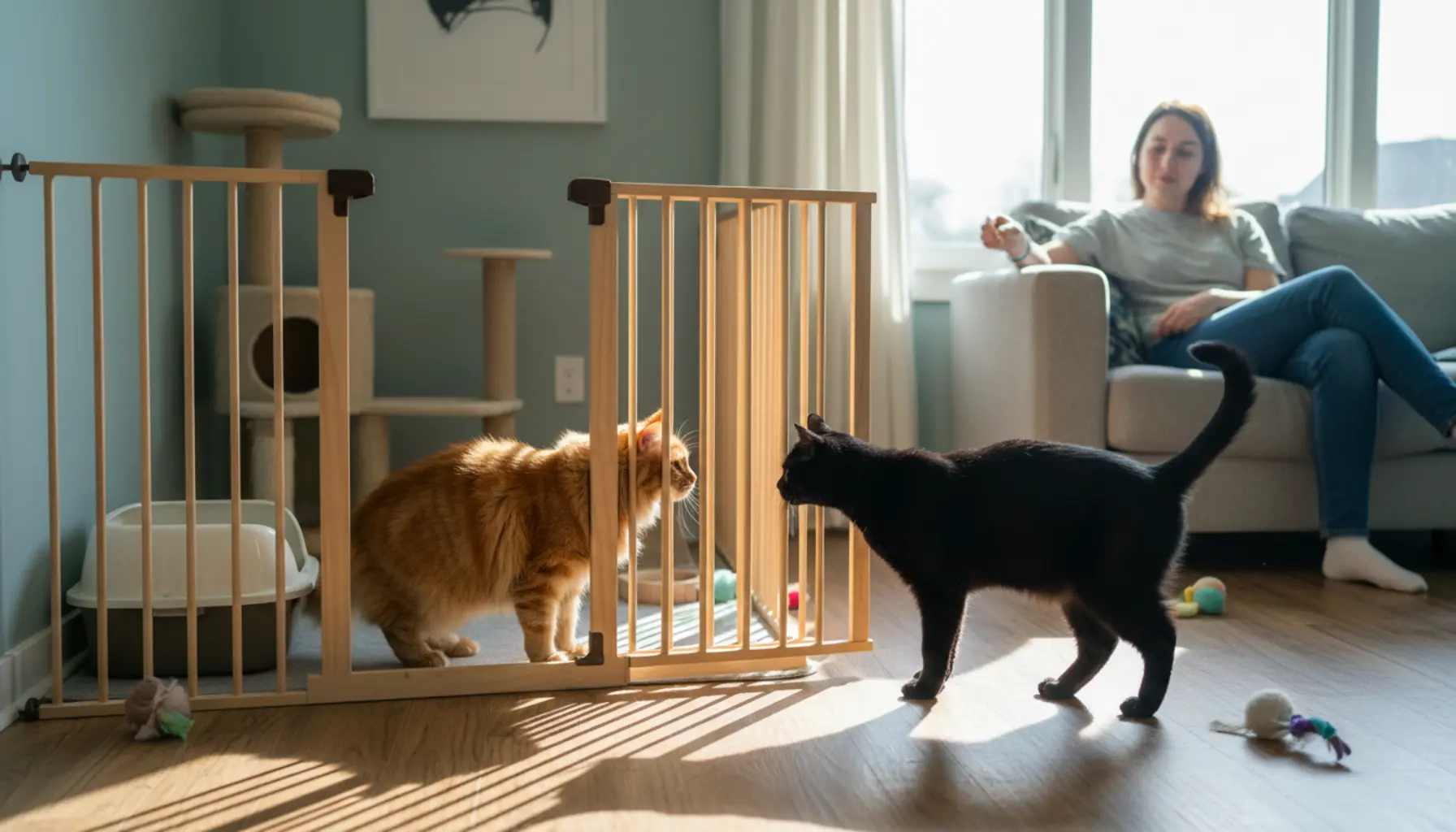
The next stage is controlled introduction of sound and visual stimuli, and only after that—first face-to-face meetings. Before opening the door, let the cats “chat” through a barrier: a door crack, grille, mosquito net, or a special gate that prevents physical contact but allows sound and visual exchange. Initially, such sessions may last only seconds, at whatever distance the cats consider comfortable—don’t force them with food or toys if they’re clearly not ready. If the resident just sniffs, wags their tail in curiosity, emits low purrs, and the newcomer withdraws but then returns to observe, slowly extend these sessions. A good practice is feeding both cats on either side of the barrier, at first far apart, then gradually moving bowls closer to the door or grille. Food thus becomes an agent for positive associations with the other cat’s presence. Next are brief, supervised meetings in the same space, ideally a “neutral” third room or the resident’s familiar room where several escape routes are available (shelves, boxes, hideouts). At first sessions, cats should be able to withdraw freely; owners should observe body language: ears tilted back, stiff tail, growling, freezing, rapid grooming may indicate growing tension. Mild hissing or rumbling is normal at first, provided it doesn’t escalate. Redirect emotions using the fishing-rod toy, tossing treats in various directions so the cats associate shared time with pleasant activities, not confrontation. Meetings should be frequent but brief—better to end them while cats are still calm than wait for conflict. As moods improve, gradually lengthen their time together, allowing free movement under human supervision. The final stage is transition to “shared life”—cats have full access to common areas, but keep resource redundancy (multiple litter boxes, bowls, beds, scratching posts) across the house to minimize future conflict. Even when cats seem to get along, keep building positive associations with joint play, feeding at a manageable distance, and ensuring each cat has a protected, inviolable resting spot—this consolidates socialization effects and helps prevent future tension.
Practical advice for owners
Practical implementation of socialization with isolation begins with a good daily plan and consistency—cats feel safer when things are predictable. Set a fixed rhythm: mealtime, play, and litter cleaning should be similar every day, and interactions with each cat planned separately to avoid anyone feeling left out. Ensure the new cat has several quiet, undisturbed daily socialization sessions with human company (petting, play, observing from a safe spot), while the resident gets as much attention as before the introduction—this prevents jealousy and loss of social resources. A helpful rule is “resident always first”: when you enter the home, greet and feed the resident before tending to the newcomer—this helps the current cat accept the change. Also control stimuli quality: if your home is loud (children, renovations, street noise), try to keep the isolation room as quiet and shielded as possible (curtains, screens, soothing music or white noise) to help the new cat settle. Keeping an observation log is useful: note dates, each cat’s reactions to various stages (scent swapping, door-crack interactions, first brief meetings), the intensity of stress signals, and incidents of conflict. This “log” helps detect patterns, plan next steps, and consult a behaviorist if needed. Don’t hesitate to step back if setbacks occur—it’s part of the process, not a failure. Maintain “scent hygiene”: use separate blankets, beds, and towels for controlled scent exchange, not unplanned “scent flooding”; avoid strong-smelling cleaners or air fresheners, which disrupt cat communication. Feed cats in separate locations—even after full integration, food and water bowls should be kept apart so cats can eat out of sight or with an alternate escape path. This lowers table-side conflict and lets cats feel safer. Maintain resources in excess: for two cats, have at least three litter boxes in different parts of the home (not side by side), plenty of beds and hideouts at various heights, two or three scratching posts, and observation spots by windows. Extra resources don’t make them lazy—on the contrary, it lowers territorial tension, as cats compete less.
An often-omitted practice is reading both cats’ body language and acting before aggression surfaces. Learn subtle signals: ears laid back, tense tail, hard staring at the other cat, freezing, frantic self-grooming or scratching can indicate growing stress. If you see these during meetings, calmly end the session—distract with treats or a toy and increase spatial separation, rather than waiting for hissing, swatting, or chasing. Never shout at cats or use physical punishment—it will increase fear and reinforce defensive aggression. Managing the “scene” works better: splitting cats with barriers (doors, gate), creating high routes (shelves, cat trees), and escape options for every situation. Lower your expectations—not every pair will be a snuggly bonded group sleeping in one bed; realistically, calm coexistence without chronic stress or fights is a success. In many homes, cats function as “housemates,” keeping distance and dividing up space—a perfectly good outcome. For shy or traumatized cats, consider synthetic pheromones (F3 diffusers, Feliway Classic, or similar) in areas they frequent; these lower the stress threshold but won’t replace good socialization. If you have children, teach them the rules: no chasing cats, no forced holding, don’t touch while sleeping or eating; explain that escape routes and hideouts are “off limits” to people. Also, pay attention to window or balcony safety (nets, guards), since in times of heightened tension, cats may bolt through ajar windows. Parallel play is a great practical tool—play with each cat in the same room, using two different toys at a distance; this way, both cats associate the other’s presence with a positive event, without resource competition. Over time, introduce “shared rituals” (e.g., meals initially far apart, then closer together, treat sessions when they calmly pass by each other in the hallway). If at any stage you observe chronic stress (cat hides most of the day, stops playing, eats little or overeats, soils outside the box, over-grooms), don’t ignore it—contact a vet to rule out health problems, and then a behaviorist to adjust the socialization process. Good cooperation with a professional and consistent use of these recommendations greatly increases your chance for a smooth introduction and stable group dynamic.
Avoiding common mistakes when introducing cats
The most common and costly mistake is rushing and skipping isolation, believing “the cats will work it out themselves.” This often leads to sudden conflict, entrenched fear, even ongoing hostility between cats. An owner who immediately lets the new cat into the living room or keeps it in a carrier in the center of the room bombards both animals with intense stimuli: strange scent, no ability to retreat, resident territory violation. Rather than curiosity, there’s soon fear—one cat may flee, the other may attack, hiss, chase, or try to drive the “intruder” away. Another common mistake is wrongly assessing the temperament and needs of your cats—choosing a companion “at random” with no thought as to whether the resident even tolerates other cats, has low enough fear, or what their play style is. Pairing a withdrawn, anxious senior with a lively young cat, without proper socialization planning, may create constant stress and threat. Another error is ignoring warning signs—owners assume “they’re just figuring it out” while dismissing a rigid body posture, hissing, blocking litter box access, avoiding certain hallways, or obsessive overgrooming. These are not “just setting ranks,” but signs of chronic stress that will worsen unless you step back in the process. Another typical mistake is insufficient resources—one litter box for two cats, one water bowl, one scratching post in the living room. Cats are highly territorial, so forced sharing of key resources leads to “guarding” bowls, blocking litter box access, pushing the weaker cat off the sofa or bed. Lack of vertical space (shelves, scratching posts, cat paths) increases conflict, as there are fewer ways to avoid each other or watch from a distance. Another pitfall is excessive human interference during first meetings—holding one cat to “show it” to the other, sitting them side by side, or restraining by the scruff to force “friendly” petting. This creates an association between human touch and stress, and leads to redirected aggression, as the cat, unable to escape, reacts by biting or scratching. Similarly, punishing for hissing, growling, or paw swatting is harmful—these are natural signals to avoid worse fights; suppressing them only robs the cat of warning tools.
Another frequent group of mistakes is to do with poor handling of associations and stimuli. Owners aware of the need to “introduce scents” often do it too intensely: rubbing one cat’s scent directly into the other’s fur, throwing the newcomer’s blanket onto the resident’s bed, changing the home’s scent overnight, flooding both cats with new stimuli. Socialization with isolation is about gradual, controlled dosing—scented blanket in the hallway, swap bedding after a few days, gentle “braiding” of scents with cloths, not sudden “scent blending.” Likewise, with sight and sound—curtains, mesh, or cracked doors are to allow observation, not to stage a dramatic “unveiling” of the new cat. A major error is inconsistency: one day, the cats are strictly isolated, the next, someone “tests” them together unsupervised because the owner caved to pressure. These disruptions set the process back and sometimes create new issues like urine marking or distancing aggression. Failing to take the health and condition of cats into account is another mistake—introducing a new cat when the resident is recovering from surgery, suffers chronic pain, hyperthyroidism, or untreated diabetes will raise irritability and lower tolerance. Meanwhile, ignoring the new cat’s prophylactic care (no exams, quarantine, infectious disease testing) risks both animals’ health and adds to stress. Add to this the owner’s emotional expectations—thinking cats “must love each other” and will sleep in a snuggly pile, causing disappointment, frustration, and pressure that runs counter to the animals’ pace. Remember, the goal is peaceful coexistence, not forced friendship. Finally, a pervasive if rarely admitted error is delaying asking for help—many owners watch tensions build for months before consulting a behaviorist, hoping it “will pass.” The longer a negative response to seeing the other cat is reinforced, the harder and slower it is to rebuild the relationship—sometimes, with deep aversion, only partial integration is possible, and lifelong partial separation is required.
When to consult a behaviorist?
During cat introduction, many challenges can be solved with patience, better spatial organization, and consistent socialization with isolation. However, there are moments when the help of an experienced feline behaviorist significantly increases the chance of success and helps prevent mounting problems. Ask for help already at the planning stage if your resident has a history of behavioral issues: severe anxiety, aggression (including redirected aggression to people or other pets), urine marking, compulsive over-grooming, persistent hiding, or excessive vocalization. A professional can assess if it’s even a good time for a new cat, suggest a compatible candidate, tailor a socialization plan to your home and household habits, and take into account factors that non-professionals often overlook—sensitivity to noise, scents, children, or other animals. A behaviorist is especially necessary if, despite proper isolation, tension appears: cats obsessively hover by the door, hiss and growl at any noise from the “cat room”; the resident starts spraying near the door, stops using the box, refuses food or compulsively overeats; the new cat refuses to leave hiding, freezes at human movement, avoids even eye contact, or each stimulus (door opening, footsteps in the hall) triggers an intense startle reaction (bolting, panting). Warning signs also include sudden behavioral changes in the resident after the new arrival: withdrawal in a normally sociable cat, apathy, irritability toward people, sleeping in unusual “emergency” places (high shelves, closets), avoiding favored activities, or changes in daily patterns (intense nighttime arousal, howling, pacing). Also remember, cats can manifest stress physically—recurring diarrhea, unexplained vomiting, poor coat condition, over-grooming of certain body parts, or a temporary lack of appetite require vet consultation first (to rule out disease) then often behaviorist support, as introduction-related stress is a leading trigger.
A clear sign help is needed is open conflict lasting more than a few days despite reverting to earlier socialization steps. If even short contact results in repeated claw and tooth attacks, chases, “hunting” the other cat, blocking escape routes, intimidation at the litter or food bowl, then there is a real safety risk and reinforcement of aggression. A behaviorist is needed here not only to “resolve conflict,” but to restore a sense of control for both cats, create new behavioral alternatives (like avoidance rather than attack), redesign resource distribution at home, and plan stepwise desensitization to the other cat’s presence. Seek help also if the process “gets stuck”—e.g., cats tolerate each other by scent, react calmly to sounds, but every eye contact leads to staring, stiff posture, low or tucked tail, flattened ears, and lingering tension for weeks, blocking more relaxed interactions. A behaviorist can help diagnose whether the issue is pace, stimulus introduction, a shortage of hideouts and exit routes, lack of parallel play and feeding routines, or if one cat has individual difficulties (poor kitten socialization, trauma, low arousal thresholds). Support is also recommended for introducing special needs cats—seniors, chronically ill, post-surgery, blind, deaf, mobility-impaired, or ex-strays with deep fear. Standard socialization protocols may need major adaptation, and individually tailored strategies (distance work, visual barriers, clicker training, veterinary-supported medication) greatly increase the chance of safe, though maybe not dramatically “friendly,” but stable, peaceful cohabitation for both cats.
Summary
Introducing a new cat to your home is a challenge requiring patience and a sound strategy. Socialization with isolation is a key process that must be stepwise for success. Preparing the right environment, scent swapping, and controlled meetings are fundamental to smooth integration. Avoiding common mistakes and understanding feline needs helps foster harmonious relationships. If difficulties arise, consult a behaviorist. Success lies in happy, integrated cats coexisting peacefully at home.

