

Tofu or corn cat litter is one of the most important choices facing a cat owner. The right litter affects your pet’s comfort, your home’s hygiene, and the convenience of daily cleaning. Discover the key differences and features of both types of litters to help make your decision easier.
Table of Contents
- Introduction to Cat Litters
- Characteristics of Tofu Litter
- Characteristics of Corn Litter
- Comparison of Both Litters’ Properties
- Impact on Cat Health
- How to Choose the Ideal Litter for Your Cat?
Corn Litter: Pros and Cons
Corn litter is another plant-based alternative to traditional mineral litters, gaining popularity among cat owners seeking more eco-friendly solutions that are convenient for everyday use. It is made from processed corn—most often from its core or cornmeal—which makes it fully biodegradable, and with an appropriate composition, it can be compostable as well. Its main advantage is excellent absorption: the granules quickly bind moisture, forming relatively compact clumps that are easy to remove with a scoop, resulting in reduced litter consumption and less frequent need to completely change the contents of the box. Many brands of corn litter are flushable, though you should always check the manufacturer’s recommendations and local plumbing regulations—not everywhere is this welcomed due to the risk of blockages or limitations regarding organic waste disposal. Another plus is low dust: compared to common bentonite, corn litter typically generates much less dust, which is appreciated by both allergy sufferers and cats with sensitive airways or after veterinary procedures. An additional benefit is the relatively light weight of the package compared to mineral litters—a large bag is lighter and easier to carry while being efficient, as the granules are very absorbent and retain their properties for a long time.
In terms of cat comfort, corn litter generally scores well in acceptance tests: the granules are medium-hard, don’t prick paw pads, and their natural, slightly grainy scent is often less irritating than the strong aromas of chemical additives. Odor neutralization can be very effective, especially in products that use ammonia-binding technology and natural additives that absorb unpleasant smells. However, as an organic material, corn litter can become a breeding ground for microorganisms when in contact with moisture—if the litterbox is not kept clean, it may start smelling sour or musty more quickly, so regular removal of clumps and freshness checks are crucial. Another advantage is its ecologically friendly aspect: production based on renewable raw materials and the potential for compost breakdown make it a more sustainable choice than classic bentonite or silica litters, though some critics highlight the use of corn as a food-competing resource, especially in regions with intense GMO cultivation; those who care about this should look for “non-GMO” or certified organic products. A significant drawback is the tendency of the granules to be tracked out on paws—the light structure and small size of the litter mean it can spread around the apartment, especially if the litterbox is shallow or lacks a mat at the entrance; this can be partially limited by choosing larger granules and a deeper litterbox with high walls. Some cats, especially young or greedy ones, may try to eat corn litter, tempted by its scent reminiscent of food or cereal flakes—usually, a small amount poses no danger, but constant nibbling may lead to stomach problems or the risk of intestinal obstruction, so in such cases, it’s better to consider another type of substrate. Also, keep in mind that in very humid conditions or when stored improperly (open bags, damp basements), corn litter can become moldy, which not only lowers its quality but can also be a potential health risk for cat and household members—for this reason, ensure storage in a dry, well-ventilated place and keep the packaging tightly closed. Pricewise, corn litter is usually in the mid to upper range—sometimes cheaper than the best tofu litters but more expensive than standard bentonite; its cost-effectiveness depends on the number of cats, their litter habits, and cleaning frequency. For some owners, limited availability of specific brands in smaller towns and quality differences between manufacturers can be a downside—cheaper products may not clump as well, break apart faster, and mask odor less effectively, which makes experiences with “corn” litter very different depending on the chosen product.
Wood Litter Alternative: Is It Worth It?
Wood litter has long been considered one of the most natural and eco-friendly options for cats, but its real value is revealed only when you look closely at its composition, mode of operation, and everyday use at home. It is usually produced from wood fibers (pine, spruce, sometimes beech), sawdust, or chips pressed into pellets or finer granules, making it fully biodegradable and often sourced from wood industry waste, which increases its ecological profile. In terms of absorption, wood litter performs very well—the natural wood structure absorbs moisture by binding it inside the fibers, and some brands produce clumping litter which, upon contact with urine, forms solid lumps that make cleaning easier. There are also non-clumping variants, where the pellet disintegrates into fine sawdust—this format requires a different approach: more frequent sifting and replenishing of the top layer. An important advantage of this type of litter is the natural, lightly woody scent that helps neutralize the unpleasant odor of urine, but remember that cats have sensitive noses and heavily perfumed versions (e.g., with essential oils) may bother them or even cause allergic reactions. Wood granules are usually very light, which makes them easy to transport and pour into the box but can also result in small pieces being scattered outside—especially if the cat likes to dig energetically. In practice, a litterbox with higher edges, covered or placed on a special mat that catches spilled granules, works well for wood litter. As for comfort, many cats appreciate the soft, springy structure of wood, which is gentler on paws than sharp bentonite granules, although some sensitive animals may react to wood dust—especially with cheap products without additional dedusting treatment.
When comparing wood litter to tofu and corn, it’s worth considering the practical and economic issues as well as the impact on the environment and home safety. In ecological terms, all three types are “green” options, but wood litter is often made from sawmill and workshop waste, allowing the wood to be reused and returning naturally to circulation rather than going to landfill. Many brands declare the possibility of composting used litter (without feces), and some owners dispose of small amounts in the toilet—although, as with tofu and corn, you should always check local regulations and manufacturer recommendations to avoid plumbing issues. Economically, wood litter usually sits between corn and tofu: it can be cheaper than high-quality tofu but more expensive than the simplest corn or bentonite variants; it’s more cost-effective if bought in large packs or heating pellets that are appropriately fine and unpalatable to cats. Regarding odor control, it deals well with neutralizing urine, but with poor cleaning, a characteristic “damp-wood” smell may develop, so daily lump removal or sawdust sifting—preferably every day—is vital for freshness. Cleaning convenience mainly depends on form: clumping wood litter behaves similarly to tofu, offering solid clumps that are easy to discard, while disintegrating pellet requires more work but absorbs moisture very well and is preferred by people sensitive to dust. Dust can be a downsides—lower quality products may crumble and dust, which isn’t good for feline or human airways; it’s best to choose low-dust or dedusted litters and avoid bags that obviously contain lots of fine particles. Another potential downside is its sensory attractiveness for some cats and kittens—the natural wood scent may encourage nibbling, although this is less common than with corn or tofu-based litters. For owners seeking to balance ecology, convenience, and cat acceptance, wood litter is a good compromise: it’s natural, relatively light, eco-friendly, and available at various price points, but before making a change, consider the specifics of your litterbox, your cat’s habits (how much it digs, sensitivity to scents and dust), and your own expectations for cleaning frequency and spent litter disposal method.
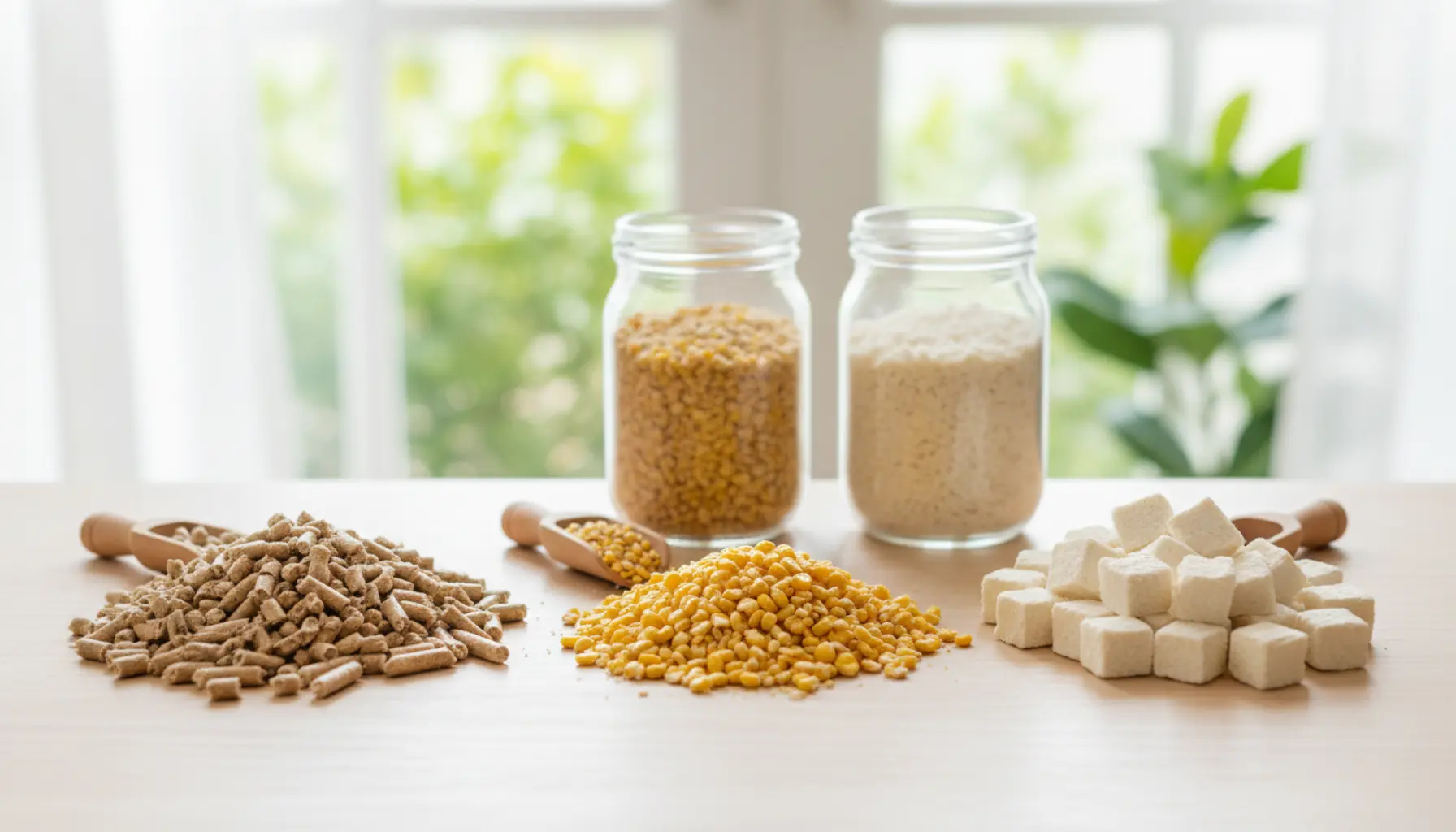
Comparison of Different Cat Litter Types
When choosing between tofu, corn, and wood litter, it’s important to look beyond price and “eco” marketing slogans, as each type behaves differently in daily use and impacts both the cat’s comfort and the ease of cleaning. As for absorption and odor control, tofu litters generally perform best—their structure allows for immediate liquid absorption and forming hard clumps that are easy to remove, resulting in less frequent need to replace all the litter in the box. Corn litter also binds moisture and odors well, but with less frequent cleaning, the box may gradually “overheat,” and the smell of corn mixed with urine can be noticeable for some. Wood litter effectively neutralizes ammonia scent thanks to the natural wood aroma, but its efficacy depends on form—non-clumping pellets break up into sawdust faster and require careful sifting, while clumping versions can match tofu and corn. In terms of dust and impact on respiratory health, high-quality tofu and corn litters typically have the edge—most brands strive for minimal dust, which allergy-prone owners and cats with sensitive airways will appreciate. Wood litter, especially cheaper varieties, may release more dust when poured or sifted, although premium options with tightly-pressed, low-dust granules exist. Granule structure and size are important: tofu and corn litters are typically smaller, lighter, and softer underpaw, but more likely to be tracked out of the box, while wood pellet is thicker and harder, so it stays in the box better, though sensitive cats may find it less comfortable on their paws.
In terms of eco-friendliness and disposal, all three are definitely more earth-friendly than traditional bentonite litters, but not to identical degrees. Tofu litter is usually made from waste or surplus soy, is fully biodegradable, and often compostable; many brands allow careful flushing of small amounts, though always check local regulations and product guidance to avoid plumbing issues. Corn litter is also biodegradable and often compostable, but as it’s plant-based, it can promote mold if not stored correctly—it needs a dry, well-ventilated location and tightly sealed bag. Wood litter, especially recycled from sawmill waste, is considered a very eco-friendly choice, and after use can often be composted (except for solid fractions, i.e. feces) or added to compost bins unless the producer adds synthetic fragrance substances. Operational cost differences stem not just from price per kilogram, but also efficiency—tofu, though generally the most expensive, can be very economical due to high absorbency and effective clumping; corn is most often mid-priced and offers a good price-to-efficiency ratio, while wood litter, especially in non-clumping form, may seem cheaper but needs full box changes more often. Don’t overlook safety and individual cat preferences—some cats eat plant-based litters, which with tofu and corn usually isn’t a big problem in small amounts, but should be checked with a vet, especially for cats with digestive disorders. Cats with sensitive paws may prefer soft tofu or fine corn granules over hard wood pellet, although some appreciate pellet as it doesn’t stick to fur and isn’t tracked around the house. Owner comfort is key: if minimal mess around the box is your priority, wood pellet will most often be superior; if fast cleaning and less frequent refilling is most important, highly clumping tofu or corn litter will be more practical; if ease of finding and affordable prices matter, wood and corn litters are usually easier to come by than specialist tofu variants.
Introduction to Cat Litters
Choosing the right cat litter is one of the most important decisions an owner makes, right after purchasing the litterbox, bowls, and food. Litter largely determines your cat’s day-to-day comfort, the cleanliness of your home, and even whether your pet will willingly use the litterbox or start avoiding it and soiling elsewhere. A well-chosen litter should combine several key qualities: high absorbency, effective odor binding, low dust, safe composition, and a manageable level of tracking outside the box. Traditionally, mineral litters—bentonite, sepiolite, or silica (so-called “silicon” litters)—have dominated the market, still frequently chosen for availability, familiar properties, and attractive pricing. However, more and more owners are paying attention to ecological concerns, cat health safety, and ease of daily cleaning, which is why plant-based litters like tofu and corn are growing in popularity. These use natural raw materials—agricultural waste or food industry byproducts—and thus can be biodegradable, compostable, and sometimes even partially flushable, which significantly enhances user comfort in small apartments. To understand why there is so much buzz about alternative litters, it’s helpful to review the basics: how major types of litters differ, the moisture and odor-neutralizing mechanisms they use, and how this impacts your cat’s health and comfort. Remember, a litterbox is a sensitive spot for most cats—a change in scent, underpaw texture, or even the noise granules make when covering waste can cause stress or avoidance. That’s why your choice should not be random or based solely on price or a store promotion but rather consider the cat’s individual preferences, age, health status (e.g., allergies, sensitive airways, urinary tendencies), and the lifestyle of household members. Also important is how often you can clean—the frequency of change needed varies between litters, some stay fresh longer but are heavier or dustier. Granule structure and size are crucial: fine, soft litters are generally more comfortable underpaw and better at absorbing moisture but may be tracked more; thicker granules limit tracking but may not be as readily accepted by delicate, indoor cats. A range of practical and behavioral factors affect your litter choice—especially if the current product has been used for years.
When analyzing litter types, it’s worth noting two primary categories: clumping and non-clumping litters. Clumping ones, including many bentonite and plant litters, form firm or semi-firm clusters on contact with moisture, easily scooped out while keeping most of the substrate relatively fresh—this is an economical and hygienic solution if the owner regularly removes waste. Non-clumping litters (often silica or some mineral types) absorb urine but don’t clump—for those, you’ll need to change the entire contents after a set period or when odor control fails. For your cat’s health and home cleanliness, dust and composition are also crucial: heavily dusty litters can irritate airways, especially for kittens, seniors, asthmatics, or allergic cats, and can settle on furniture and be inhaled by people. That’s why interest is rising in low-dust, unscented litters free of synthetic additives that could bother sensitive noses. Modern owners are increasingly aware of environmental aspects—traditional mineral litters require raw material mining (often by open-pit methods), are not biodegradable, and create waste, while plant-based litters come mainly from renewable resources and decompose faster. Disposal is another important feature: some plant-based litters, mainly tofu and corn, may be disposed of in the toilet in small amounts, subject to local regulations and plumbing capacity, which is a significant convenience for many apartment dwellers. Against this backdrop is the strategic question: which litter is the best compromise between human convenience, your cat’s needs, and environmental care? The answer is increasingly next-generation plant-based litters—especially tofu and corn—which combine high absorbency, good odor control, low dust, and greater delicacy for feline paws. But before comparing these two solutions by specific parameters, it’s important to remember the broader context—from rising environmental awareness to animal health and practical matters like ease of cleaning and long-term cost; these factors mean that for many owners, tofu and corn are the natural direction for change, not classic mineral litters.
What Should Guide Your Choice?
Choosing the right litter—whether tofu, corn, or wood—should start with careful observation of your cat and its individual preferences. Not every cat feels comfortable on the fine, soft granules of tofu, just as not all will like the larger, rougher wood pellets. Pay attention to how your pet reacts to texture—do they enter the litterbox willingly, avoid it, or scratch at the sides instead of burying waste? Cats with sensitive paws, older cats, or those overweight usually prefer finer, softer litter, while young and active cats often adapt to different textures. Sensitivity to allergies also matters—if your cat sneezes, tears up, or scratches more after a litter change, dust may be too high and it’s worth choosing a variant labeled “low dust,” more often met by quality tofu and corn litters. The number and size of litterboxes at home is equally important: for multi-cat homes with limited space, speed and ease of cleaning become priorities, so pay attention to clumping strength and stability. Tofu litters usually form tight, easy-to-remove clumps, appreciated by owners who clean daily but want to minimize full substrate changes. Conversely, non-clumping wood litters are better if you prefer to “sift”—clean granules remain on top, and sawdust residues are removed along with the bottom layer. Also consider your cat’s scent sensitivity: some wood and corn litters are naturally aromatic, pleasant to humans but overwhelming to cats. There, it’s better to choose unscented tofu or less intense corn litter, then observe if your cat uses the box without hesitation.
Another crucial factor is practicality—adapting the litter to your household’s lifestyle, cleaning frequency, and home environment. If you live in an apartment and cannot carry heavy bags of used mineral litter, lighter options—such as tofu, corn, or wood—will make life easier, especially since many are suitable for bio-waste disposal or composting (always check local regulations and manufacturer recommendations). Cleaning is not just about clumping but also how much the litter is tracked around—finer granules have a greater tendency to “travel” between rooms, so for tofu and corn, a litterbox with a high rim and an entry mat are helpful. Wood pellet usually sticks to paws less but can be noisy when burying waste, which matters in small apartments and for cats that are active at night. Health issues for household members also matter—if someone has asthma or allergies, picking a low-dust litter is essential, which is usually met by high-quality tofu and some corn litters. Finally, consider your budget and actual running costs: tofu may be the most expensive to buy, but its high absorbency means you change the box less often, which could balance the cost in the long run. Corn litters tend to be mid-priced, but lower quality ones soak up faster and may require more frequent changes, increasing the overall monthly cost. Wood litter, especially made from wood waste, is usually the most budget-friendly if you accept more frequent top-ups and possible odor control compromises. Finally, analyze the eco-impact: if minimal footprint is your priority, look for certified, renewable-resource litters free of chemical scents and bleaches. Tofu and corn usually offer good biodegradability, while wood—especially recycled—is in line with closed-cycle economics. The final choice is rarely a one-off decision—it’s wise to buy small packs for testing, observe your cat’s behavior and cleaning ease, monitor consumption over time, and only then decide which type—tofu, corn, or wood—best meets all these criteria at once.
Characteristics of Tofu Litter
Tofu litter is one of the most advanced substrate types for cat boxes, mainly made from soy flour and other processed soybean byproducts. Thus, it is fully plant-based, and in many cases, also edible and safe if accidentally ingested by cats. Tofu litter granules are usually light, smooth, and have a cylindrical or fine-grained shape, making them gentle on paws while being less likely to stick to fur than sharp mineral aggregates. One key feature is its very high absorbency—it can absorb multiples of its weight in liquids, forming firm, well-defined clumps. This structure enables easy cleaning: waste and soiled clumps can be quickly removed with a scoop, without needing frequent full substrate changes, which is both economical and practical. Many tofu litter brands offer scented variants—such as with green tea or lavender—but if your cat is sensitive, it’s best to choose unscented types to avoid discouraging litter box use. In terms of odor control, tofu litter excels at binding ammonia—urine is absorbed quickly, and unpleasant odors are trapped inside clumps, keeping the box relatively neutral-smelling for longer with good hygiene. Unlike many mineral litters, which tend to be very dusty, good-quality tofu litter is minimally dusty, benefiting both cats with airway problems and owners sensitive to dust or suffering from allergies. Another important feature is disposability—some producers allow small amounts of tofu litter to be flushed, as the granules break up in water and are biodegradable; always check the packaging instructions and local rules to avoid plumbing issues. Alternatively, used litter can be thrown away with household waste or, for products without added chemicals or fragrances, composted—a particularly attractive prospect for those concerned with environmental footprint.
In daily use, the lightness and consistency of tofu litter is key to both cat and owner comfort. Light granules are easy to carry, pour, and swap, but can be more easily tracked out of the box—especially if the cat digs energetically; in practice, this sometimes means mats in front of the box or more frequent sweeping. The finer the granules, the better they conform to paws, which many cats find pleasant, especially if they previously used sharp bentonite or coarse silica litters. Tofu litter also works well in homes with kittens, seniors, or immune-compromised cats; if swallowed in small amounts, it is generally safer than mineral litters—it doesn’t swell as much in the gut, contains no silica, and has no sharp edges. However, some cats, especially young ones, may treat scented granules as food, so it’s advisable to watch your pet closely for the first days after switching. Tofu litter also works well in closed litterboxes with a carbon filter, where its odor control is further improved, but in humid environments, ensure storage in a dry, tightly closed place to avoid dampness and mold. Compared with other plant-based litters like corn or wood, tofu often provides better clumping and a milder, “natural” aroma, which many sensitive owners enjoy. Its unit price is higher than basic bentonite, but its high efficiency—resulting from only removing the soiled clumps and rarely changing all the box content—means that monthly costs are often comparable or even lower. What sets tofu litter apart is the combination of user comfort and eco-friendliness: full biodegradability, plant-based raw materials, and the ability to compost or more safely dispose of it, making it an attractive option for those who want to minimize the waste generated by living with a cat without sacrificing convenience or home hygiene standards.
Cat Litter: Ecology and Economy
Eco-friendliness of cat litter involves more than the material it is made from—it’s about the full product life cycle, from raw material sourcing, through transport, to disposal at home. Tofu, corn, and wood litters belong to the group of plant substrates, which, compared to traditional bentonite, have a much smaller carbon footprint and don’t require energy-intensive mining. Tofu litter is typically made from waste products of the food industry (mainly soy remnants), fitting the closed-loop economy concept—rather than becoming landfill, the raw material gets a “second life” in the litterbox. Corn litters are made from ground corn, often from industrial crops, which some see as a flaw (food resource usage), but on the other hand, it’s an alternative to non-renewable minerals. Wood substrates, especially if produced from sawdust and sawmill waste, fit well with the “zero waste” idea—though it is important that it comes from unvarnished, chemical-free wood. Biodegradability is also key: tofu, corn, and wood litters break down significantly faster than bentonite, which in practice simply remains in landfills. Many plant-based litters can be composted (with attention to local rules and hygiene—fecal matter is best separated or used only for ornamental plants), reducing household waste. For city dwellers, flushing in the toilet matters—some manufacturers of tofu and corn litter say small clumps can be flushed, as long as this is done sensibly, and local regulations are checked. Generally, the lighter and more efficient the litter, the fewer packages needed, less plastic consumed, less frequent shopping, and fewer shipments, all lowering your environmental footprint. Ecology also affects the immediate home: less dusty, fragrance-free plant-based litters reduce the risk of respiratory irritation for cats and humans, especially in small apartments and families with children or allergy sufferers.
The economics of cat litter can be more complex than the price tag alone, so it’s worth considering the “monthly cost” and usage efficiency. Tofu litters are often among the most expensive per kilogram, but their high absorbency and clumping strength mean relatively little is used—fluids are bound into solid, easily removed lumps, so you swap the full box less often, only topping it up. For many households, this translates to a lower actual cost over several months than much cheaper-at-the-outset bentonite or non-clumping wood litter, which needs full changes more frequently. Corn litter is usually mid-priced and also efficient, though with poor box hygiene it may smell sooner, requiring earlier replacement. Wood substrates can be among the most affordable solutions, especially in non-clumping versions, but whether they’re economical depends on the number of cats and your cleanliness standards—frequent changes can eliminate the initial savings for those more demanding on hygiene. Add in “hidden costs”: lugging heavy bags more often, more waste to dispose of, more time cleaning up tracked granules or worn-out litter mats if the substrate is loose and sticky. Convenience can be seen as a time-economy: clumping plant litters, especially tofu, make daily cleaning much quicker, and less frequent full box changes mean less work and less strain on your plumbing or garbage system. In the eco-economic context, consider your packaging: large paper bags or reusable containers reduce plastic and often offer a better per-kilo price. Ultimately, the best value in litter balances buying price, change frequency, cat comfort (since a cat that refuses a substrate may soil elsewhere, causing extra costs and problems), and environmental impact, which translates not just to less waste but also to better home air, less water to wash the box, and greater owner comfort overall.
Characteristics of Corn Litter
Corn litter belongs to the group of modern plant-based substrates for cat boxes made mainly from processed corn—usually cornmeal, bran, fiber, or starch. This raw material is often a byproduct of the food industry, increasing its appeal from a sustainability viewpoint. The granules are usually small cylinders or irregular grains of a light, yellowish color and a relatively lightweight structure. In effect, corn litter bags weigh much less than bentonite equivalents for the same volume. The light granules track out on paws more easily, so many manufacturers produce more compact, cylindrical shapes or use ingredients to limit tracking. Depending on the recipe, corn litter may be clumping or non-clumping, though clumping types are most common—the corn starch binds urine into tight clumps that are easy to remove with a scoop. A main feature is very high absorbency, reaching even several times their own weight, which means less litter is needed to fill the box and less frequent full changes. Odor is neutralized on two levels: mechanically, by quickly absorbing moisture and limiting bacterial growth, and chemically, thanks to natural plant fibers that bind ammonia. Some products also include bacteriostatic additives or natural plant extracts to boost deodorizing effect. Unlike many heavy mineral litters, corn litter is usually low-dust; granulation and dedusting processes largely remove fine dust at the production stage. This is a valuable advantage for cats with sensitive airways as well as owners with allergies. However, quality between brands varies—cheaper products may dust more or contain irregular, sharp-edged granules that aren’t as comfortable for paws as the smooth premium cylinders. Corn litter’s scent is usually naturally grainy, which some cats tolerate well and may associate with food. For this reason, young, curious cats may try to eat it, especially when the product is additionally scented with vanilla or other “tasty” aromas—hence the recommendation to observe your cat’s behavior after introducing a new litter.
From a safety perspective, corn litter is relatively friendly, especially compared to classic bentonite litters with silica, which can pose a risk if swallowed. Corn is a plant material that typically passes through the cat’s digestive tract in small amounts without issue, though it’s not intended for regular consumption. For kittens and cats that tend to lick or eat litter, this can be safer than heavy mineral gravel. Another important feature is high biodegradability—corn litter can, in most cases, be composted (always check your local laws and producer guidance) or disposed of with bio waste if permitted. Some brands claim their product is flushable, which is convenient but should be done cautiously: plumbing in many buildings is not meant to handle larger amounts of organic material, and over-flushing could cause blockages. From an ecological perspective, correct storage is also important—corn readily absorbs moisture, and in poorly ventilated or damp areas may mold. Open bags should be tightly sealed and kept in a dry, ventilated place, ideally in a closed container. Mold not only affects absorption but also health, for both cats and people, triggering allergies or respiratory issues. In practical use, users appreciate corn litter’s efficiency—owing to high absorbency and good clumping, you can often use a thinner layer in the box than with traditional substrates, and daily clump removal keeps the box clean for longer. The lightness of the granules does lead them to “travel” more around the house and may require mats before the box. Ultimately, user comfort depends not just on litter type but also product quality, granulation, and choice of open or closed box, high rim, or sieve inserts to separate clean from clumped granules.
Comparison of Both Litters’ Properties
When comparing tofu and corn litter, the primary functional differences are in absorbency and clump stability. Tofu litter, based on soy fibers, rapidly soaks up urine and forms firm, hard clumps that don’t break when scooped. This leads to less total usage, since only soiled portions are removed, keeping the rest of the litter fresh for longer. Corn litter is also absorbent and clumping, but the resulting clumps may be more fragile—especially with cheaper products or with too thin a layer in the box. In practice, this can mean more frequent sifting and more detailed cleaning to prevent residue buildup. Odor control is another difference: tofu typically binds ammonia better, keeping the box neutral for longer, particularly appreciated in small apartments. Corn litter works well at first but with less frequent cleaning or high humidity, its effectiveness can wane, and prolonged exposure can cause a “pickled corn” scent. There are also physical differences: tofu granules are usually thin, smooth rods, gentle for cats, especially those with sensitive pads. Corn granules can be more irregular and sometimes sharper, which may not bother most cats but could deter very sensitive ones; for this reason, tofu is often recommended for kittens, seniors, and post-surgery animals where paw comfort is crucial. In terms of accidentally eating the litter, both are much less problematic than mineral litters, but there are different temptations: tofu, especially those with strong scents (milk or fish), as well as corn’s natural sweetness, may both be mistaken for food by curious or young cats. Their plant-based nature means small amounts usually pass through the gut, but repeated eating may cause digestive disorders. Owners should watch their cat after introducing new litter and, if necessary, choose unscented variants and store the bag tightly to avoid extra attraction.
Other differences between tofu and corn also appear in daily use for both cat and owner. Both are lightweight, but tofu is usually slightly lighter, making transport and changing easier but also increasing tracking. In practice, a mat outside the box or a box with a higher rim is helpful to limit tracking with tofu. Corn litter, depending on grain size, may track less, but with finer granules, the issue is similar but often slightly less pronounced. Dust-wise, high-quality tofu is virtually dust-free, which allergy-prone owners and respiratory-issue cats will appreciate. Corn is also marketed as low-dust, but with lower-quality brands or disintegrated remains, there may be slightly more, especially when pouring. Both options are more eco-friendly than bentonite. Tofu is fully biodegradable, often flushable in small amounts (if allowed by the producer and local rules), and after use can be composted, if not used for edible plants. Corn litter is also compostable, but its plant structure makes it susceptible to mold if stored improperly—storing it in a dry place and not leaving dirty clumps for too long is essential. Price and efficiency differ as well: tofu is generally more expensive per unit, but tight clumps reduce real usage and may lower monthly costs compared to corn. Corn litter is usually mid-priced, and its cost-effectiveness depends on quality—cheaper brands lose absorbency faster, requiring more frequent full changes. Both types come in scented and unscented versions, but for scent-sensitive cats, neutral variants are preferable, as strong scents may overwhelm the litterbox’s natural odor. To summarize, tofu usually delivers better odor control and firmer clumps but tracks more, while corn is a slightly cheaper, equally ecological option, requiring more attention to hygiene and storage conditions to maintain optimal absorbency and scent properties.
Impact on Cat Health
The choice between tofu and corn litter directly affects your cat’s health, especially if the animal suffers from allergies, has sensitive airways, or is prone to eating litter. Mineral litters, like bentonite, are known for high dust and silica content, which can irritate airways in kittens, seniors, and asthmatic cats. Both tofu and corn score much better—they are low-dust, contain no sharp, irritating mineral fractions, and are generally well tolerated in daily use. The differences, though, show in how they behave when wet, how long they stay fresh, and the risk if swallowed. Tofu, made from processed soy, is fast-absorbing and forms firm clumps, limiting contact time for paws and fur with moisture and bacteria—meaning less urine “sits” in the litterbox, which is useful for cats with bladder problems and sensitive skin. Corn litter also absorbs well, but with irregular cleaning and high humidity, its granules can break down, soaking like a sponge, creating an environment conducive to bacteria and yeast growth. For cats predisposed to urinary infections or paw pad inflammation (pododermatitis), not just the type of litter but cleaning frequency matters—a stricter regime is needed with corn to avoid contact with damp, softened substrate. For contact allergies, most cats tolerate both types well, but very sensitive individuals may display soy or corn protein allergy—manifesting as paw itching, between-finger licking, reddened skin, or increased scratching after box visits. In such a case, test a temporary switch to another plant-based substrate, such as wood, and observe whether symptoms subside; if so, sensitivity to a specific raw material is likely. Another health aspect is the presence of scents and chemical additives. Some manufacturers offer scented tofu and corn litters—green tea, lavender, fresh air. While humans may like these, for cats’ highly sensitive noses, intense fragrances may be overwhelming—the cat may avoid the box, hold urine, raising the risk of cystitis, crystal formation, or recurring urinary problems. Mildly scented or unscented tofu is generally accepted best by sensitive cats, while with corn, beware especially of cheap, highly perfumed products. Concerning respiratory health, one big advantage of premium tofu is very low dust—fine dust clouds, rising when pouring, can intensify coughing, sneezing, and eye-watering in asthmatic cats. Corn is generally low-dust too, but cheaper variants may have more fines, which with digging can get airborne. If your cat sneezes after each visit to the box, sift a little litter and see how much dust remains—in high-end tofu, it’s usually noticeably less.
One particularly important topic is safety if the litter is swallowed, mostly concerning kittens, greedy cats, or those “testing” new textures with their mouths. Both tofu and corn are much safer in this respect than bentonite, which can expand in intestines and cause blockages. Soy and corn granules soften and pass through the gut in small amounts, but as with any substrate, risk rises if cats eat a lot—especially with highly absorbent, clumping litters. With tofu, the risk of confusing it for food rises if it is shaped like “crunchies” and strongly scented (e.g., milky, fishy, green tea); with corn, it’s the natural sweetness that’s tempting. Warning signs after nibbling are vomiting, loss of appetite, abdominal pain, or lack of stools for more than 24 hours—in such cases, see a vet. As a precaution, for kittens, cats with pica (object-eating habit), or digestive disorders, an unscented tofu litter with simple composition is safest; after switching, monitor litter visits for a few days. Another rarely discussed health risk is microbiology—plant-based litters in damp environments can encourage mold and bacteria. Corn, stored in damp conditions or open bags, is especially at risk for mold, whose spores can irritate both cats’ and humans’ respiratory tracts and skin. Tofu is slightly more stable but still must be kept in a tightly sealed, dry location—not in kitchens or bathrooms, where humidity is high. In the litterbox, leaving damp lumps too long promotes bacteria, detected as a characteristic “sour” or musty smell. Feline urinary diseases like idiopathic cystitis (FIC) or recurring bacterial infections are very common, so limiting contact with dirty litter has real value for prevention. For joint and spine comfort, especially in older cats or those with dysplasia, arthritis, or post-orthopedic surgery, the soft, smooth tofu rods are more tolerable than some rougher corn granules—the cat enters the box more willingly and is less uncomfortable standing or digging. Also pay attention to litter depth: with tofu, a slightly lower layer is enough, because clumps are compact, reducing pressure on toes and joints during digging. Ultimately, not only the choice between tofu and corn—but also daily practice—matters: cleaning frequency, dust level when pouring, presence of colorants, fragrances, anti-bacterial additives, storage method, and attentive observation for subtle signs of discomfort, such as box avoidance, vocalizing during urination, excessive licking, or sudden “accidents” outside the box.
How to Choose the Ideal Litter for Your Cat?
Choosing the ideal litter starts with close observation of your cat—they are the main “reviewer” of the substrate before you. Pay attention to your cat’s preferred toilet surfaces (garden sand, flowerpot soil, carpet, doormat)—this hints as to whether they’ll prefer fine, loose granules (typically tofu or fine-grain corn) or larger, more tactile ones (often wood pellet). Kittens and sensitive cats, those with joint issues or recovering from surgery, typically tolerate the very soft, smooth tofu granules better, which don’t “pinch” pads or get stuck between toes. Confident adult cats usually accept both tofu and corn, but may have a clear preference for scent—some do not tolerate aromatic additives, even if pleasant to humans. Thus, the first rule is to pick unscented or very gently scented formulas, and avoid brightly colored granules, which tend to contain more chemicals. If your cat tends to lick or nibble litter, especially after a change, go for the simplest label, without unnecessary flavor additives—important especially for corn litters, which might seem like food to the cat. Health is the next pillar: for skin allergies or suspected soy or corn allergies, try other plant-based options (such as wood) or test selected litters in a small pack, monitoring skin, ears, and box habits. For asthmatic, chronically sniffling cats, or those recently recovered from respiratory infections, lowest possible dust is a must—here, quality tofu and well-pressed corn litter have the edge, with no “cloud” rising during scooping. Also assess how much your cat digs: energetic “diggers” need a litter that doesn’t scatter and forms hard clumps, so waste doesn’t break up and mix with clean substrate.
Your daily habits and home conditions matter just as much. If you live in a small apartment, scent control and easy cleaning will be crucial—often the best choice is tofu litter, which quickly forms small, tight clumps and binds ammonia effectively, keeping the home free of the strong cat urine smell. In larger homes, with more boxes, and good ventilation, you may opt for corn litter with slightly weaker odor control, provided you remove soiled granules regularly and top up more often. Think also about how often you can realistically clean: if daily scooping is routine, go for strongly clumping tofu, which works best with such hygiene. If there are days you’ll skip, choose substrates that can withstand a bit of negligence without a major drop in odor control—again, premium tofu does this best; corn, with prolonged moisture, can “start to work” microbiologically and go moldy, especially in a warm bathroom. Logistics and budget also play a role: lighter plant-based litters are much easier to carry, especially if you live without an elevator or order bigger packs online. Calculate real monthly usage—not just bag price but also efficiency: how long does the litter last, how well does it clump, how much ends up in the bin. Tofu, though seemingly pricier, often lasts longer thanks to clumping, as you only remove clumps and keep the rest clean. With corn, you may use more due to fragile clumps and the need to change the top layer more. Don’t ignore ecology or disposal—if you can compost, plant-based, additive-free litters are highly attractive; if considering flushing, check manufacturer guidance, local law, and your pipework, as even “flushable” litters may cause blockages in older systems. The best approach is to test: pick 2–3 products meeting your criteria (e.g., tofu and corn from different brands), introduce them gradually, mixing with the old, and observe which case your cat uses more readily and calmly, is less fussy, spends less time in the box, and whether it’s actually easier to keep the smell and home fresh.
Summary
Making a decision between tofu and corn litter requires analyzing several factors. Tofu litter is soft and gentle for your cat’s paws and biodegradable, making it eco-friendly. Corn litter, on the other hand, offers better clumping and odor neutralization, making daily litterbox maintenance easier. The ultimate choice should consider the cat’s preferences, owner’s needs, and the litter’s impact on the pet’s health. Trying both options to see which better meets your expectations is a good idea.

