

The Balinese cat is a unique domestic cat breed that impresses with its oriental appearance, semi-long hair, and extremely sociable disposition. Discover what sets the Balinese cat apart, how to take care of it, and for whom this breed is the best choice!
Discover the Balinese cat – breed description, character, care, price, appearance, and tips for future owners. Find out if the Balinese is for you!
Table of Contents
- Balinese cat – origin and breed history
- Balinese cat appearance – special features
- Characteristic and temperament
- Care and health requirements
- Balinese cat price and where to buy
- Balinese cat at home – who is this breed for?
Balinese cat – origin and breed history
The Balinese cat, despite its exotic-sounding name, is not a breed originating from Bali or any other part of Indonesia – its roots are closely associated with American and European Siamese cat breeding. The breed emerged relatively recently, in the 20th century, as a result of planned selection of long-haired Siamese individuals. The first cats with characteristic semi-long coats began appearing in Siamese litters at the beginning of the 20th century, mainly in the United States and Great Britain. Initially, they were considered a “freak of nature” or the effect of a spontaneous gene mutation responsible for hair length. Kittens with longer fur were often excluded from breeding plans, sold as “household pets”, or even banned from shows, as they didn’t fit the very explicit Siamese standard of the time. However, some breeders eventually saw their potential – the elegant silhouette of the Siamese combined with a softer outline of the coat, reminiscent of an oriental breed with a more “gentle” look. In the 1940s and 1950s in the USA, the first organized attempts to preserve this trait were made by breeding long-haired Siamese cats together. Importantly, the roots of the Balinese breed lies solely in Siamese cats – no other long-haired breeds such as Persian or Angora were introduced, which is crucial for pedigree purity and maintaining the characteristic Siamese temperament. The first breeding lines were developed mainly on the west coast of the United States, where a few enthusiastic breeders began keeping meticulous records and selecting for harmoniously built bodies, silky but not overly fluffy coats, and classic colourpoint markings. Gradually, a distinct type of cat emerged which, although visually close to the Siamese, was notably more “balletic” in lightness, with a feathery tail and softly draping fur.
The name “Balinese cat” was inspired by the grace and elegance of these animals, reminiscent of Balinese dancers – thus, it has no historical or geographical link to the island of Bali. This exotic name was also a marketing strategy: breeders wanted to clearly separate the new breed from the traditional Siamese, avoiding negative connotations with a “deviation from the standard” as long-haired kittens in Siamese litters had previously been deemed. A key figure in the breed’s history was American breeder Helen Smith, who in the 1950s actively promoted Balinese cats, describing them in the industry press and advocating for their official recognition. She helped popularize the name “Balinese” in the felinological world. In 1961, the breed was officially recognized by the first major organization – the American Cat Fanciers’ Association (ACFA), with additional federations soon joining, including the CFA (Cat Fanciers’ Association). Balinese cats appeared somewhat later in Europe, but quickly gained fans in Great Britain, Scandinavia, and Germany, where breeding lines closely related to the Siamese and oriental were developed. Over time, some felinological federations began distinguishing color varieties – traditionally, the Balinese cat appeared only in classic Siamese points (seal, blue, chocolate, lilac), while other colourpoint colorations, such as red, cream, or tabby, were classified as a separate but related breed – Javanese. This distinction still causes confusion; depending on the federation, the Balinese may be recognized more narrowly or broadly in terms of color palette. Modern breed history is mainly about preserving the typical Siamese temperament – lively, communicative, and highly sociable – alongside elegant, slender body type and semi-long, silky coat without undercoat, distinguishing the Balinese from heavier long-haired breeds. Many breeding programs still allow controlled outcrossing with Siamese and Oriental Shorthair cats, to reinforce desired oriental traits and broaden the gene pool while preserving a filigree appearance and characteristic, springy movement. As a result, the Balinese cat remains true to its Siamese ancestors while constituting a clearly separate breed, prized for its unique combination of exotic beauty and sociable temperament.
Balinese cat appearance – special features
The Balinese cat instantly captivates with its slim, almost sculpted figure combined with softly falling, semi-long hair. It is the contrast between the delicate body line and the fluffy “plume” tail that gives the Balinese such an elegant and exotic look. The body structure is typically oriental: a long, graceful torso, slender yet well-muscled limbs, with small, oval paws. Males are generally a bit larger and more robust than females, but still retain subtlety and lightness of movement. The Balinese cat’s neck is long and slender, flowing smoothly into the characteristic wedge-shaped head, which tapers from the wide base at the ears towards the nose. The most prominent feature is the large, widely spaced ears – broad at the base, set high, often visually “lengthened” by tufts of fur. These large, open ears form, together with the chin and nose, a distinct triangular head shape typical for oriental breeds. Balinese cat eyes are intensely blue – the deeper and more saturated the shade, the higher the show rating. The eyes are slightly slanted, set in line with the nose and ears, giving the gaze an impression of sharp intelligence, yet a gentle look. Eye color is a strong distinguishing feature of the breed – lack of deep blue or eyes of another color is considered a flaw by breed standards.
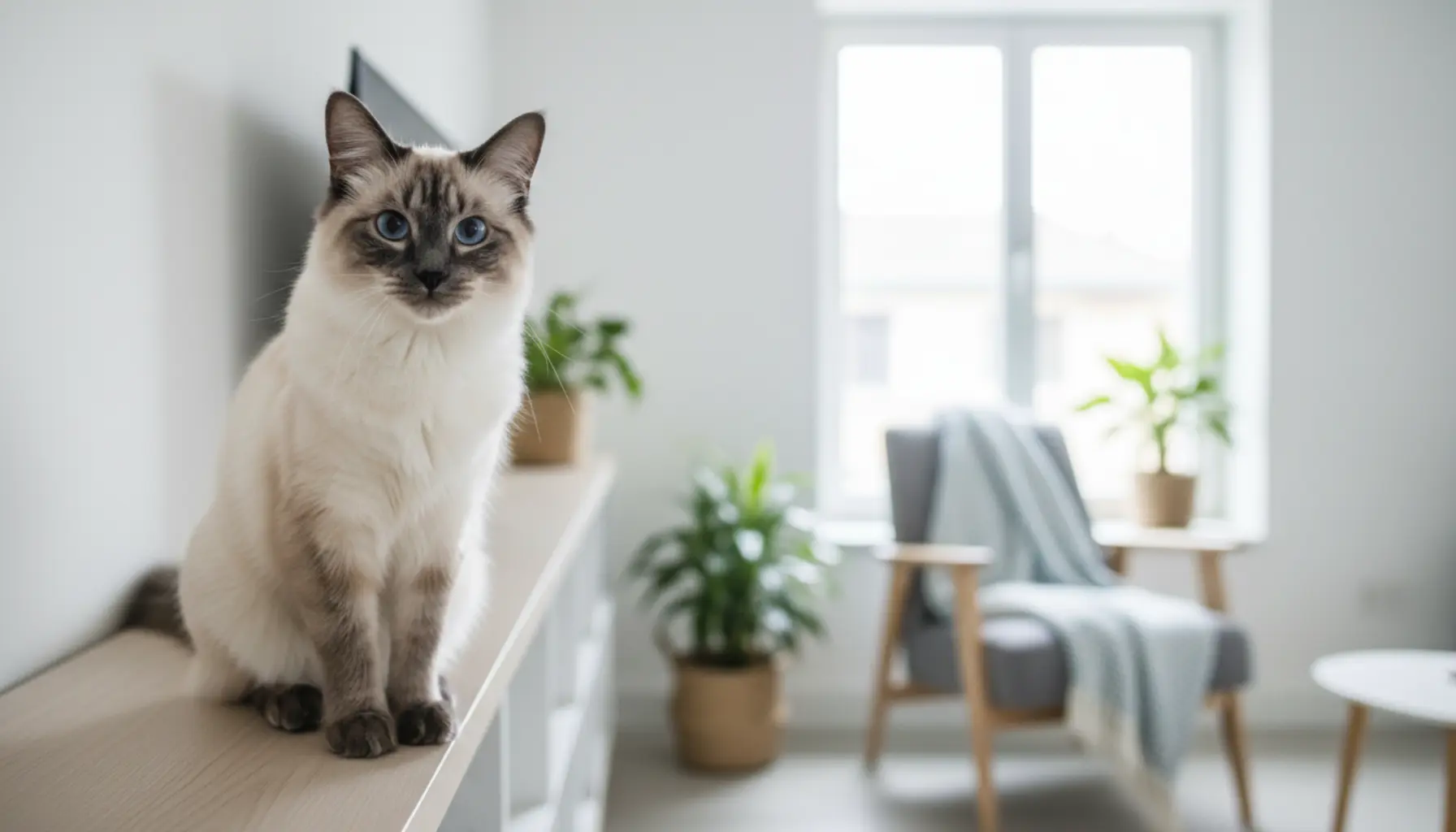
The Balinese cat’s coat is semi-long, silky, and lacks a thick undercoat, which differentiates it from typical long-haired breeds such as the Persian or Maine Coon. The hair is very soft and flowing to the touch, gently clinging to the body, and when the cat moves it falls into natural waves, emphasizing the slim silhouette. The most spectacular part of the coat is the tail – long, thin, richly covered with longer hair, creating a “plume” or feather-like effect. The tail is usually carried high, further highlighting the Balinese’s self-confidence and slightly cheeky personality. There is often a delicate “collar” ruff around the neck, especially in adult males, although not as rich as in typical long-haired breeds. The skin and coat show the characteristically Siamese colourpoint pattern – a lighter body color with darker points (face, ears, legs, and tail). Typical color varieties include seal point (dark brown on a cream background), blue point (cool blue-gray on a pale body), chocolate point, lilac point, and increasingly popular red, cream, or tortie points accepted by some cat associations. With age, the body color in many Balinese cats may darken slightly, but the contrast between body and extremities should remain visible. Breed standards strictly define body proportions: the cat can’t be stocky or heavy, but excessive thinness is also undesirable. Average body weight is about 3 to 4.5 kg, but the most important are harmonious proportions and the overall impression of lightness and elegance. The Balinese walks with springy, fluid steps reminiscent of a dancer – when walking, the tail is often upright and the silhouette maintains a distinctly elongated line. Due to close relation to the Siamese, there is variation in body type depending on lineage – some individuals are more “classic” with softer head shaping, others extremely oriental with a very elongated profile and exceptionally large ears. The common denominator is always the smooth, semi-long coat, blue eyes, contrast point coloring, and an overall impression of harmony, slimness, and extraordinary grace, thanks to which the Balinese cat is often called the “long-haired Siamese in haute couture edition.”
Characteristic and temperament
The Balinese cat is one of the most sociable and vocal breeds – it is definitely not a “decorative” pet, but a full-fledged family member actively participating in the daily life of the household. The Balinese forms strong bonds with people, often choosing one “favorite” person to follow everywhere like a shadow, but readily interacts with the rest of the family as well. This is the type of cat who greets its carer at the door, “tells” them about its day, and suffers if ignored. Its vocalization is compared to the Siamese, but many owners stress that the Balinese’s voice is somewhat softer and more melodic. Still, you should expect your Balinese to vocalize frequently – seeking attention, food, play, or simply commenting on whatever is happening around. Unlike many other breeds that prefer distance, the Balinese adores physical contact: it sits on laps, sleeps in bed, rubs against your face, and may even “hug” the neck with its paws. This cat truly needs closeness, and if deprived of it, may become frustrated and even develop problematic behaviors such as excessive meowing, urine marking, or anxious over-grooming. On one hand, this makes the breed perfect for people working from home, retirees, or families spending a lot of time together; on the other hand – it is completely unsuitable for people who leave the home empty for many hours each day. Balinese cats generally get along well with children provided they are taught to treat animals gently; they participate eagerly in play, like to be at the center of events, and rarely hide from noise or guests. They also tend to be tolerant with other cats, especially equally sociable and active breeds, and with proper introduction can do well with dogs. However, companions must not be overly dominant, as the Balinese’s sensitive spirit won’t tolerate ongoing stress, bullying, or aggression from other animals.
In terms of temperament, the Balinese cat combines the qualities of an “eternal kitten” with intelligence and a high need for mental stimulation. This is an extremely active, agile, and inquisitive breed – a Balinese will explore every nook of the house, look in cupboards, watch the owner’s hands in the kitchen, and even try to “help” with daily chores, which can be both cute and slightly troublesome. High intelligence means the cat easily learns simple commands (coming when called, “give paw”, fetching a favorite toy) and also responds to its name, gestures, and the owner’s tone of voice. If not provided with sufficient tasks, it will find them itself, such as opening cupboards, pushing objects off shelves, or biting plants. Therefore, an enriched environment is crucial: cat trees, high shelves for climbing, interactive toys, tunnels, and daily play sessions with a human. Balinese cats have a reputation for being “emotional” – they quickly sense their owner’s mood and can adjust, are sometimes jealous of attention, and are not always willing to share their human with other pets or… a laptop. Their strong need for closeness and constant contact can lead to separation anxiety if suddenly left alone for long hours. Therefore, a prospective owner should realistically assess their lifestyle. Note also that this breed is not particularly “couch potato” – even though the Balinese loves to sit on a lap, it won’t just nap most of the day; it expects interaction, conversation, walking around the apartment, or playing hunting games. For this reason, it does well in homes with more than one animal, as a companion (ideally another cat with a similar temperament) can satisfy part of its social and activity needs. While Balinese cats are generally confident and outgoing, they are sensitive to loud sounds, shouting, or chaotic atmospheres – too much noise and lack of routine can stress them. The breed values predictability and rituals: regular feeding times, consistent play sessions, evening cuddling routines. If an owner can provide this, in return they get a highly devoted, loyal, and engaged cat, often compared to a dog in loyalty and willingness to cooperate, though retaining typical feline independence and a touch of mischief.
Care and health requirements
Despite their impressive appearance, Balinese cats do not belong to breeds that are particularly difficult to care for, but they do require consistent grooming and awareness of specific health needs. Their semi-long, undercoat-free hair has a tendency to “fall into place” naturally, so usually thorough brushing 2–3 times a week with a soft bristle brush or smooth-toothed metal comb is sufficient. Regular grooming removes dead hair, reduces shedding, and lessens the risk of hairballs in the digestive tract, which is important in active, self-grooming Balinese cats. During heavy shedding periods, usually in spring and autumn, you can use a gentle furminator or denser comb, but without aggressive “combing to the skin,” so as not to irritate the skin. Baths are not necessary if the coat is well-maintained and the cat has no skin problems, but occasional baths with a good longhair shampoo may help in cases of soiling or before a show; always rinse the cosmetic thoroughly and dry the coat completely to avoid catching a chill. In addition to the coat, ear hygiene is important – due to their large, widely spaced ear flaps, wax and dust may accumulate faster, so once every 2–3 weeks they should be gently wiped with a cotton pad moistened with a veterinarian-recommended liquid, never a cotton bud inserted deep into the ear canal. Similarly for the eyes – slightly teary corners can be wiped with a cotton pad soaked in boiled water or saline, using a separate pad for each eye to reduce infection risk. Do not forget claws, even if the cat uses scratchers; every 3–4 weeks they should be gently clipped, especially in indoor cats, to avoid ingrown nails or catching on fabrics. Care also includes oral hygiene – Balinese, like many oriental cats, can be prone to tartar build-up, so ideally kittens should be trained young for regular brushing with special cat toothpaste and have their gums checked routinely at veterinary visits. An important part of health care is a high-quality diet: well-balanced food rich in animal protein, suited to age, activity, and any illnesses, constant access to fresh water (preferably from a fountain, which many Balinese adore), and avoiding overfeeding – the breed’s slim figure loses its proportions easily with too many calories and too little exercise.
In general health terms, the Balinese is considered a relatively resilient breed, but – as with all oriental-type cats – may show predispositions to certain conditions that are best prevented through proper prophylaxis and responsible breeding. Possible issues include hereditary heart diseases (e.g., hypertrophic cardiomyopathy), neurological disorders, dentition defects, or tendency toward periodontal disease. Therefore, choosing a responsible breeder doing genetic and cardiac testing of the parents is key to the health of the future kitten. Regular veterinary check-ups – minimally once a year, and for older cats every six months – enable early detection of abnormalities, blood tests, urine, and abdominal ultrasound as needed. A current vaccination schedule against infectious diseases (panleukopenia, feline cold, calicivirus), and, in some cases, rabies (depending on legal requirements and the cat’s lifestyle), is essential. Regular internal parasite control (deworming every 3–6 months or as per fecal tests) and external protection (products for fleas and ticks, especially if the cat accesses a secured balcony, garden, or travels) should be established with the vet. The Balinese is very sensitive to stress and needs a stable, predictable environment: sudden changes, prolonged loneliness, noisy surroundings or conflict with other animals can cause behavioral problems, lower immunity, and even somatic conditions such as idiopathic cystitis. This makes it essential to provide a rich home environment (environmental enrichment) – scratchers, shelves and tunnels for climbing, interactive toys, regular play sessions “hunting” with a human, and access to quiet hiding spots. Due to their curiosity and agility, Balinese cats should be kept as indoor cats or have access only to secured outdoor areas (netted balcony, enclosure), which minimizes the risk of injury, infection, or poisoning. Also, remember to monitor body weight – although naturally slim and active, lack of movement or too high-calorie a diet quickly leads to overweight, increasing the risk of diabetes, joint, and liver issues. Spaying or neutering at the appropriate age not only prevents unwanted breeding and behaviors associated with heat but also reduces the risk of certain cancers and reproductive diseases – discuss the best surgery time with your vet. Maintaining the mental and physical condition of your Balinese, combined with regular veterinary care, lets many cats of this breed enjoy good health for 15–18 years and sometimes longer.
Balinese cat price and where to buy
The Balinese cat belongs to rare and rather exclusive breeds, so its price is higher than that of popular house cats or even many pedigree breeds. In Poland, a Balinese kitten from a legal, registered cattery usually costs around 3500 up to even 7000 PLN, and for exceptional breeding lines (intended for further breeding or shows), the price may be even higher. The final price depends mostly on the origin and reputation of the cattery – the better documented the pedigree, ancestors’ health and show success of parents, the higher the price. The intended purpose of the kitten also matters: a “pet only” animal (i.e., as a companion, usually with mandatory neutering/spaying) is less expensive than a fully breeding-quality kitten with rare phenotypic qualities. The price also varies with sex – in some catteries, breeding females are priced higher than males, especially if they feature rare gene combinations. Remember, costs don’t end with the purchase price: you must also count the starter kit (litter box, scratcher, carrier, bowls, bed, toys), first vet checks after arrival, extra vaccinations, spaying or neutering (if not already done), and quality food. A breeder who cares for their animals invests in genetic testing of parents, regular vet control, good kitten socialization and decent housing – all of which is reflected in the price, but also raises the odds that the kitten will be physically and mentally healthy. A price that’s too low in an advertisement should raise suspicion, as that may indicate a puppy mill, missing paperwork, lack of testing, or improper conditions. When choosing a Balinese, remember that this breed is less popular in Poland than e.g. Siamese, Maine Coons, or Ragdolls, which may involve having to join a waiting list or import a kitten from abroad – in this case, animal price is increased by shipping, possible quarantine, extra vaccinations, and travel paperwork (passport, microchip, tests).
The safest place to get a Balinese cat is a legal, registered cattery that operates under recognized felinological organizations (e.g. FPL/FIFe, WCF, TICA), not a random internet advertisement. When choosing, focus not only on price but above all the breeder’s transparency: they should eagerly show pedigrees of the parents, results of genetic tests (for hereditary diseases typical of oriental and Siamese cats), vaccination records, housing conditions of the litter, and allow a personal visit to the cattery. A good breeder will ask potential owners many questions – about home conditions, experience with cats, neutering plans, presence of other pets – which shows genuine concern for the kitten’s well-being, not just profit. The kitten should leave the cattery no earlier than 12 weeks (usually 14–16 weeks), after at least two vaccinations, deworming, and with a microchip, together with full paperwork – pedigree, health book or passport, sales/adoption agreement. Contracts often require castration if the animal is for “pet only.” Avoid any places offering “purebred cats without pedigree” – legally and ethically, such an animal is only “in type of breed,” not a true representative; lack of pedigree obscures origin, health, and is often a sign of a puppy mill. In addition to Polish catteries you may consider buying abroad, especially if you seek a specific line, coat color, or exhibition/breeding plans; in such cases be sure to check reputable catteries on foreign felinological club websites, check reviews, and clarify transport and pick-up conditions. An alternative, though very rare, is adopting an adult Balinese cat from a foster home or private owners whose circumstances have changed – usually you don’t pay a traditional “purchase price”, but there may be an adoption fee and further vetting required. Regardless of source, the key criterion in choosing a Balinese should be the animal’s welfare and the reliability of the owner it comes from, as this directly impacts health, character, socialization, and the later joy of living together.
Balinese cat at home – who is this breed for?
The Balinese cat is the ideal choice for people who are looking not just for a pet “to admire,” but above all a close, intense companion for daily life. Due to their need for contact and strong attachment to humans, they are best suited for homes where someone is present most of the day – people working from home, retirees, families with school-age children, or couples who spend their free time at home, not constantly traveling. The Balinese is emotionally sensitive and does not handle prolonged loneliness well, so it’s not a good choice for people who work long hours away from home or travel frequently without arranging substitute care. With high energy and a curious nature, this breed will especially appeal to active owners who like to play with the cat, teach it new things, and involve it in daily chores – the Balinese will happily “help” with cleaning, unpacking groceries, or working at the desk, demanding attention and conversation. It is also great for people dreaming of a “dog-like” pet: one that follows its owner from room to room, gazing at them and responding to their mood – Balinese cats often come to comfort you when they sense stress or sadness, and with their presence and purring, they can genuinely affect the household’s well-being. Balinese cats generally do very well with children provided the youngest learn gentleness and respect – this breed likes play and contact, but is also very affectionate and sensitive, and should not be treated like a toy; in families that set boundaries, it often becomes an engaged “pack member.” The breed can be a good choice for apartment dwellers as long as there is sufficient environmental enrichment – tall climbers, wall shelves, tunnels, interactive toys, and daily play hunting; lack of opportunity to expend energy often leads to undesirable behaviors, such as climbing curtains, excessive meowing, or destroying items out of boredom. The prospective owner must realize that the Balinese is a lively athlete, not a lazy “pillow cat.”
Because of their intelligence and talkativeness, the Balinese cat fits perfectly with communicative people who like to “talk to the cat” and don’t mind that their pet replies using a full arsenal of sounds – from gentle murmurs to loud calls. Even though their voices are usually a bit softer than classic Siameses, this is still a breed you’ll easily “hear,” which can be bothersome for those who value absolute quiet, work in deep focus, or live in very acoustic buildings with sensitive neighbors. Due to their social nature, the Balinese also adapts well to multi-pet households – with other cats of similar temperament or friendly, nonintrusive dogs; the company of another animal can reduce the risk of separation anxiety, but doesn’t fully replace human interaction, so a second cat should not be considered a “substitute” carer. Prospective owners should be ready for regular grooming, investment in high quality food and preventive care – the Balinese’ longevity and deep attachment require treating the relationship as a years-long commitment, not a whim. It is not advised for extremely busy people, frequent movers, or those seeking an independent, low-maintenance cat – the Balinese will suffer if its need for closeness is unmet, which may manifest as excessive vocalization, changes in appetite, or behavioral issues. Nor is this the best breed for those particularly sensitive to cat hair or with allergies – although some breeders market Balinese as “more allergy-friendly” than other long-haired breeds, there are no truly hypoallergenic cats, and the level of reaction depends on individual sensitivity to allergens. On the other hand, it is a perfect choice for conscious, involved owners who want a relationship based on daily contact, play, clicker training, or teaching simple tricks – Balinese quickly associate commands with rewards, fetch toys, learn to walk on a harness, and often see such activities as the highlight of their day; creative, patient people, open to constant cat interaction, often fall in love irreversibly with this breed.
Summary
The Balinese cat is an elegant, graceful breed that delights not only with its long, silky coat but also with its unique, sociable character. It is an ideal pet for people seeking an intelligent, active, and attached cat, but it requires regular grooming and a lot of attention. The price of a Balinese cat reflects the breeding standard and the uniqueness of the breed’s features. If you value beauty, intelligence, and a close relationship with your pet, the Balinese cat will be a perfect addition to your home.

