

First aid for cats is a skill that can save your pet’s life in an emergency. Knowing the basic rules allows for rapid recognition of symptoms and the correct reaction in a crisis. Find out how to effectively help your cat in the event of an injury, choking, or breathing problems.
Table of Contents
- Recognizing a Crisis Situation in a Cat
- How to Effectively Secure a Cat in Panic
- First Aid for Choking
- Artificial Respiration and Chest Compressions in Cats
- Wound Care and Bandages
- When to See a Veterinarian
Recognizing a Crisis Situation in a Cat
Noticing that something serious is happening to a cat is often harder than with a dog or human — cats are masters at hiding pain and discomfort. That’s why it’s crucial to pay attention to sudden, distinct deviations from everyday behavior and monitor several basic life parameters. A situation can be considered potentially critical when a cat suddenly becomes extremely apathetic, doesn’t respond to stimuli, hides in unusual places, or, conversely, is excessively agitated, restless, vocalizes (meows, squeals) in an abnormal way. Pay attention to breathing: rapid breathing, visible effort with each breath, panting with an open mouth (always a worrying sign in cats), wheezing or snoring sounds, flared nostrils, or the chest and abdomen rising unnaturally—all require urgent reaction. The cat’s body posture is also significant: a hunched silhouette, “prayer” posture (front lowered, rear raised), tense and hard abdomen, reluctance to move, stiff limbs, or unsteady gait may indicate severe pain, shock, internal injury, or serious illness. If a cat suddenly stops eating and drinking, vomits repeatedly in a short period, passes bloody or mucous diarrhea, has a clearly bloated abdomen, pants, salivates excessively, or has foam at the mouth, treat this as an emergency. Equally suspicious is any sudden collapse of previous activity — a cat that was playing and running in the morning but within hours looks “lifeless,” lies in one place, does not respond to calling, refuses food and touch — it may be in a life-threatening state. Acute pain can manifest subtly: the cat may avoid jumping down, not leap up to favorite spots, hiss or purr in an unnatural “empty” way, react aggressively to touch in a particular area, lick excessively in one spot, hold the tail low or tucked under, ears flat to the sides. Watch the eyes, too: dilated or uneven pupils, cloudy cornea, pronounced redness or sudden clouding, abundant purulent or bloody discharge all signal you should not delay a vet visit. Other critical symptoms may include neurological disturbances — sudden loss of balance, circling, abruptly falling sideways, stiff limbs, full-body seizures, “absent” stare, no reaction to movement before the eyes, tilting the head to one side, or rapid, involuntary eye movements.
It’s also very important to quickly recognize signs of shock and cardio-respiratory issues, which can be deadly without immediate help. Warning signs include, for example, very rapid or conversely — markedly slowed heart rate, pale or bluish mucous membranes (conjunctiva, gums, inside lips), cold paws and ears, sticky, pale gums, and marked apathy. If you suspect shock, gently check capillary refill: slightly press a gum until it turns white, then observe how quickly natural color returns — in a healthy cat, this should take about 1–2 seconds; a longer time indicates a serious circulatory problem. Significant warning signs also include bleeding — both visible externally (heavy bleeding from a wound, nose, mouth, anus, reproductive tract) and those suggesting internal hemorrhage (rapid abdominal swelling, weakness, collapse, pale mucous membranes). Never ignore signs of poisoning: sudden, heavy drooling, vomiting with blood or with an unusual smell, seizures, unsteady gait, dilated pupils, loss of consciousness, disorientation and coordination issues, sudden aggression, or conversely — extreme apathy after exposure to a potentially toxic substance (e.g., houseplants, cleaning agents, rodent poison, human medications). Particularly dangerous emergencies include difficulty urinating — a cat repeatedly goes to the litter box, strains, meows, assumes odd postures, there’s no urine or just a few drops, often with blood. For males, this may mean a blocked urethra — a life-threatening condition within hours. Also alarming: sudden respiratory difficulty at rest, blue tongue, collapsing chest, loss of consciousness, fainting, or sudden collapse to the side. A cat in a crisis often sends several signals at once — every owner should know their pet’s “norm”: normal activity level, appetite, breathing patterns, litter box routines, and social behavior. Severe deviations from this individualized norm, especially when combined with the physical symptoms described above, are the surest sign not of merely a “bad day,” but of a possible health- or life-threatening situation, when you should prepare to give first aid and consult a veterinarian as quickly as possible.
How to Effectively Secure a Cat in Panic
A panicked cat can behave completely differently than usual — even the calmest and trustiest animal may, in sudden pain, severe stress, or accident, react with aggression, biting, or scratching. The first step to securing a panicking cat is understanding that the behavior comes from fear and survival instinct — not “malice.” Before approaching, assess the environment: ensure there are no additional dangers (traffic, sharp objects, other animals, fire, water). If the cat is on a road, balcony, or other dangerous place, first try to limit risk (close doors, block stairs, ask others to cordon off the area), then try to secure the cat. Always approach calmly, with no sudden movements and quiet, soft voice — speak gently, avoid direct eye contact (which may feel threatening to a cat). Stop at a distance where the cat doesn’t hiss, growl, or back away further; if its body is taut, tail bushy, ears flat, pupils dilated, the panic is high — each step must be well considered. If possible, remove children and bystanders, turn off loud music, TV, even vacuum cleaner or appliance noise that may raise stress. Remember your own safety: a panicked cat can inflict painful injuries, so wear long sleeves, if time allows use a thick towel or blanket as a “shield,” and tie up jewelry, scarves, or long hair to avoid being grabbed. It’s crucial to reduce the cat’s movements as much as possible without using more force than strictly necessary. You can use a large towel, blanket, or even a fleece jacket — slowly and calmly drape the fabric from the back over the cat, covering its head and front paws; limiting visual stimuli often helps lower panic. Then gently, but firmly, wrap the animal, holding the material tight enough to prevent escape or flailing, while leaving chest area room to breathe. This “towel burrito” not only protects against claws but stabilizes the cat for easier moving and first aid. If the cat has visible limb or spine injuries, do not force its body straight — wrap it as is, stabilizing as much as possible. Never grab by the scruff unless experienced and only if the cat is not highly agitated — with adults this rarely calms, and may worsen aggression.
To safely secure a panicked cat, a few basic accessories are helpful to keep in your home first-aid kit: a sturdy carrier, towel or blanket, thick protective gloves (like leather gardening gloves), and, if possible, a hygiene pad or rigid board/tray as an improvised stretcher. The safest form of transport is always a closed carrier — never carry a panicked cat loosely in your arms or just in a blanket, as it may escape suddenly in a car or on the street, creating more danger. To get a frightened animal into the carrier, stand it upright, door facing up — often easier than a side entrance. Holding the towel-wrapped cat, place rear paws in first, then carefully slide the rest of the body in. With carriers with removable top panels, place the wrapped cat on the bottom half, then close and secure. In very panicked cases, covering the carrier briefly with a thin blanket may help reduce light and visual stimulation. If you don’t have a carrier, use a sturdy cardboard box with air holes — pad it with a blanket, put in the wrapped cat, close the top allowing air in but no escape. If the cat hisses, swipes, and won’t let you touch, try placing the carrier or box sideways and encourage the cat to enter with its favorite blanket or treat; only use the rear-towel method if that fails. How you position the cat inside also matters: if breathing is difficult, don’t lay it on its back — better is sternal (on breastbone) or slightly on the side with neck extended; for suspected spine injury, avoid bending and transport on a hard, flat surface. Watch the cat throughout — if panic suddenly gives way to apathy, staggering gait, pale gums, or very slow movement, it may be in shock or deteriorating rapidly; this requires even faster veterinary care. Never give human tranquilizers, alcohol, or strong painkillers — these can cause poisonings and complicate veterinary work. Your primary goal is to minimize stimuli, immobilize the cat as needed for safety (of both cat and people), and transport to a specialist as quickly and calmly as possible for further medical action.
First Aid for Choking
Choking in cats is one of the scariest situations for owners, since breathing difficulties can quickly become life-threatening. It’s important first to understand what signs may indicate a foreign object lodged in the airway. Typical signs: sudden, violent attempts to cough, gagging, retching without output, wide open mouth, intense salivation, pawing at the mouth, anxiety, frantic running, or, conversely, collapsing to one side and weakness. In advanced cases gums and tongue may turn blue (especially visible on gums and tongue), breathing may be shallow or interrupted, and even unconsciousness may occur. It’s crucial to distinguish choking from other breathing problems such as asthma attack, pulmonary edema, or shortness of breath from heart disease — in those cases the cat struggles to breathe but usually isn’t violently coughing or pawing at the mouth. If unsure if it’s choking or another breathing problem, take the safest course: limit manipulation and contact a vet urgently, watching the cat closely. If you suspect the cat is choking, the key is to stay calm and quickly determine if any air is passing. If the cat is breathing, even with difficulty, and can still make sounds (cough, meow), the airway is not completely blocked — in such cases, forceful home “rescue maneuvers” may do more harm than good by pushing the object deeper. Prepare for rapid vet transport, reduce stress, provide fresh air, avoid squeezing the chest or giving any food or water. If the cat is conscious but panicking, wrap gently in a towel (do not compress the neck or chest) to reduce risk of biting and help control the animal during the trip. Never try to induce vomiting nor force down oil, milk, liquid or food hoping it will “flush out” the object — this can cause aspiration and further airway injury.
If you suspect total airway blockage — the cat cannot inhale, cannot make any sound, mouth open wide, gums suddenly turning blue, breathing ceases or is extremely labored — immediate action is vital. The first step is quickly and carefully checking the mouth, only if it’s fairly safe for you and the cat. Wrap in a towel to immobilize legs if possible, gently tilt the head back, open the mouth by levering the corners with thumb and index finger. Use good lighting — flashlight or phone — and look for a visible object: piece of bone, string, toy, plant bit, hairball. If the object is clearly visible, sitting shallow and easily grasped with two fingers, grabber or tweezers, remove it calmly and decisively in one move, avoiding pushing it deeper. Never blindly “fish” in the cat’s throat if you can’t see the object — clumsy probing can push it into the trachea, injure tissue, or break teeth. If unable to remove the obstruction and signs of severe dyspnea or lack of breathing persist, you may try chest compression maneuvers — akin to the human Heimlich maneuver, though they are gentler and riskier in cats. For a small cat, face the head downward, supporting the body with one hand, and give several rapid but moderate palm blows between the shoulder blades — sometimes this is enough to dislodge the object. For a larger cat, try gentle pressure on the lower chest: grasp around the torso just behind the ribs and repeatedly, rhythmically squeeze toward the spine and head, watching if anything moves into the mouth. Each attempt should be for a few seconds; then re-check the mouth. If breathing stops and the cat loses consciousness, and your efforts are unsuccessful, cardiopulmonary resuscitation (artificial respiration and chest compressions) may be necessary while arranging rapid vet transport with help from another person. In every instance of choking, even if you remove the object and the cat seems better, an urgent veterinary consultation is required — airways may be irritated, swollen, or partially damaged, risking later complications such as laryngeal edema, pneumonia or secondary infections. Also remember prevention: don’t give cooked bones, limit access to small objects (rubber bands, strings, needles, foil balls), choose safe toys without detachable small parts, and feed small pieces and supervise especially in greedy cats prone to gulping food.
Artificial Respiration and Chest Compressions in Cats
Artificial respiration and chest compressions in a cat are reserved only for situations of extreme life threat, when the cat has stopped breathing or no heartbeat is detected. Before starting any action, ensure the area is safe (no road traffic, dangerous substances, aggressive animals) and quickly assess the cat’s basic vital parameters. Lay the cat on a hard, flat surface, ideally on its side, gently straighten the neck to open the airways, and carefully tilt the head down, especially if fluid may be present in the airway. Check the mouth: gently open the mouth, pull the tongue to the side, and check for foreign objects, vomit, mucus, or blood — remove using gauze, tissue, or a corner of a towel, but never insert fingers too deeply to avoid pushing the obstruction further. Next, assess breathing by holding your cheek or the back of your hand near the nose and mouth, watching chest movement for about 10 seconds. If you detect no breathing, start artificial respiration; if uncertain, assume breathing is inadequate and proceed with the procedure while arranging for emergency vet care. In small animals, like cats, too much pressure is easy to apply, so keep all movements gentle, fluid, and controlled — do not crush the ribcage or squeeze the mouth too tightly to avoid tissue damage. Before starting compressions, check the pulse — the easiest way is by placing two fingers (not the thumb) on the inner thigh at the femoral artery, or by placing your hand on the left side of the chest just behind the elbow to feel for heartbeats. If there’s no pulse and no breathing, start cardiopulmonary resuscitation immediately.
Artificial respiration for cats is performed by gently blowing air into the nose while the mouth is closed. Lay the cat on its right side, gently extend the neck and ensure the tongue isn’t blocking the windpipe — it can be slightly pulled to the side. Put your mouth over the cat’s nose (or nose and mouth together for very small individuals), using your other hand to gently, but fully, close the mouth so air doesn’t escape. Blow in air gently, in short puffs, never as hard as you can — cats’ lung capacity is several times smaller than humans, so too strong a breath can damage lung tissue or the stomach. Watch if the chest rises noticeably, but not excessively; if there’s no movement, adjust the head or mouth seal and try again. The ideal rate is 10–15 breaths per minute, or about one every 4–6 seconds. If the cat has a heartbeat but isn’t breathing, continue artificial respiration only, monitor, and arrange emergency vet transport. If no heartbeat is detected, add chest compressions. For an adult cat, place your hand at the highest point of the chest (behind the elbow) on the side; place your other hand over it or grasp the chest from top and bottom to form a “ring.” Compress the chest to about 1/3 of its width at a pace of 100–120 compressions per minute — the motion resembles quick, short “pumping.” For kittens and very small cats, use the “two finger” technique, or encircle your hand completely: thumb on one side, fingers opposite, compressing gently but firmly. Standard recommendation is 30 compressions to 2 rescue breaths, but with cats 15:2 is often advised, especially if alone. Keep rhythm: do a series of compressions, then two calm breaths, then resume compressions quickly. Every two minutes, pause briefly (5–10 seconds max.) to check for spontaneous breathing or pulse. Continue resuscitation until the cat breathes on its own, you feel a pulse, help arrives, or you reach the vet clinic. Note that CPR effectiveness with animals is limited, but even a few minutes can be crucial for subsequent treatment success. While performing compressions and breathing, remain calm and focused, don’t stop without clear reason, and — if possible — have someone else call the vet, who can guide you remotely, adapting to the cat’s age, weight, and health condition.
Wound Care and Bandages
Proper wound care for a cat is one of the most important elements of first aid, since even minor cuts can quickly lead to infection, severe pain, or in extreme cases — life risk. Start by assessing the type and extent of injury: superficial scratches, deeper cuts or bites, torn skin, lacerations, or even burns and frostbite each require slightly different handling. Also monitor the cat’s overall state — if the wound is heavily bleeding, subcutaneous tissue or muscle is visible, if the pet is apathetic, breathing rapidly, has pale gums, or shows severe pain (hissing, growling at touch, curling up, immobile), immediate vet contact is essential. Before doing anything, ensure safety — a frightened or hurting cat may scratch or bite. If possible, wear long sleeves, wrap the cat gently in a towel, leaving only the wound exposed. Do not attempt first aid if the cat is extremely aggressive — instead, immobilize in a carrier and rush to the vet. Stopping the bleeding is next: for minor, surface wounds, gentle pressure with sterile gauze or a clean cloth for a few minutes is often enough. For pulsing or very heavy bleeding (possible damaged vessel), do not apply a tourniquet unless your vet directly instructs you — excessive pressure may cause tissue death. Instead, apply sterile compresses in layers, adding more as needed, maintaining gentle, steady pressure until reaching a clinic. If bleeding isn’t severe, proceed to cleaning as gently as possible: use lukewarm, boiled water or saline (0.9% NaCl), rinsing away dirt, sand, fur, or soil. Avoid powerful jets of water aimed deep in the wound to prevent further damage. Avoid alcohol, hydrogen peroxide, strong iodine meant for humans, or products with lidocaine or other anesthetics — these may be toxic or irritating to cats. If you have an antiseptic suited to animals (e.g., dilute octenidine or chlorhexidine), softly clean around the wound, never rubbing hard. For penetrating wounds (like from stick or metal), be especially cautious — never remove deeply embedded objects (glass, metal splinters) yourself, since extraction may worsen bleeding or damage structures; instead, stabilize the area (wrap with sterile gauze to prevent movement) and get to the vet immediately.
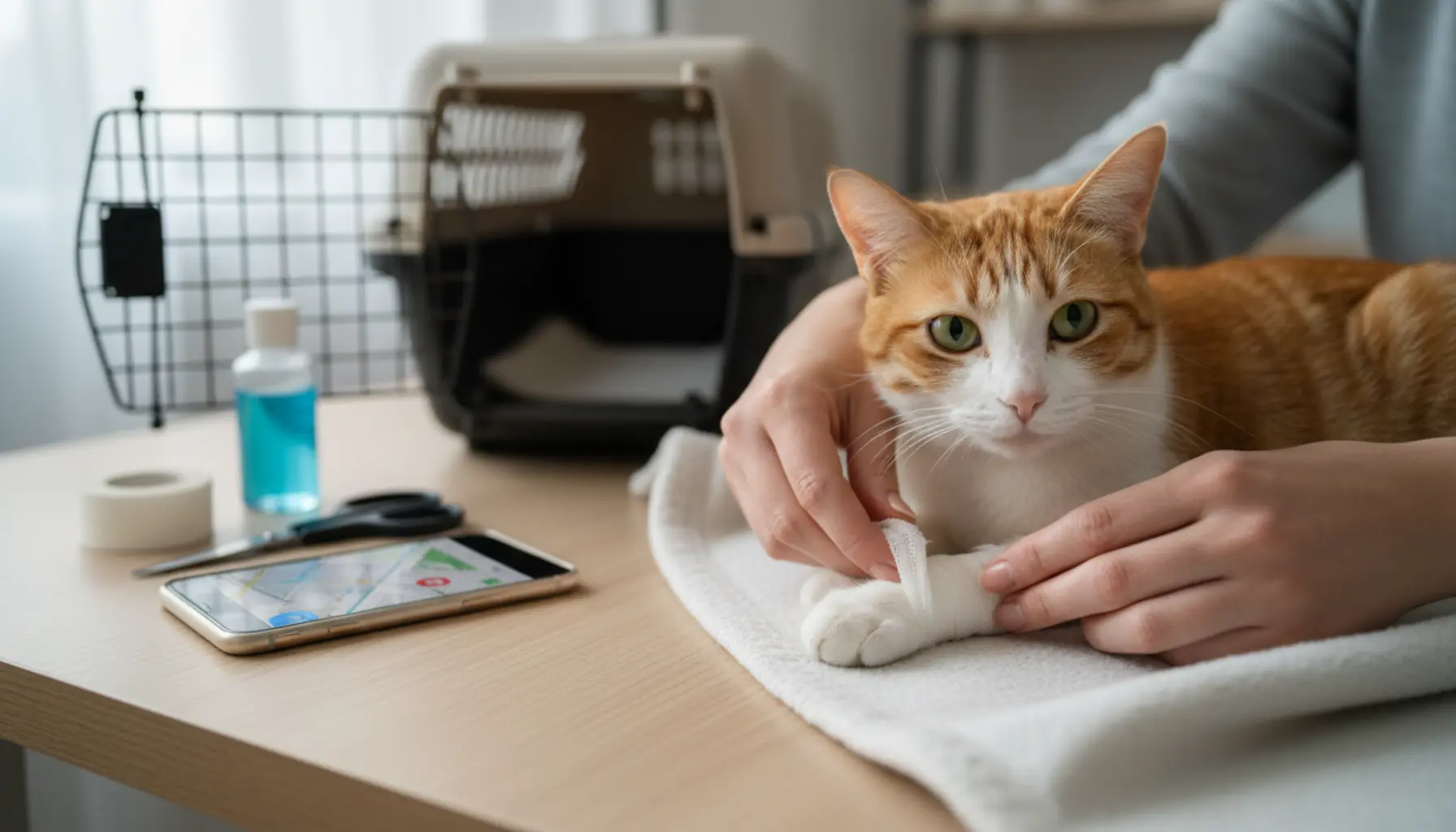
Proper bandaging has two goals: protection against dirt and licking, and minimizing additional mechanical trauma, while still allowing blood and air into tissues. Use sterile compresses or gauze (non-fibrous preferred), elastic or regular gauze bandage, plus self-adhesive mesh or hypoallergenic tape for fixing — never stick tape directly to cat fur as removal is painful and can injure skin. For small surface wounds, a light, soft protective dressing is usually enough to prevent licking and dirt. Place the gauze to fully cover the wound, then wrap gently but firmly; make sure it’s not too tight — you should be able to slip the tip of your little finger under the bandage. Especially with cats, do not compress the chest or legs too tightly; signs of a too-tight bandage include cold, blue or swollen paw below the bandage, obvious discomfort or continued attempts to remove the bandage. Wounds on paws and tail can be covered with “tube dressings” — wrapping the bandage several times around the limb or tail with extra folds above joints to prevent slipping. For the torso, particularly the abdomen, improvised “vests” from bandage or children’s t-shirt work to block access without squeezing. Head, ear or cheek wounds are trickier, as cats may remove bandages with paws; here, an Elizabethan collar (cone) is helpful to stop scratching and licking. Remember, bandaging is always a temporary solution — its job is to protect until the vet can assess for surgical cleaning, stitches, antibiotics, or pain relief. At home, regularly inspect the bandage: if it soaks with blood, pus or other discharge, smells bad, slips, or the cat is very restless and chewing it, replace quickly or consult your vet. Never use steroid, antibiotic ointments or “folk” remedies with alcohol, essential oils or herbs — these can be toxic to cats, delaying healing. After surgical stitches, obey directions for changing dressings and scar inspection: excess redness, swelling, pus or odor may indicate improper healing. Proper cleaning and bandaging combined with quick response to alarming symptoms lowers risk of complications such as abscesses, systemic infections, or chronic, painful scarring, plus protects your cat from unnecessary stress and prolonged discomfort.
When to See a Veterinarian
With cats, the boundary between when you can safely monitor at home and when urgent veterinary assistance is required is often unclear. Cats masterfully mask pain and malaise, so any rapid, obvious or unusual symptom should catch your attention. Absolute emergencies that demand immediate veterinary attention include any breathing disturbances — rapid, noisy, wheezing breath, mouth breathing, blue gums or tongue, labored breathing with flared nostrils, sudden weakness or unconsciousness. Signs of shock such as very fast or undetectable pulse, pale or blue mucous membranes, cold paws, profound apathy, unsteady walk, or inability to stay upright are also life-threatening. Here, home first aid is only a stopgap — getting the cat to a clinic safely and quickly is paramount. Immediate intervention is also needed for uncontrollable bleeding, deep, bite or torn wounds, visible bone, muscle, or organs, and after falls, vehicle accidents, or other mechanical injury — even if the cat appears “normal.” Cats are prone to internal injuries, which may not show obvious signs initially, so every major accident should result in a veterinary check. Emergencies also include urinary problems, especially in males — repeated box visits, peeing posture, crying, only dribbling, or not urinating at all may indicate a life-threatening blockage. Also alarming: severe abdominal pain (hard, tense, painful on touch belly), adopting “prayer” position (front down, rear up), collapsing sideways, vocalizing, sudden apathy or aggression when touched. Seek a vet urgently if the cat starts moving abnormally (paralysis, weakness, stiff gait, staggering, head twisting), has seizures, muscle tics, or you suspect poisoning — like eating a houseplant, human medicine, chemicals, rodent poison, insecticide, or unsuitable food (like onion, garlic, chocolate, or certain tablets). Remember poisoning symptoms may not appear at once; they can build from “just” weakness to vomiting, diarrhea, drooling, dilated pupils, or seizures, so don’t wait “to see if it passes,” consult your vet at any suspicion.
There are also symptoms that are not always immediately life-threatening but still require prompt (within hours) veterinary attention. These include: repeated vomiting (especially with apathy, blood in vomit, appetite loss or diarrhea), persistent diarrhea lasting over 24 hours, blood in stool or urine, sudden total appetite loss over 24 hours for adult cats (less for kittens and chronically ill cats), obvious pain on touching any body part, silicone or purulent discharge from eyes, nose, anus or genitals, and fever (over 39.5°C / 103.1°F) combined with listlessness. Quick consult is also warranted by rapid behavioral changes: aggression in a previously gentle cat, unusual withdrawal, staring at a wall, meowing without reason, disorientation, hiding in dark places, being unable to jump into favorite spots, trouble using stairs, loss of interest in play or human contact. For senior cats especially concerning are any sudden weight loss, excessive drinking/urination, bouts of sudden “craziness” with loud meowing, especially at night. It’s smart to have the phone numbers of several nearby clinics and a 24-hour hospital in view, to avoid delay in a crisis. When in doubt, a quick phone call to the vet — describing symptoms, their duration, behavior, and circumstances (e.g., trauma, possible toxin exposure, diet change) will allow the specialist to decide if home observation is enough or urgent intervention is needed. Record abnormal symptoms, make short videos of the cat’s breathing or behavior, and take them to the clinic — this can hugely help diagnosis. Remember, with cats, “better safe than sorry” applies especially strongly: quick response and vet visits, even if the problem later proves minor, are often crucial for recovery and minimizing suffering.
Summary
Knowing the principles of first aid for cats is essential in any crisis. Start by identifying the situation, to assess level of risk. Securing and calming your cat helps avoid further injury. For choking, learn to identify and remove the obstruction from the airway. In critical moments, apply artificial respiration and chest compressions to sustain vital functions. Remember to dress wounds appropriately if the cat is injured. In any of these scenarios, do not hesitate to contact a veterinarian for professional support.

